
Pulp Fiction, 1916 · page 82 of 216
The Argosy, Vol. 82 No. 2 — page 82: what you’re looking at
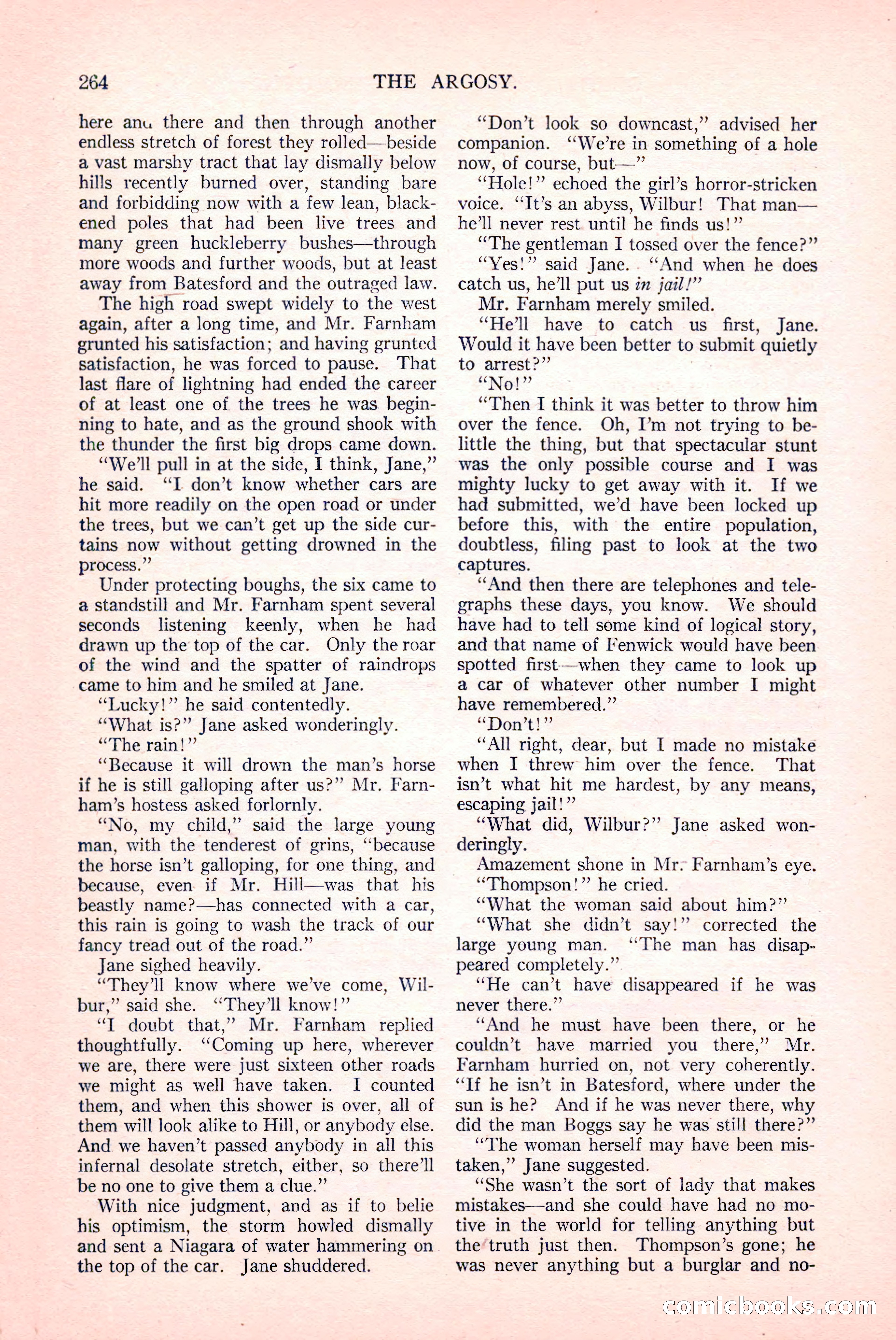
A restored page from Pulp Fiction, 1916. Page through the whole issue in the reader above.
📄 Transcribed text from this page (OCR, searchable)
Machine-transcribed from the original scan — historical spelling and the odd misread are preserved.
264 THE here anu there and then through another endless stretch of forest they rolled—beside a vast marshy tract that lay dismally below hills recently burned over, standing bare and forbidding now with a few lean, black- ened poles that had been live trees and many green huckleberry bushes—through more woods and further woods, but at least away from Batesford and the outraged law. The high road swept widely to the west again, after a long time, and Mr. Farnham grunted his satisfaction; and having grunted satisfaction, he was forced to pause. That last flare of lightning had ended the career of at least one of the trees he was begin- ning to hate, and as the ground shook with the thunder the first big drops came down. “We'll pull in at the side, I think, Jane,” he said. “I don’t know whether cars are hit more readily on the open road or under the trees, but we can’t get up the side cur- tains now without getting drowned in the process.” Under protecting boughs, the six came to a standstill and Mr. Farnham spent several seconds listening keenly, when he had drawn up the top of the car. Only the roar of the wind and the spatter of raindrops came to him and he smiled at Jane. “Lucky!” he said contentedly. “What is?” Jane asked wonderingly. “The rain!” “Because it will drown the man’s horse if he is still galloping after us?” Mr. Farn- ham’s hostess asked forlornly. “No, my child,” said the large young man, with the tenderest of grins, “because the horse isn’t galloping, for one thing, and because, even if Mr. Hill—was that his beastly name?—has connected with a car, this rain is going to wash the track of our fancy tread out of the road.” Jane sighed heavily. “They'll know where we’ve come, Wil- bur,” said she. ‘‘They’ll know!” “T doubt that,” Mr. Farnham replied thoughtfully. ‘Coming up here, wherever we are, there were just sixteen other roads we might as well have taken. I counted them, and when this shower is over, all of them will look alike to Hill, or anybody else. And we haven’t passed anybody in all this infernal desolate stretch, either, so there’ll be no one to give them a clue.”’ With nice judgment, and as if to belie his optimism, the storm howled dismally and sent a Niagara of water hammering on the top of the car. Jane shuddered. ARGOSY. “Don’t look so downcast,” advised her companion. ‘We’re in something of a hole now, of course, but—”’ “Hole!” echoed the girl’s horror-stricken voice. “It’s an abyss, Wilbur! That man— he’ll never rest until he finds us!” “The gentleman I tossed over the fence?” “Yes!” said Jane. . “And when he does catch us, he’ll put us 7» jail!” Mr. Farnham merely smiled. “He'll have to catch us first, Jane. Would it have been better to submit quietly to arrest?”’ wal) 3 | el “Then I think it was better to throw him over the fence. Oh, I’m not trying to be- little the thing, but that spectacular stunt was the only possible course and I was mighty lucky to get away with it. If we had submitted, we’d have been locked up before this, with the entire population, doubtless, filing past to look at the two captures. ‘And then there are telephones and tele- graphs these days, you know. We should have had to tell some kind of logical story, and that name of Fenwick would have been spotted first—when they came to look up a car of whatever other number I might have remembered.”’ “Don t! ) ‘All right, dear, but I made no mistake when I threw him over the fence. That isn’t what hit me hardest, by any means, escaping jail!” “What did, Wilbur?” Jane asked won- deringly. Amazement shone in Mr- Farnham’s eye. “Thompson!” he cried. “What the woman said about him?” “What she didn’t say!” corrected the large young man. ‘The man has disap- peared completely.” “He can’t have disappeared if he was never there.”’ ‘““And he must have been there, or he couldn’t have married you there,” Mr. Farnham hurried on, not very coherently. “Tf he isn’t in Batesford, where under the sun is he? And if he was never there, why did the man Boggs say he was still there?”’ ‘The woman herself may have been mis- taken,” Jane suggested. “She wasn’t the sort of lady that makes mistakes—and she could have had no mo- tive in the world for telling anything but the’truth just then. Thompson’s gone; he was never anything but a burglar and no- CORMICGLOOkKS (C@)