
Pulp Fiction, 1916 · page 76 of 216
The Argosy, Vol. 82 No. 2 — page 76: what you’re looking at
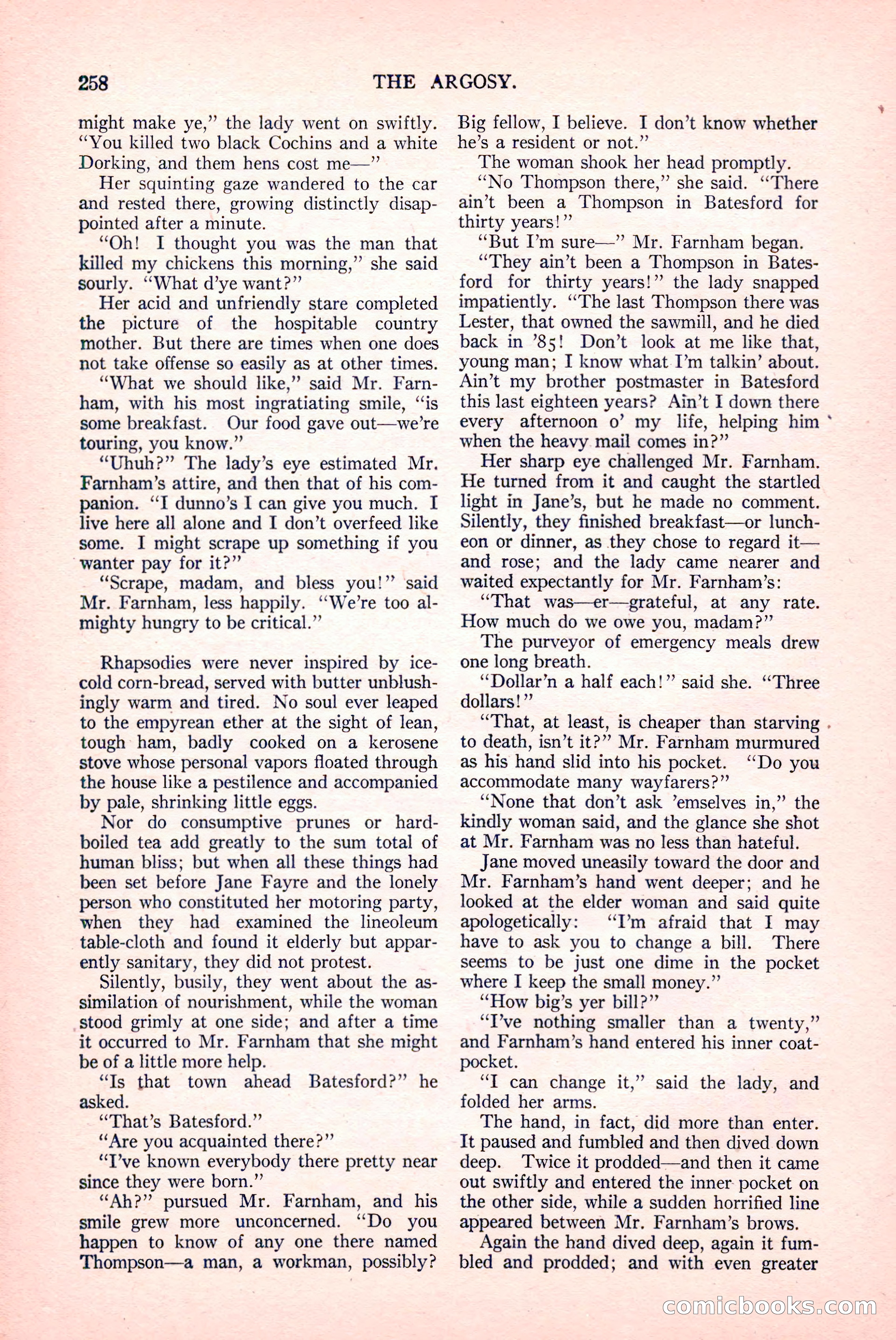
A restored page from Pulp Fiction, 1916. Page through the whole issue in the reader above.
📄 Transcribed text from this page (OCR, searchable)
Machine-transcribed from the original scan — historical spelling and the odd misread are preserved.
208 might make ye,” the lady went on swiftly. “You killed two black Cochins and a white Dorking, and them hens cost me—” Her squinting gaze wandered to the car and rested there, growing distinctly disap- pointed after a minute. “Oh! I thought you was the man that killed my chickens this morning,” she said sourly. ‘“‘What d’ye want?” Her acid and unfriendly stare completed the picture of the hospitable country mother. But there are times when one does not take offense so easily as at other times. “What we should like,” said Mr. Farn- ham, with his most ingratiating smile, “‘is some breakfast. Our food gave out—we’re touring, you know.” “Uhuh?” The lady’s eye estimated Mr. Farnham’s attire, and then that of his com- panion. “I dunno’s I can give you much. I live here all alone and I don’t overfeed like some. I might scrape up something if you wanter pay for it?” “Scrape, madam, and bless you!’’ said Mr. Farnham, less happily. ‘‘We’re too al- mighty hungry to be critical.” Rhapsodies were never inspired by ice- cold corn-bread, served with butter unblush- ingly warm and tired. No soul ever leaped to the empyrean ether at the sight of lean, tough ham, badly cooked on a kerosene stove whose personal vapors floated through the house like a pestilence and accompanied by pale, shrinking little eggs. Nor do consumptive prunes or hard- boiled tea add greatly to the sum total of human bliss; but when all these things had been set before Jane Fayre and the lonely person who constituted her motoring party, when they had examined the lineoleum table-cloth and found it elderly but appar- ently sanitary, they did not protest. Silently, busily, they went about the as- similation of nourishment, while the woman stood grimly at one side; and after a time it occurred to Mr. Farnham that she might be of a little more help. “Is that town ahead Batesford?” he asked. “That’s Batesford.”’ “Are you acquainted there?” “T’ve known everybody there pretty near since they were born.”’ “Ah?” pursued Mr. Farnham, and his smile grew more unconcerned. “Do you happen to know of any one there named Thompson—a man, a workman, possibly? THE ARGOSY. Big fellow, I believe. I don’t know whether he’s a resident or not.” The woman shook her head promptly. ‘‘No Thompson there,” she said. ‘‘There ain’t been a Thompson in Batesford for thirty years!” “But I’m sure—” Mr. Farnham began. “They ain’t been a Thompson in Bates- ford for thirty years!” the lady snapped impatiently. ‘““The last Thompson there was Lester, that owned the sawmill, and he died back in 785! Don’t look at me like that, young man; I know what. I’m talkin’ about. Ain’t my brother postmaster in Batesford this last eighteen years? Ain’t I down there every afternoon o’ my life, helping him * when the heavy mail comes in?” Her sharp eye challenged Mr. Farnham. He turned from it and caught the startled light in Jane’s, but he made no comment. Silently, they finished breakfast—or lunch- eon or dinner, as they chose to regard it— and rose; and the lady came nearer and waited expectantly for Mr. Farnham’s: “That was—er—grateful, at any rate. How much do we owe you, madam?” The purveyor of emergency meals drew one long breath. ‘“Dollar’n a half each!” said she. ‘“Three dollars!” ‘That, at least, is cheaper than starving . to death, isn’t it?’”? Mr. Farnham murmured as his hand slid into his pocket. “Do you accommodate many wayfarers?”’ “None that don’t ask ’emselves in,” the kindly woman said, and the glance she shot at Mr. Farnham was no less than hateful. Jane moved uneasily toward the door and Mr. Farnham’s hand went deeper; and he looked at the elder woman and said quite apologetically: “I’m afraid that I may have to ask you to change a bill. There seems to be just one dime in the pocket where I keep the small money.”’ “How big’s yer bill?” ‘“T’ve nothing smaller than a twenty,” and Farnham’s hand entered his inner coat- pocket. “IT can change it,” said the lady, and folded her arms. The hand, in fact, did more than enter. It paused and fumbled and then dived down deep. Twice it prodded—and then it came out swiftly and entered the inner. pocket on the other side, while a sudden horrified line appeared between Mr. Farnham’s brows. Again the hand dived deep, again it fum- bled and prodded; and with even greater Gomichboo (Cc <S (C@