
Pulp Fiction, 1916 · page 73 of 216
The Argosy, Vol. 82 No. 2 — page 73: what you’re looking at
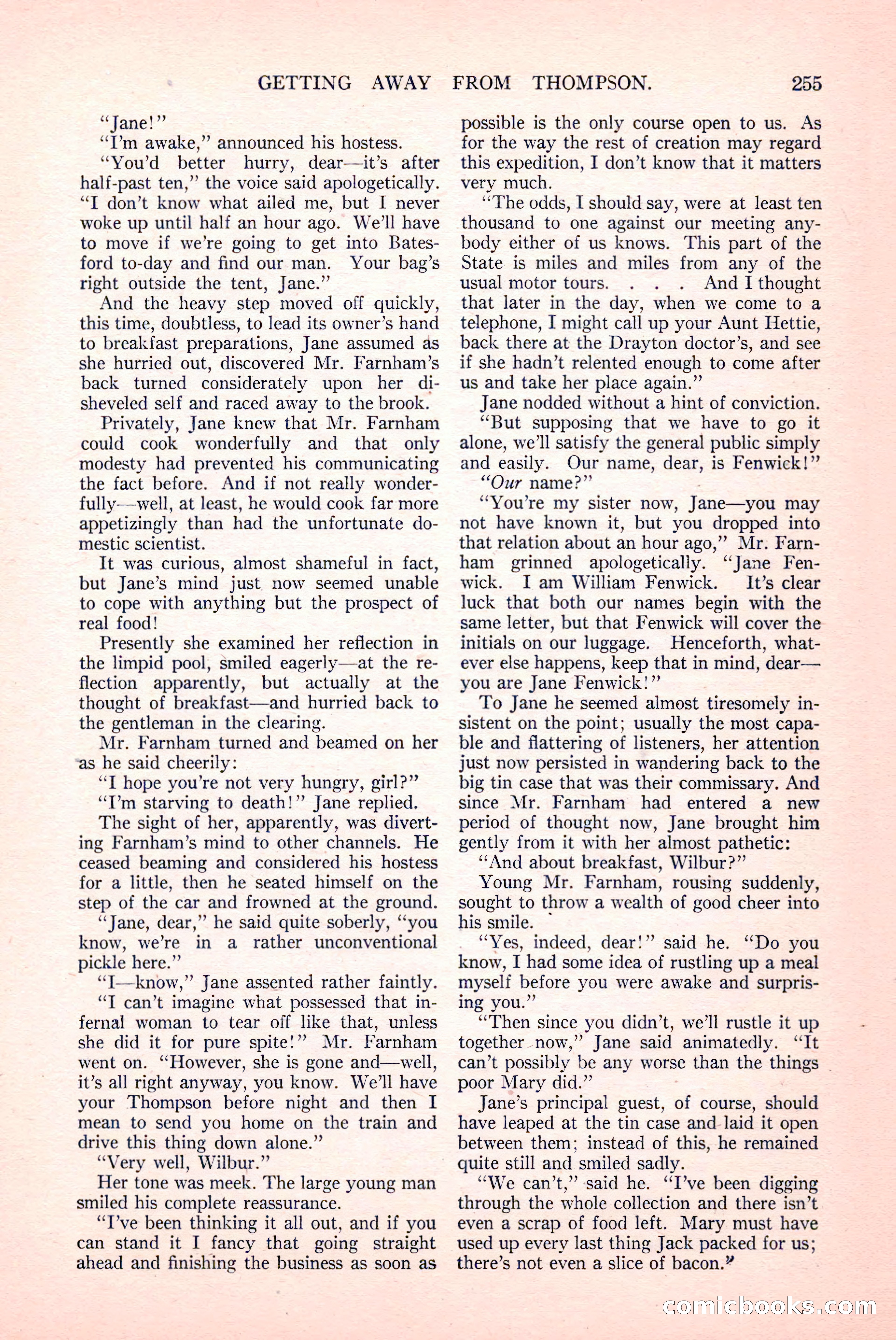
A restored page from Pulp Fiction, 1916. Page through the whole issue in the reader above.
📄 Transcribed text from this page (OCR, searchable)
Machine-transcribed from the original scan — historical spelling and the odd misread are preserved.
GETTING & Jane! ” “T’m awake,” announced his hostess. “You’d better hurry, dear—it’s after half-past ten,” the voice said apologetically. “T don’t know what ailed me, but I never woke up until half an hour ago. We'll have to move if we’re going to get into Bates- ford to-day and find our man. Your bag’s right outside the tent, Jane.” And the heavy step moved off quickly, this time, doubtless, to lead its owner’s hand to breakfast preparations, Jane assumed as she hurried out, discovered Mr. Farnham’s back turned considerately upon her di- sheveled self and raced away to the brook. Privately, Jane knew that Mr. Farnham could cook wonderfully and that only modesty had prevented his communicating the fact before. And if not really wonder- fully—well, at least, he would cook far more appetizingly than had the unfortunate do- mestic scientist. It was curious, almost shameful in fact, but Jane’s mind just now seemed unable to cope with anything but the prospect of real food! Presently she examined her reflection in the limpid pool, smiled eagerly—at the re- flection apparently, but actually at the thought of breakfast—and hurried back to the gentleman in the clearing. Mr. Farnham turned and beamed on her as he said cheerily: “T hope you’re not very hungry, girl?” “T’m starving to death!” Jane replied. The sight of her, apparently, was divert- ing Farnham’s mind to other channels. He ceased beaming and considered his hostess for a little, then he seated himself on the step of the car and frowned at the ground. ‘Jane, dear,”’ he said quite soberly, “you know, we’re in a _ rather unconventional pickle here.” “T—know,” Jane assented rather faintly. “T can’t imagine what possessed that in- fernal woman to tear off like that, unless she did it for pure spite!” Mr. Farnham went on. ‘‘However, she is gone and—well, it’s all right anyway, you know. We’ll have your Thompson before night and then I mean to send you home on the train and drive this thing down alone.” “Very well, Wilbur.” Her tone was meek. The large young man smiled his complete reassurance. “T’ve been thinking it all out, and if you can stand it I fancy that going straight ahead and finishing the business as soon as AWAY FROM THOMPSON. 255 possible is the only course open to us. As for the way the rest of creation may regard this expedition, I don’t know that it matters very much. ‘The odds, I should say, were at least ten thousand to one against our meeting any- body either of us knows. This part of the State is miles and miles from any of the usual motor tours. And I thought that later in the day, when we come to a telephone, I might call up your Aunt Hettie, back there at the Drayton doctor’s, and see if she hadn’t relented enough to come after us and take her place again.”’ Jane nodded without a hint of conviction. | “But supposing that we have to go it alone, we'll satisfy the general public simply and easily. Our name, dear, is Fenwick!” “Our name?” , “You're my sister now, Jane—you may not have known it, but you dropped into that relation about an hour ago,” Mr. Farn- ham grinned apologetically. “Jane Fen- wick. Iam William Fenwick. It’s clear luck that both our names begin with the same letter, but that Fenwick will cover the initials on our luggage. Henceforth, what- ever else happens, keep that in mind, dear— you are Jane Fenwick!” To Jane he seemed almost tiresomely in- sistent on the point; usually the most capa- ble and flattering of listeners, her attention just now persisted in wandering back to the big tin case that was their commissary. And since Mr. Farnham had entered a new period of thought now, Jane brought him gently from it with her almost pathetic: ‘“‘And about breakfast, Wilbur?” Young Mr. Farnham, rousing suddenly, sought to throw a wealth of good cheer into his smile. — “Yes, indeed, dear!” said he. ‘‘Do you know, I had some idea of rustling up a meal myself before you were awake and surpris- ing you.”’ “Then since you didn’t, we’ll rustle it up together now,” Jane said animatedly. “It can’t possibly be any worse than the things | poor Mary did.” Jane’s principal guest, of course, should have leaped at the tin case and laid it open between them; instead of this, he remained quite still and smiled sadly. “We can’t,” said he. “I’ve been digging through the whole collection and there isn’t even a scrap of food left. Mary must have used up every last thing Jack packed for us; there’s not even a slice of bacon.” Go OOOKS AUG (C@)