
Pulp Fiction, 1916 · page 66 of 216
The Argosy, Vol. 82 No. 2 — page 66: what you’re looking at
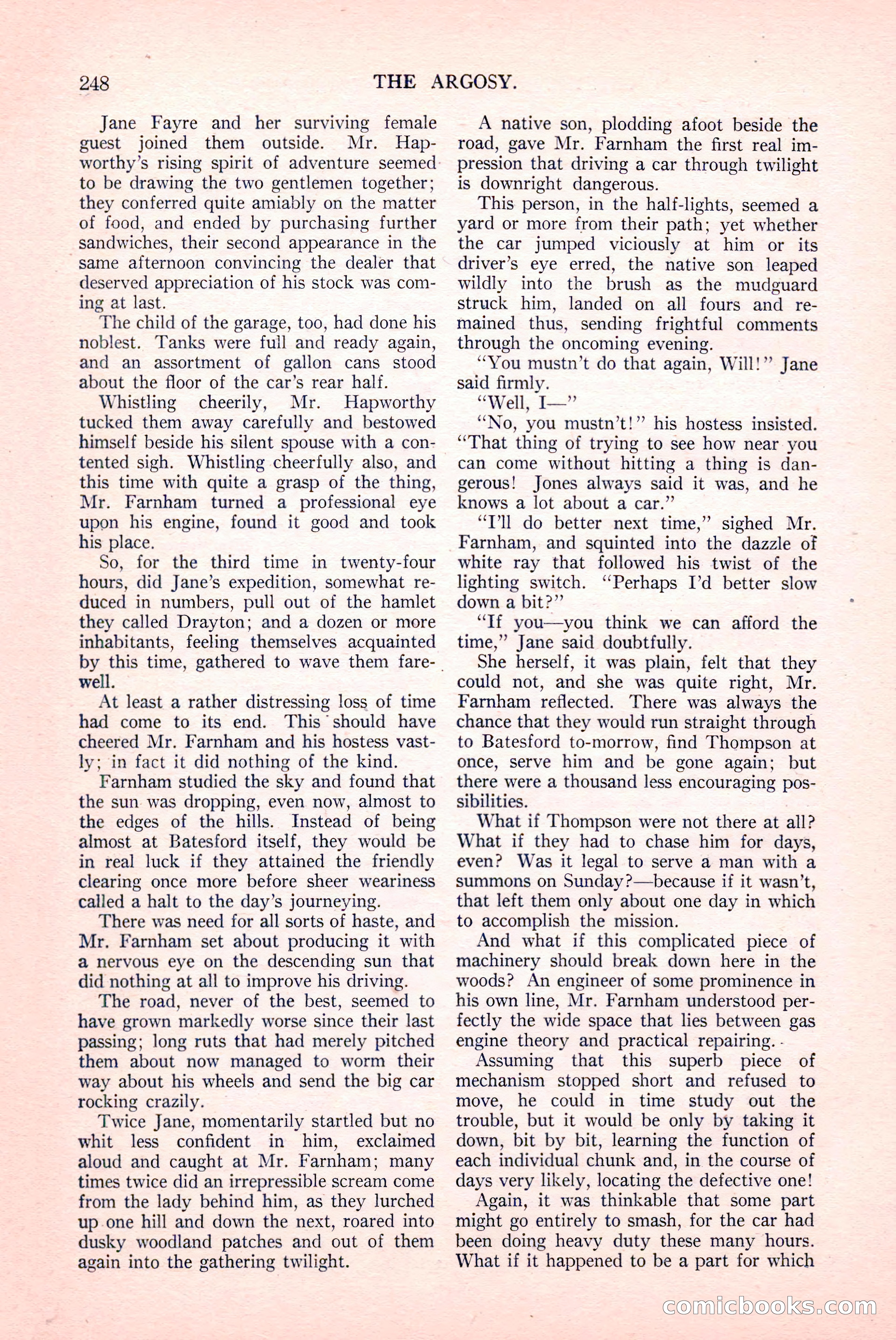
A restored page from Pulp Fiction, 1916. Page through the whole issue in the reader above.
📄 Transcribed text from this page (OCR, searchable)
Machine-transcribed from the original scan — historical spelling and the odd misread are preserved.
248 Jane Fayre and her surviving female guest joined them outside. Mr. MHap- worthy’s rising spirit of adventure seemed: to be drawing the two gentlemen together; they conferred quite amiably on the matter of food, and ended by purchasing further sandwiches, their second appearance in the same afternoon convincing the dealer that deserved appreciation of his stock was com- ing at last. The child of the garage, too, had done his noblest. Tanks were fuil and ready again, and an assortment of gallon cans stood about the floor of the car’s rear half. Whistling cheerily, Mr. Hapworthy tucked them away carefully and bestowed himself beside his silent spouse with a con- tented sigh. Whistling cheerfully also, and this time with quite a grasp of the thing, Mr. Farnham turned a professional eye upon his engine, found it good and took his place. So, for the third time in twenty-four hours, did Jane’s expedition, somewhat re- duced in numbers, pull out of the hamlet they called Drayton; and a dozen or more inhabitants, feeling themselves acquainted by this time, gathered to wave them fare- well. At least a rather distressing loss of time had come to its end. This should have cheered Mr. Farnham and his hostess vast- ly; in fact it did nothing of the kind. Farnham studied the sky and found that the sun was dropping, even now, almost to the edges of the hills. Instead of being almost at Batesford itself, they would be in real luck if they attained the friendly clearing once more before sheer weariness called a halt to the day’s journeying. There was need for all sorts of haste, and Mr. Farnham set about producing it with a nervous eye on the descending sun that did nothing at all to improve his driving. The road, never of the best, seemed to have grown markedly worse since their last passing; long ruts that had merely pitched them about now managed to worm their way about his wheels and send the big car rocking crazily. Twice Jane, momentarily startled but no whit less confident in him, exclaimed aloud and caught at Mr. Farnham; many times twice did an irrepressible scream come from the lady behind him, as they lurched up one hill and down the next, roared into dusky woodland patches and out of them again into the gathering twilight. THE ARGOSY. A native son, plodding afoot beside the road, gave Mr. Farnham the first real im- pression that driving a car through twilight is downright dangerous. This person, in the half-lights, seemed a yard or more from their path; yet whether the car jumped viciously at him or its driver’s eye erred, the native son leaped wildly into the brush as the mudguard struck him, landed on all fours and re- mained thus, sending frightful comments through the oncoming evening. ‘You mustn’t do that again, Will!” Jane said firmly. “Well, I—”’ ‘“‘No, you mustn’t!” his hostess insisted. ‘That thing of trying to see how near you can come without hitting a thing is dan- gerous! Jones always said it was, and he knows a lot about a car.” “Tl do better next time,” sighed Mr. Farnham, and squinted into the dazzle of white ray that followed his twist of the lighting switch. ‘Perhaps I’d better slow down a bit?” “Tf you—you think we can afford the time,” Jane said doubtfully. She herself, it was plain, felt that they could not, and she was quite right, Mr. Farnham reflected. There was always the chance that they would run straight through to Batesford to-morrow, find Thompson at once, serve him and be gone again; but there were a thousand less encouraging pos- sibilities. What if Thompson were not there at all? What if they had to chase him for days, even? Was it legal to serve a man with a summons on Sunday ?—because if it wasn’t, that left them only about one day in which to accomplish the mission. And what if this complicated piece of machinery should break down here in the woods? An engineer of some prominence in his own line, Mr. Farnham understood per- fectly the wide space that lies between gas engine theory and practical repairing. - Assuming that this superb piece of mechanism stopped short and refused to move, he could in time study out the trouble, but it would be only by taking it down, bit by bit, learning the function of each individual chunk and, in the course of days very likely, locating the defective one! Again, it was thinkable that some part might go entirely to smash, for the car had been doing heavy duty these many hours. What if it happened to be a part for which CORMMICLOOOKS (C@)