
Pulp Fiction, 1916 · page 60 of 216
The Argosy, Vol. 82 No. 2 — page 60: what you’re looking at
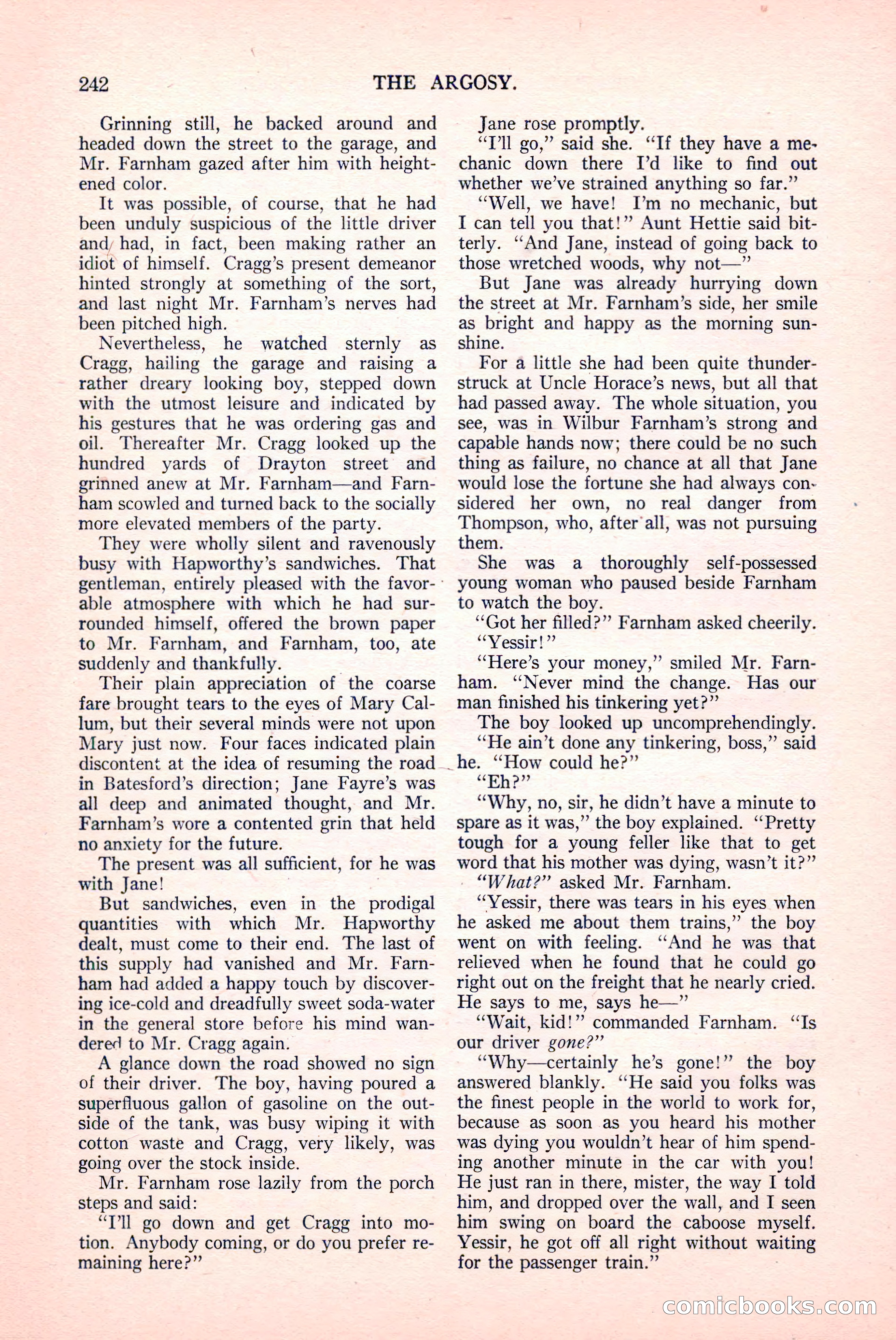
A restored page from Pulp Fiction, 1916. Page through the whole issue in the reader above.
📄 Transcribed text from this page (OCR, searchable)
Machine-transcribed from the original scan — historical spelling and the odd misread are preserved.
242 Grinning still, he backed around and headed down the street to the garage, and Mr. Farnham gazed after him with height- ened color. It was possible, of course, that he had been unduly suspicious of the little driver and, had, in fact, been making rather an idiot of himself. Cragg’s present demeanor hinted strongly at something of the sort, and last night Mr. Farnham’s nerves had been pitched high. Nevertheless, he watched sternly as Cragg, hailing the garage and raising a rather dreary looking boy, stepped down with the utmost leisure and indicated by his gestures that he was ordering gas and oil. Thereafter Mr. Cragg looked up the hundred yards of Drayton street and grinned anew at Mr. Farnham—and Farn- ham scowled and turned back to the socially more elevated members of the party. They were wholly silent and ravenously busy with Hapworthy’s sandwiches. That gentleman, entirely pleased with the favor- ° able atmosphere with which he had sur- rounded himself, offered the brown paper to Mr. Farnham, and Farnham, too, ate suddenly and thankfully. | Their plain appreciation of the coarse fare brought tears to the eyes of Mary Cal- lum, but their several minds were not upon Mary just now. Four faces indicated plain discontent at the idea of resuming the road in Batesford’s direction; Jane Fayre’s was all deep and animated thought, and Mr. Farnham’s wore a contented grin that held no anxiety for the future. The present was all sufficient, for he was with Jane! | 7 But sandwiches, even in the prodigal quantities with which Mr. Hapworthy dealt, must come to their end. The last of this supply had vanished and Mr. Farn- ham had added a happy touch by discover- ing ice-cold and dreadfully sweet soda-water in the general store before his mind wan- dered to Mr. Cragg again. A glance down the road showed no sign of their driver. The boy, having poured a superfluous gallon of gasoline on the out- side of the tank, was busy wiping it with cotton waste and Cragg, very likely, was going over the stock inside. Mr. Farnham rose lazily from the porch steps and said: “T’ll go down and get Cragg into mo- tion. Anybody coming, or do you prefer re- maining here?” _he. THE ARGOSY. Jane rose promptly. “Tl go,” said she. “If they have a me- chanic down there I’d like to find out whether we’ve strained anything so far.” ‘Well, we have! I’m no mechanic, but I can tell you that!” Aunt Hettie said bit- terly. ‘“‘And Jane, instead of going back to those wretched woods, why not—” But Jane was already hurrying down the street at Mr. Farnham’s side, her smile as bright and happy as the morning sun- shine. For a little she had been quite thunder- struck at Uncle Horace’s news, but all that had passed away. The whole situation, you see, was in Wilbur Farnham’s strong and capable hands now; there could be no such thing as failure, no chance at all that Jane would lose the fortune she had always con- sidered her own, no real danger from Thompson, who, after all, was not pursuing them. She was a _ thoroughly self-possessed young woman who paused beside Farnham to watch the boy. ‘Got her filled?”’ Farnham asked cheerily. ‘Yessir! ”’ ‘““Here’s your money,” smiled Mr. Farn- ham. ‘‘Never mind the change. Has our man finished his tinkering yet?” The boy looked up uncomprehendingly. “He ain’t done any tinkering, boss,”’ said “How could he?” wa 3 gad “Why, no, sir, he didn’t have a minute to spare as it was,” the boy explained. “Pretty tough for a young feller like that to get word that his mother was dying, wasn’t it?” “What?” asked Mr. Farnham. “Yessir, there was tears in his eyes when he asked me about them trains,” the boy went on with feeling. ‘‘And he was that relieved when he found that he could go right out on the freight that he nearly cried. He says to me, says he—”’ ‘Wait, kid!” commanded Farnham. “Is our driver gone?” ‘““Why—certainly he’s gone!”’ the boy answered blankly. ‘‘He said you folks was the finest people in the world to work for, because as soon as you heard his mother was dying you wouldn’t hear of him spend- ing another minute in the car with you! He just ran in there, mister, the way I told him, and dropped over the wall, and I seen him swing on board the caboose myself. Yessir, he got off all right without waiting for the passenger train.” CORNICLOOKS (C@