
Pulp Fiction, 1916 · page 57 of 216
The Argosy, Vol. 82 No. 2 — page 57: what you’re looking at
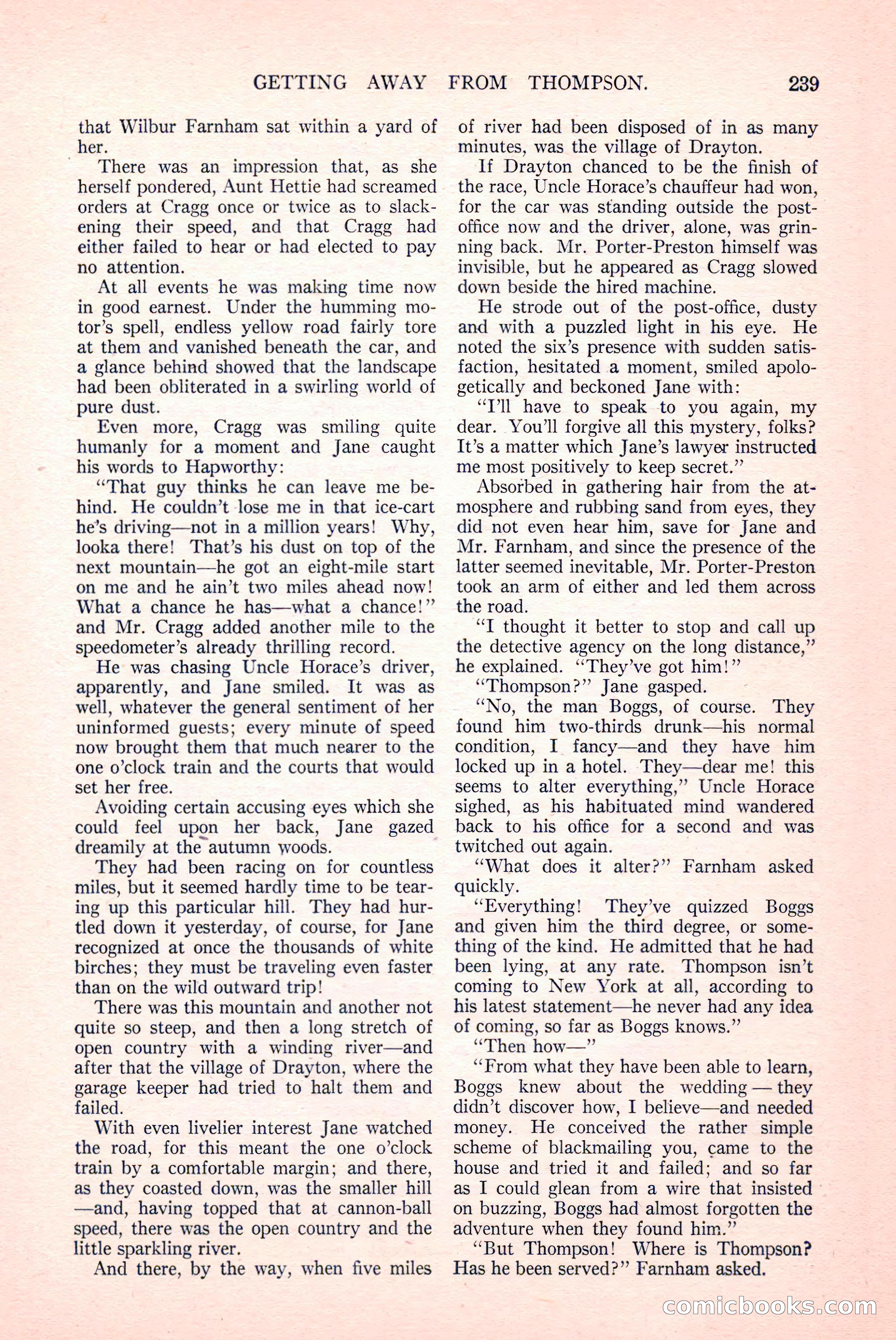
A restored page from Pulp Fiction, 1916. Page through the whole issue in the reader above.
📄 Transcribed text from this page (OCR, searchable)
Machine-transcribed from the original scan — historical spelling and the odd misread are preserved.
GETTING AWAY FROM THOMPSON. that Wilbur Farnham sat within a yard of her. There was an impression that, as she herself pondered, Aunt Hettie had screamed orders at Cragg once or twice as to slack- ening their speed, and that Cragg had either failed to hear or had elected to pay no attention. At all events he was making time now in good earnest. Under the humming mo- tor’s spell, endless yellow road fairly tore at them and vanished beneath the car, and a glance behind showed that the landscape had been obliterated in a swirling world of pure dust. Even more, Cragg was smiling quite humanly for a moment and Jane caught his words to Hapworthy: “That guy thinks he can leave me be- hind. He couldn’t lose me in that ice-cart he’s driving—not in a million years! Why, looka there! That’s his dust on top of the next mountain—he got an eight-mile start on me and he ain’t two miles ahead now! What a chance he has—what a chance!” and Mr. Cragg added another mile to the speedometer’s already thrilling record. He was chasing Uncle Horace’s driver, apparently, and Jane smiled. It was as well, whatever the general sentiment of her uninformed guests; every minute of speed now brought them that much nearer to the one o’clock train and the courts that would set her free. Avoiding certain accusing eyes which she could feel upon her back, Jane gazed dreamily at the autumn woods. They had been racing on for countless miles, but it seemed hardly time to be tear- ing up this particular hill. They had hur- tled down it yesterday, of course, for Jane recognized at once the thousands of white birches; they must be traveling even faster than on the wild outward trip! There was this mountain and another not quite so steep, and then a long stretch of open country with a winding river—and after that the village of Drayton, where the garage keeper had tried to halt them and failed. With even livelier interest Jane watched the road, for this meant the one o’clock train by a comfortable margin; and there, as they coasted down, was the smaller hill —and, having topped that at cannon-ball speed, there was the open country and the little sparkling river. And there, by the way, when five miles 239 of river had been disposed of in as many minutes, was the village of Drayton. If Drayton chanced to be the finish of the race, Uncle Horace’s chauffeur had won, for the car was standing outside the post- office now and the driver, alone, was grin- ning back. Mr. Porter-Preston himself was invisible, but he appeared as Cragg slowed down beside the hired machine. He strode out of the post-office, dusty and with a puzzled light in his eye. He noted the six’s presence with sudden satis- faction, hesitated a moment, smiled apolo- getically and beckoned Jane with: “Tl have to speak to you again, my dear. You'll forgive all this mystery, folks? It’s a matter which Jane’s lawyer instructed me most positively to keep secret.” Absorbed in gathering hair from the at- mosphere and rubbing sand from eyes, they did not even hear him, save for Jane and Mr. Farnham, and since the presence of the latter seemed inevitable, Mr. Porter-Preston took an arm of either and led them across the road. “T thought it better to stop and call up the detective agency on the long distance,” he explained. ‘‘They’ve got him!” “Thompson?” Jane gasped. ‘No, the man Boggs, of course. They found him two-thirds drunk—his normal condition, I fancy—and they have him locked up in a hotel. They—dear me! this seems to alter everything,” Uncle Horace sighed, as his habituated mind wandered back to his office for a second and was twitched out again. “What does it alter?” Farnham asked quickly. “Everything! They’ve quizzed Boggs and given him the third degree, or some- thing of the kind. He admitted that he had been lying, at any rate. Thompson isn’t coming to New York at all, according to his latest statement—he never had any idea of coming, so far as Boggs knows.” “Then how—”’ ‘‘From what they have been able to learn, Boggs knew about the wedding — they didn’t discover how, I believe—and needed money. He conceived the rather simple scheme of blackmailing you, came to the house and tried it and failed; and so far as I could glean from a wire that insisted on buzzing, Boggs had almost forgotten the adventure when they found him.” “But Thompson! Where is Thompson? Has he been served?” Farnham asked. COMMICLOOokKS (C@