
Pulp Fiction, 1916 · page 45 of 216
The Argosy, Vol. 82 No. 2 — page 45: what you’re looking at
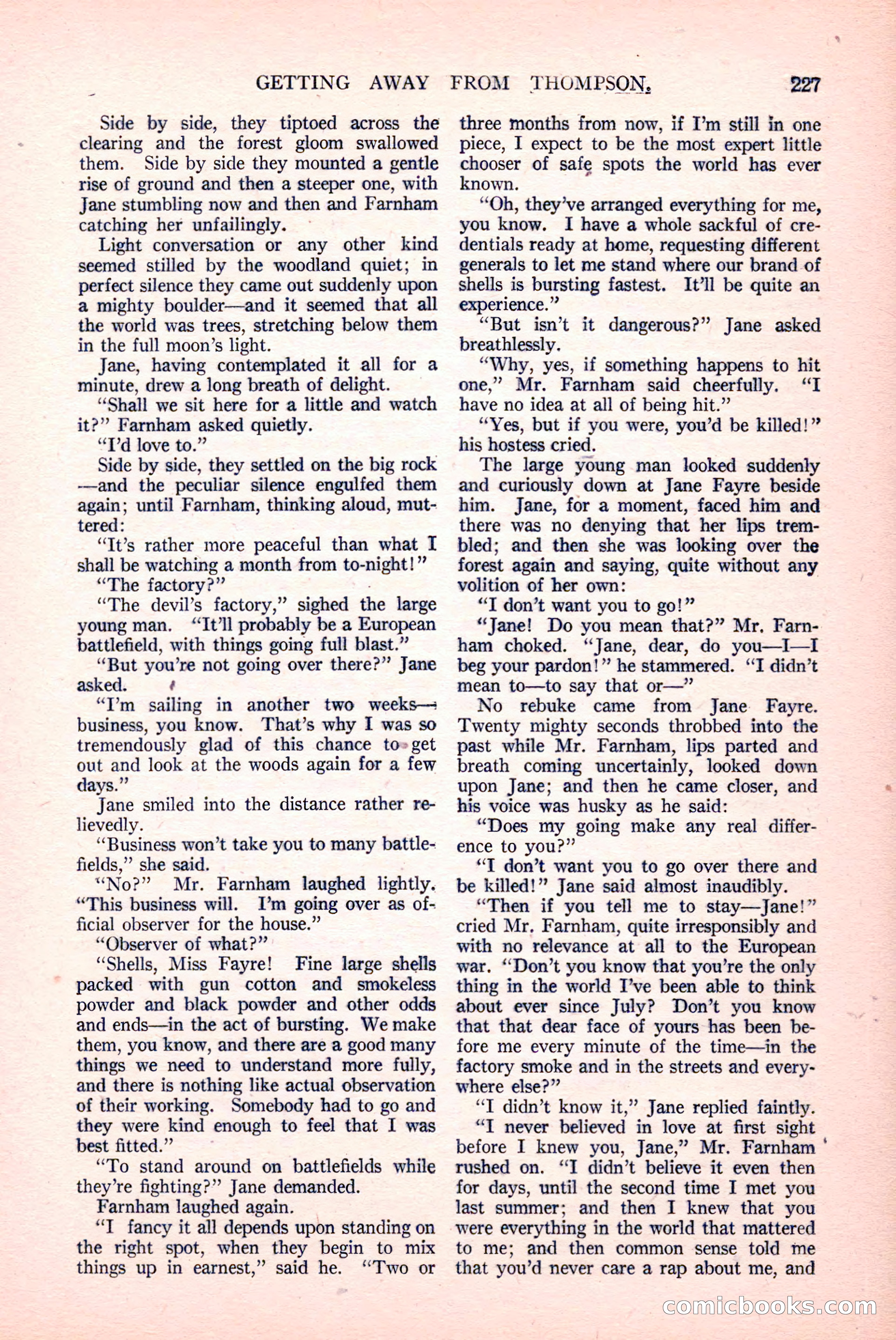
A restored page from Pulp Fiction, 1916. Page through the whole issue in the reader above.
📄 Transcribed text from this page (OCR, searchable)
Machine-transcribed from the original scan — historical spelling and the odd misread are preserved.
—_ Side by side, they tiptoed across the clearing and the forest gloom swallowed them. Side by side they mounted a gentle rise of ground and then a steeper one, with Jane stumbling now and then and Farnham catching her unfailingly. Light conversation or any other kind seemed stilled by the woodland quiet; in perfect silence they came out suddenly upon a mighty boulder—and it seemed that all the world was trees, stretching below them in the full moon’s light. Jane, having contemplated it all for a minute, drew a long breath of delight. “Shall we sit here for a little and watch it?” Farnham asked quietly. “T’d love to.” 3 Side by side, they settled on the big rock -——and the peculiar silence engulfed them again; until Farnham, thinking aloud, mut- tered: “Tt’s rather more peaceful than what I shall be watching a month from to-night!” “The factory?” “The devil’s factory,” sighed the large young man. “It'll probably be a European battlefield, with things going full blast.” “But you’re not going over there?” Jane asked. t “I’m sailing in another two weeks— business, you know. That’s why I was so tremendously glad of this chance to» get out and look at the woods again for a few days.” Jane smiled into the distance rather re- lievedly. ‘Business won’t take you to many battle- fields,” she said. “No?” Mr. Farnham laughed lightly. “This business will. I’m going over as of- ficial observer for the house.” “Observer of what?” “Shells, Miss Fayre! Fine large shells packed with gun cotton and smokeless powder and black powder and other odds and ends—in the act of bursting. We make them, you know, and there are a good many things we need to understand more fully, and there is nothing like actual observation of their working. Somebody had to go and they were kind enough to feel that I was best fitted.” “To stand around on battlefields while they’re fighting?” Jane demanded. Farnham laughed again. “T fancy it all depends upon standing on the right spot, when they begin to mix things up in earnest,” said he. “Two or GETTING AWAY FROM ‘THOMPSON, 227 three months from now, if I’m still in one piece, I expect to be the most expert little chooser of safe spots the world has ever known. “Oh, they’ve arranged everything for me, you know. I have a whole sackful of cre- dentials ready at home, requesting different generals to let me stand where our brand of shells is bursting fastest. It'll be quite an experience.” “But isn’t it dangerous?” Jane asked breathlessly. “Why, yes, if something happens to hit one,’ Mr. Farnham said cheerfully. “TI have no idea at all of being hit.” “Ves, but if you were, you’d be killed!” his hostess cried. The large young man looked suddenly and curiously down at Jane Fayre beside him. Jane, for a moment, faced him and there was no denying that her lips trem- bled; and then she was looking over the forest again and saying, quite without any volition of her own: “T don’t want you to go!” “Jane! Do you mean that?” Mr, Farn- ham choked. “Jane, dear, do you—I—I beg your pardon!” he stammered. “I didn’t mean to—to say that or—” No rebuke came from Jane Fayre. Twenty mighty seconds throbbed into the past while Mr. Farnham, lips parted and breath coming uncertainly, looked down upon Jane; and then he came closer, and his voice was husky as he said: “Does my going make any real differ- ence to you?” “T don’t want you to go over there and be killed!” Jane said almost inaudibly. “Then if you tell me to stay—TJane!” cried Mr. Farnham, quite irresponsibly and with no relevance at all to the European war. ‘‘Don’t you know that you’re the only thing in the world I’ve been able to think about ever since July? Don’t you know that that dear face of yours has been be- fore me every minute of the time—in the factory smoke and in the streets and every- where else?” “T didn’t know it,” Jane replied faintly. “T never believed in love at first sight before I knew you, Jane,” Mr. Farnham rushed on. “I didn’t believe it even then for days, until the second time I met you last summer; and then I knew that you were everything in the world that mattered to me; and then common sense told me that you’d never care a rap about me, and CORMMICLOOOKS - (C@