
Pulp Fiction, 1916 · page 38 of 216
The Argosy, Vol. 82 No. 2 — page 38: what you’re looking at
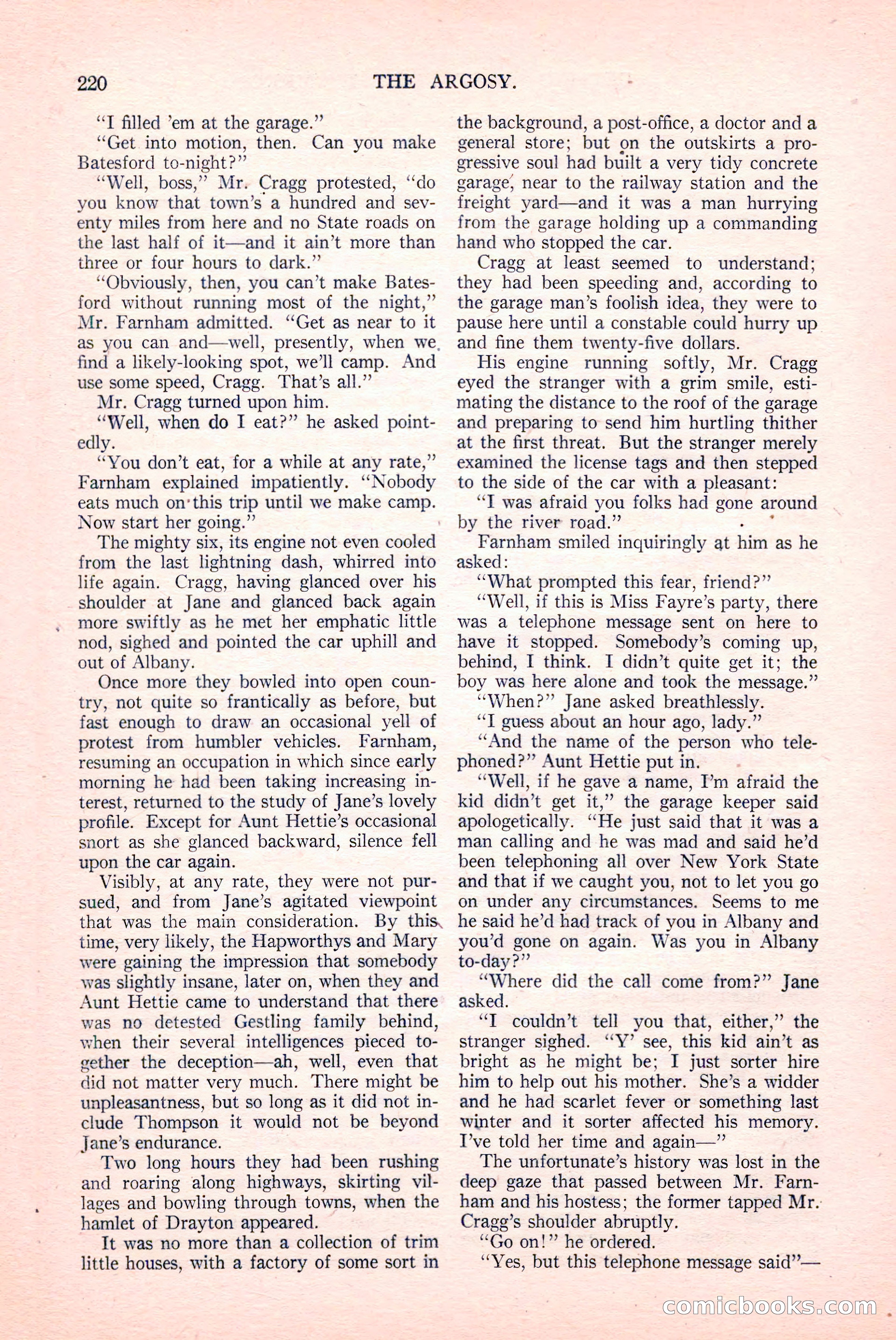
A restored page from Pulp Fiction, 1916. Page through the whole issue in the reader above.
📄 Transcribed text from this page (OCR, searchable)
Machine-transcribed from the original scan — historical spelling and the odd misread are preserved.
220 “T filled ’em at the garage.” “Get into motion, then. Can you make Batesford to-night?” ‘Well, boss,” Mr. Cragg protested, ‘“‘do you know that town’s a hundred and sev- enty miles from here and no State roads on the last half of it—and it ain’t more than three or four hours to dark.” “Obviously, then, you can’t make Bates- ford without running most of the night,” Mr. Farnham admitted. “Get as near to it as you can and—well, presently, when we. find a likely-looking spot, we’ll camp. And use some speed, Cragg. That’s all.” Mr. Cragg turned upon him. “Well, when do I eat?” he asked point- edly. “You don’t eat, for a while at any rate,” Farnham explained impatiently. ‘Nobody eats much on’this trip until we make camp. Now start her going.” The mighty six, its engine not even cooled from the last lightning dash, whirred into life again. Cragg, having glanced over his shoulder at Jane and glanced back again more swiftly as he met her emphatic little nod, sighed and pointed the car uphill and out of Albany. Once more they bowled into open coun- try, not quite so frantically as before, but fast enough to draw an occasional yell of protest from humbler vehicles. Farnham, resuming an occupation in which since early morning he had been taking increasing in- terest, returned to the study of Jane’s lovely profile. Except for Aunt Hettie’s occasional snort as she glanced backward, silence fell upon the car again. Visibly, at any rate, they were not pur- sued, and from Jane’s agitated viewpoint that was the main consideration. By this, time, very likely, the Hapworthys and Mary were gaining the impression that somebody was slightly insane, later on, when they and Aunt Hettie came to understand that there was no detested Gestling family behind, when their several intelligences pieced to- gether the deception—ah, well, even that did not matter very much. There might be unpleasantness, but so long as it did not in- clude Thompson it would not be beyond Jane’s endurance. Two long hours they had been rushing and roaring along highways, skirting vil- lages and bowling through towns, when the hamlet of Drayton appeared. It was no more than a collection of trim little houses, with a factory of some sort in THE ARGOSY. the background, a post-office, a doctor and a general store; but on the outskirts a pro- gressive soul had built a very tidy concrete garage, near to the railway station and the freight yard—and it was a man hurrying from the garage holding up a commanding hand who stopped the car. Cragg at least seemed to understand; they had been speeding and, according to the garage man’s foolish idea, they were to pause here until a constable could hurry up and fine them twenty-five dollars. His engine running softly, Mr. Cragg eyed the stranger with a grim smile, esti- mating the distance to the roof of the garage and preparing to send him hurtling thither at the first threat. But the stranger merely examined the license tags and then stepped to the side of the car with a pleasant: ‘“T was afraid you folks had gone around by the river road.” Farnham smiled inquiringly at him as he asked: ‘What prompted this fear, friend?” “Well, if this is Miss Fayre’s party, there was a telephone message sent on here to have it stopped. Somebody’s coming up, behind, I think. I didn’t quite get it; the boy was here alone and took the message.” “When?” Jane asked breathlessly. “IT guess about an hour ago, lady.” ‘And the name of the person who tele- phoned?” Aunt Hettie put in. “Well, if he gave a name, I’m afraid the kid didn’t get it,” the garage keeper said apologetically. “He just said that it was a man calling and he was mad and said he’d been telephoning all over New York State and that if we caught you, not to let you go on under any circumstances. Seems to me he said he’d had track of you in Albany and you’d gone on again. Was you in Albany to-day?” “Where did the call come from?” Jane asked. “T couldn’t tell you that, either,” the stranger sighed. “Y’ see, this kid ain’t as bright as he might be; I just sorter hire him to help out his mother. She’s a widder and he had scarlet fever or something last winter and it sorter affected his memory. I’ve told her time and again—” The unfortunate’s history was lost in the deep gaze that passed between Mr. Farn- ham and his hostess; the former tapped Mr. Crage’s shoulder abruptly. “Go on!” he ordered. “Ves, but this telephone message said” — COMMICLOO® (C cS (C@