
Pulp Fiction, 1916 · page 30 of 216
The Argosy, Vol. 82 No. 2 — page 30: what you’re looking at
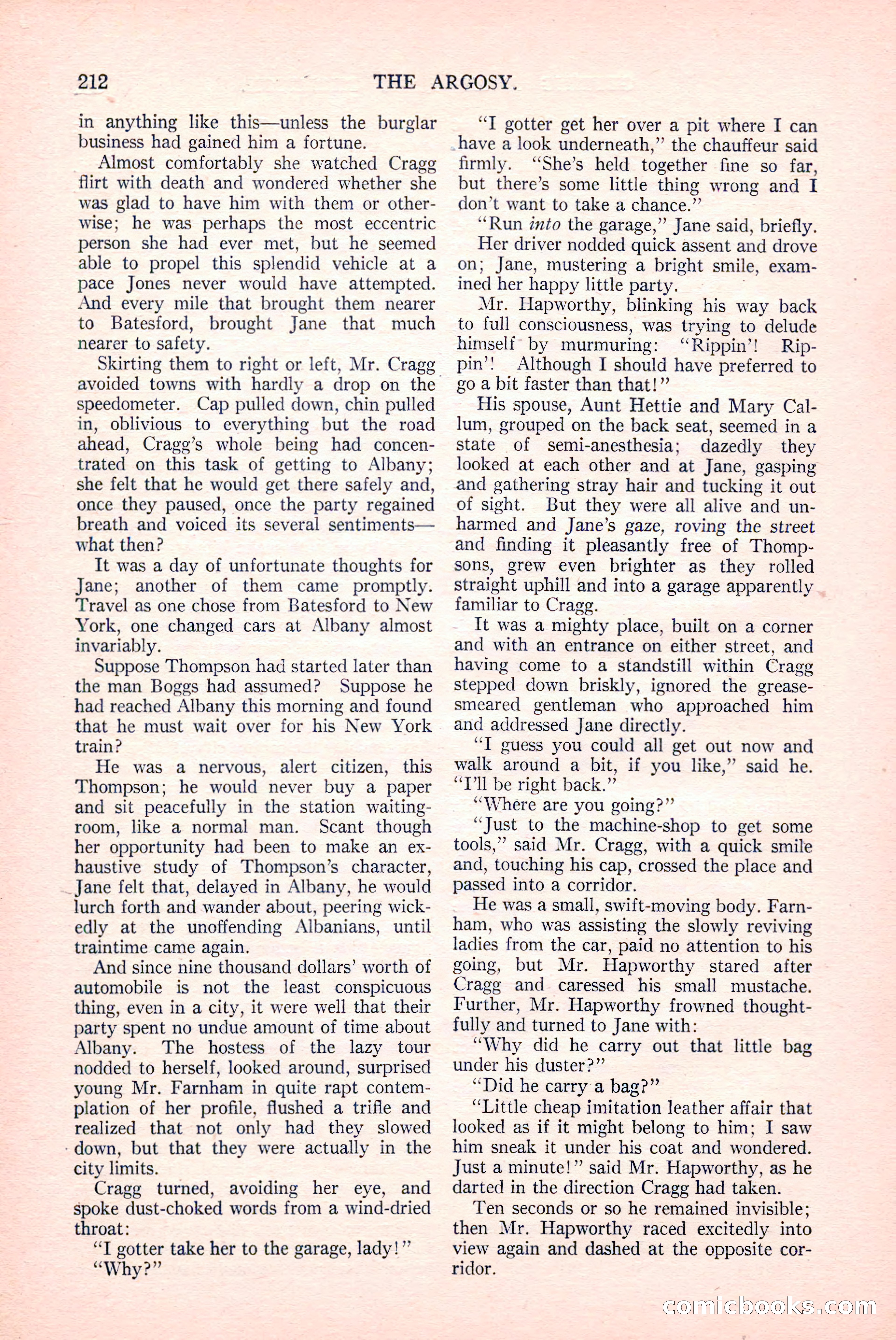
A restored page from Pulp Fiction, 1916. Page through the whole issue in the reader above.
📄 Transcribed text from this page (OCR, searchable)
Machine-transcribed from the original scan — historical spelling and the odd misread are preserved.
212 in anything like this—unless the burglar business had gained him a fortune. Almost comfortably she watched Cragg flirt with death and wondered whether she was glad to have him with them or other- wise; he was perhaps the most eccentric person she had ever met, but he seemed able to propel this splendid vehicle at a pace Jones never would have attempted. And every mile that brought them nearer to Batesford, brought Jane that much nearer to safety. Skirting them to right or left, Mr. Cragg. avoided towns with hardly a drop on the speedometer. Cap pulled down, chin pulled in, oblivious to everything but the road ahead, Crage’s whole being had concen- trated on this task of getting to Albany; she felt that he would get there safely and, once they paused, once the party regained breath and voiced its several sentiments— what then? It was a day of unfortunate thoughts for Jane; another of them came promptly. Travel as one chose from Batesford to New York, one changed cars at Albany almost invariably. Suppose Thompson had started later than the man Boggs had assumed? Suppose he had reached Albany this morning and found that he must wait over for his New York train? He was a nervous, alert citizen, this Thompson; he would never buy a paper and sit peacefully in the station waiting- room, like a normal man. Scant though her opportunity had been to make an ex- haustive study of Thompson’s character, _Jane felt that, delayed in Albany, he would lurch forth and wander about, peering wick- edly at the unoffending Albanians, until traintime came again. And since nine thousand dollars’ worth of automobile is not the least conspicuous thing, even in a city, it were well that their party spent no undue amount of time about Albany. The hostess of the lazy tour nodded to herself, looked around, surprised young Mr. Farnham in quite rapt contem- plation of her profile, flushed a trifle and realized that not only had they slowed -down, but that they were actually in the city limits. Cragg turned, avoiding her eye, and spoke dust-choked words from a wind-dried throat: “T gotter take her to the garage, lady!” “Why?” THE ARGOSY. “T gotter get her over a pit where I can have a look underneath,” the chauffeur said firmly. ‘She’s held together fine so far, but there’s some little thing wrong and I don’t want to take a chance.” ‘Run into the garage,” Jane said, briefly. Her driver nodded quick assent and drove on; Jane, mustering a bright smile, exam- ined her happy little party. Mr. Hapworthy, blinking his way back to full consciousness, was trying to delude himself by murmuring: “Rippin’! Rip- pin’! Although I should have preferred to go a bit faster than that!” His spouse, Aunt Hettie and Mary Cal- lum, grouped on the back seat, seemed in a state of semi-anesthesia; dazedly they looked at each other and at Jane, gasping and gathering stray hair and tucking it out of sight. But they were all alive and un- harmed and Jane’s gaze, roving the street and finding it pleasantly free of Thomp- sons, grew even brighter as they rolled straight uphill and into a garage apparently familiar to Cragg. It was a mighty place, built on a corner and with an entrance on either street, and having come to a standstill within Cragg stepped down briskly, ignored the grease- smeared gentleman who approached him and addressed Jane directly. ‘‘T guess you could all get out now and walk around a bit, if you like,” said he. “Tl be right back.” “Where are you going?” ‘Just to the machine-shop to get some tools,” said Mr. Cragg, with a quick smile and, touching his cap, crossed the place and passed into a corridor. He was a small, swift-moving body. Farn- ham, who was assisting the slowly reviving ladies from the car, paid no attention to his going, but Mr. Hapworthy stared after Cragg and caressed his small mustache. Further, Mr. Hapworthy frowned thought- fully and turned to Jane with: “Why did he carry out that little bag under his duster?” “Did he carry a bag?” “Little cheap imitation leather affair that looked as if it might belong to him; I saw him sneak it under his coat and wondered. Just a minute!” said Mr. Hapworthy, as he darted in the direction Cragg had taken. Ten seconds or so he remained invisible; then Mr. Hapworthy raced excitedly into view again and dashed at the opposite cor- ridor. COMMICLOOKS (C@