
Pulp Fiction, 1916 · page 27 of 216
The Argosy, Vol. 82 No. 2 — page 27: what you’re looking at
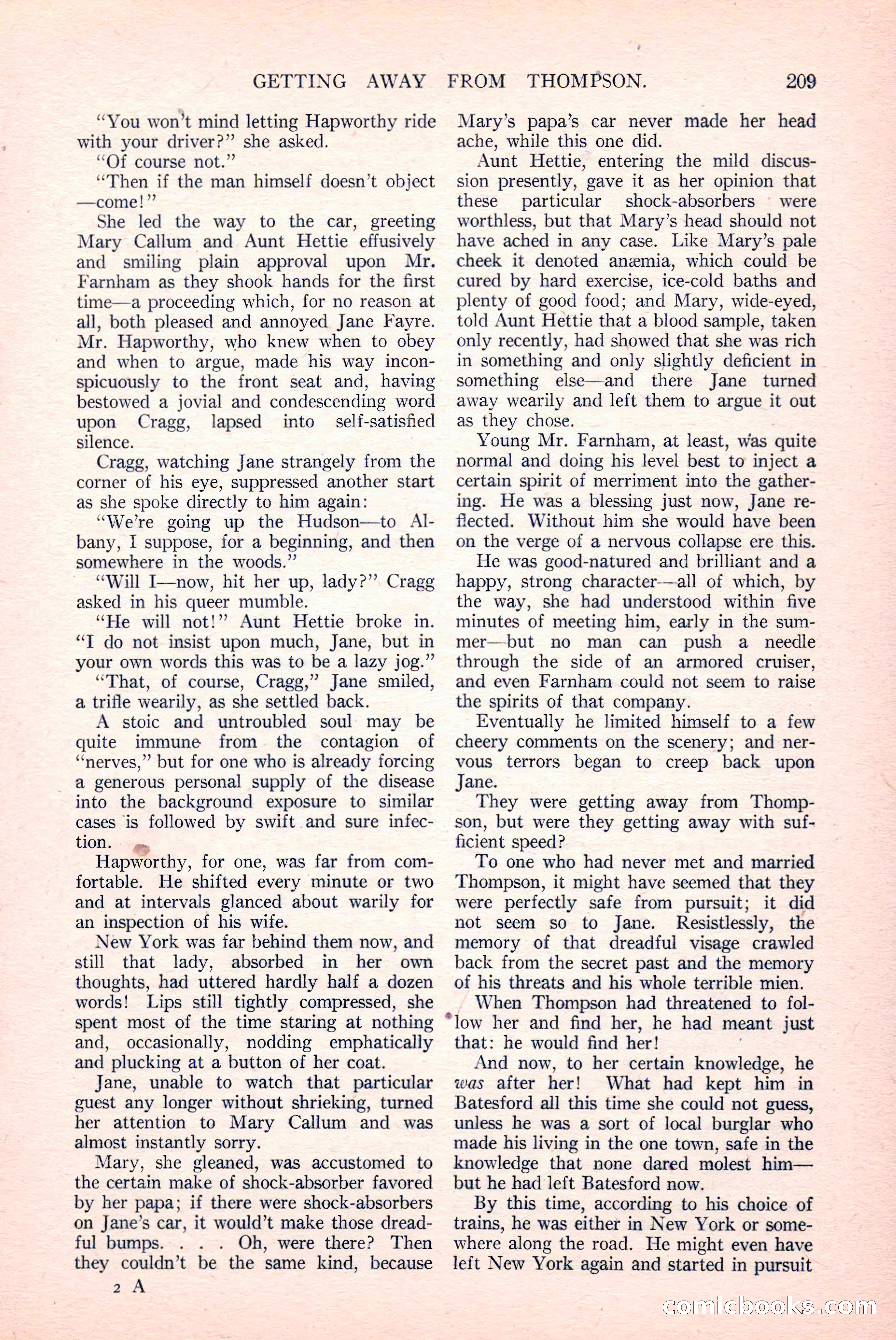
A restored page from Pulp Fiction, 1916. Page through the whole issue in the reader above.
📄 Transcribed text from this page (OCR, searchable)
Machine-transcribed from the original scan — historical spelling and the odd misread are preserved.
GETTING AWAY FROM THOMPSON. “You won’t mind letting Hapworthy ride with your driver?” she asked. “Of course not.” “Then if the man himself doesn’t object —come!”’ She led the way to the car, greeting Mary Callum and Aunt Hettie effusively and smiling plain approval upon Mr. Farnham as they shook hands for the first time—a proceeding which, for no reason at all, both pleased and annoyed Jane Fayre. Mr. Hapworthy, who knew when to obey and when to argue, made his way incon- spicuously to the front seat and, having bestowed a jovial and condescending word upon Cragg, lapsed into self-satisfied silence. Cragg, watching Jane strangely from the corner of his eye, suppressed another start as she spoke directly to him again: “We're going up the Hudson—to Al- bany, I suppose, for a beginning, and then somewhere in the woods.”’ “Will I—now, hit her up, lady?” Cragg asked in his queer mumble. “We will not!’?’ Aunt Hettie broke in. “T do not insist upon much, Jane, but in your own words this was to be a lazy jog.” “That, of course, Cragg,” Jane smiled, a trifle wearily, as she settled back. A stoic and untroubled soul may be quite immune from the contagion of “nerves,” but for one who is already forcing a generous personal supply of the disease into the background exposure to similar cases is followed by swift and sure infec- tion. gp Hapworthy, for one, was far from com- fortable. He shifted every minute or two and at intervals glanced about warily for an inspection of his wife. New York was far behind them now, and still that lady, absorbed in her own thoughts, had uttered hardly half a dozen words! Lips still tightly compressed, she spent most of the time staring at nothing and, occasionally, nodding emphatically and plucking at a button of her coat. Jane, unable to watch that particular guest any longer without shrieking, turned her attention to Mary Callum and was almost instantly sorry. Mary, she gleaned, was accustomed to the certain make of shock-absorber favored by her papa; if there were shock-absorbers on Jane’s car, it would’t make those dread- ful bumps. . Oh, were there? Then they couldn’t be the same kind, because 2A 209 Mary’s papa’s car never made her head ache, while this one did. Aunt Hettie, entering the mild discus- sion presently, gave it as her opinion that these particular shock-absorbers were worthless, but that Mary’s head should not have ached in any case. Like Mary’s pale cheek it denoted anemia, which could be cured by hard exercise, ice-cold baths and plenty of good food; and Mary, wide-eyed, told Aunt Hettie that a blood sample, taken only recently, had showed that she was rich in something and only slightly deficient in something else—and there Jane turned away wearily and left them to argue it out as they chose. Young Mr. Farnham, at least, was quite normal and doing his level best to inject a certain spirit of merriment into the gather- ing. He was a blessing just now, Jane re- flected. Without him she would have been on the verge of a nervous collapse ere this. He was good-natured and brilliant and a happy, strong character-—all of which, by the way, she had understood within five minutes of meeting him, early in the sum- mer—but no man can push a needle through the side of an armored cruiser, and even Farnham could not seem to raise the spirits of that company. Eventually he limited himself to a few cheery comments on the scenery; and ner- vous terrors began to creep back upon Jane. They were getting away from Thomp- son, but were they getting away with suf- ficient speed? To one who had never met and married Thompson, it might have seemed that they were perfectly safe from pursuit; it did not seem so to Jane. Resistlessly, the memory of that dreadful visage crawled back from the secret past and the memory of his threats and his whole terrible mien. When Thompson had threatened to fol- “low her and find her, he had meant just that: he would find her! And now, to her certain knowledge, he was after her! What had kept him in Batesford all this time she could not guess, unless he was a sort of local burglar who made his living in the one town, safe in the knowledge that none dared molest him— but he had left Batesford now. By this time, according to his choice of trains, he was either in New York or some- where along the road. He might even have left New York again and started in pursuit CORNICGLOOKS (C@