
Pulp Fiction, 1916 · page 140 of 216
The Argosy, Vol. 82 No. 2 — page 140: what you’re looking at
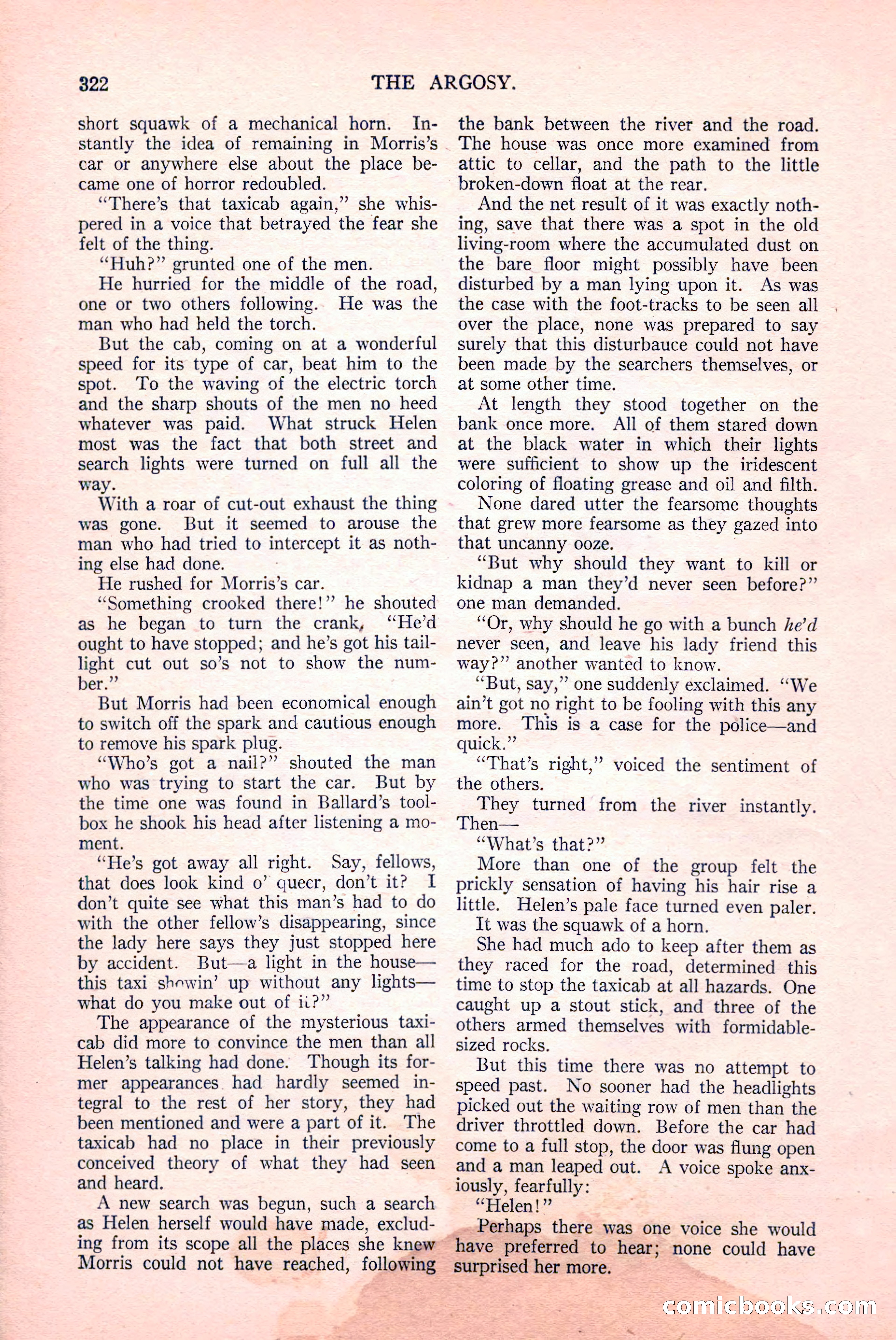
A restored page from Pulp Fiction, 1916. Page through the whole issue in the reader above.
📄 Transcribed text from this page (OCR, searchable)
Machine-transcribed from the original scan — historical spelling and the odd misread are preserved.
322 short squawk of a mechanical horn. In- stantly the idea of remaining in Morris’s car or anywhere else about the place be- came one of horror redoubled. “There’s that taxicab again,” she whis- pered in a voice that betrayed the fear she felt of the thing. “Huh?” grunted one of the men. He hurried for the middle of the road, one or two others following. He was the man who had held the torch. But the cab, coming on at a wonderful speed for its type of car, beat him to the spot. To the waving of the electric torch and the sharp shouts of the men no heed whatever was paid. What struck Helen most was the fact that both street and search lights were turned on full all the way. With a roar of cut-out exhaust the thing was gone. But it seemed to arouse the man who had tried to intercept it as noth- ing else had done. He rushed for Morris’s car. “Something crooked there!’’ he shouted as he began to turn the crank, ‘He'd ought to have stopped; and he’s got his tail- light cut out so’s not to show the num- ber.”’ But Morris had been economical enough to switch off the spark and cautious enough to remove his spark plug. “Who’s got a nail?” shouted the man who was trying to start the car. But by the time one was found in Ballard’s tool- box he shook his head after listening a mo- ment. “He’s got away all right. Say, fellows, that does look kind o’ queer, don’t it? I don’t quite see what this man’s had to do with the other fellow’s disappearing, since the lady here says they just stopped here by accident. But—a light in the house— this taxi showin’ up without any lights— what do you make out of it?” The appearance of the mysterious taxi- cab did more to convince the men than all Helen’s talking had done. Though its for- mer appearances. had hardly seemed in- tegral to the rest of her story, they had been mentioned and were a part of it. The taxicab had no place in their previously conceived theory of what they had seen and heard. A new search was begun, such a search as Helen herself would have made, exclud- ) ing from its scope all the places she knew” Morris could not have reached, following THE ARGOSY. the bank between the river and the road. The house was once more examined from attic to cellar, and the path to the little broken-down float at the rear. And the net result of it was exactly noth- ing, save that there was a spot in the old living-room where the accumulated dust on the bare floor might possibly have been disturbed by a man lying upon it. As was the case with the foot-tracks to be seen all over the place, none was prepared to say surely that this disturbauce could not have been made by the searchers themselves, or at some other time. At length they stood together on the bank once more. All of them stared down at the black water in which their lights were sufficient to show up the iridescent coloring of floating grease and oil and filth. None dared utter the fearsome thoughts that grew more fearsome as they gazed into that uncanny ooze. | “But why should they want to kill or kidnap a man they’d never seen before?” one man demanded. “Or, why should he go with a bunch he’d never seen, and leave his lady friend this way?” another wanted to know. “But, say,” one suddenly exclaimed. “We ain’t got no right to be fooling with this any more. This is a case for the police—and quick.”’ “That’s right,” voiced the sentiment of the others. They turned from the river instantly. Then— “What’s that?” More than one of the group felt the prickly sensation of having his hair rise a little. Helen’s pale face turned even paler. It was the squawk of a horn. She had much ado to keep after them as they raced for the road, determined this time to stop the taxicab at all hazards. One caught up a stout stick, and three of the others armed themselves with formidable- sized rocks. But this time there was no attempt to speed past. No sooner had the headlights picked out the waiting row of men than the driver throttled down. Before the car had come to a full stop, the door was flung open and a man leaped out. A voice spoke anx- iously, fearfully: “Helen!” _.~Perhaps there was one voice she would have preferred to hear; none could have surprised her more. | (EOLPMIGE LOOKS (C@)