
Pulp Fiction, 1916 · page 116 of 216
The Argosy, Vol. 82 No. 2 — page 116: what you’re looking at
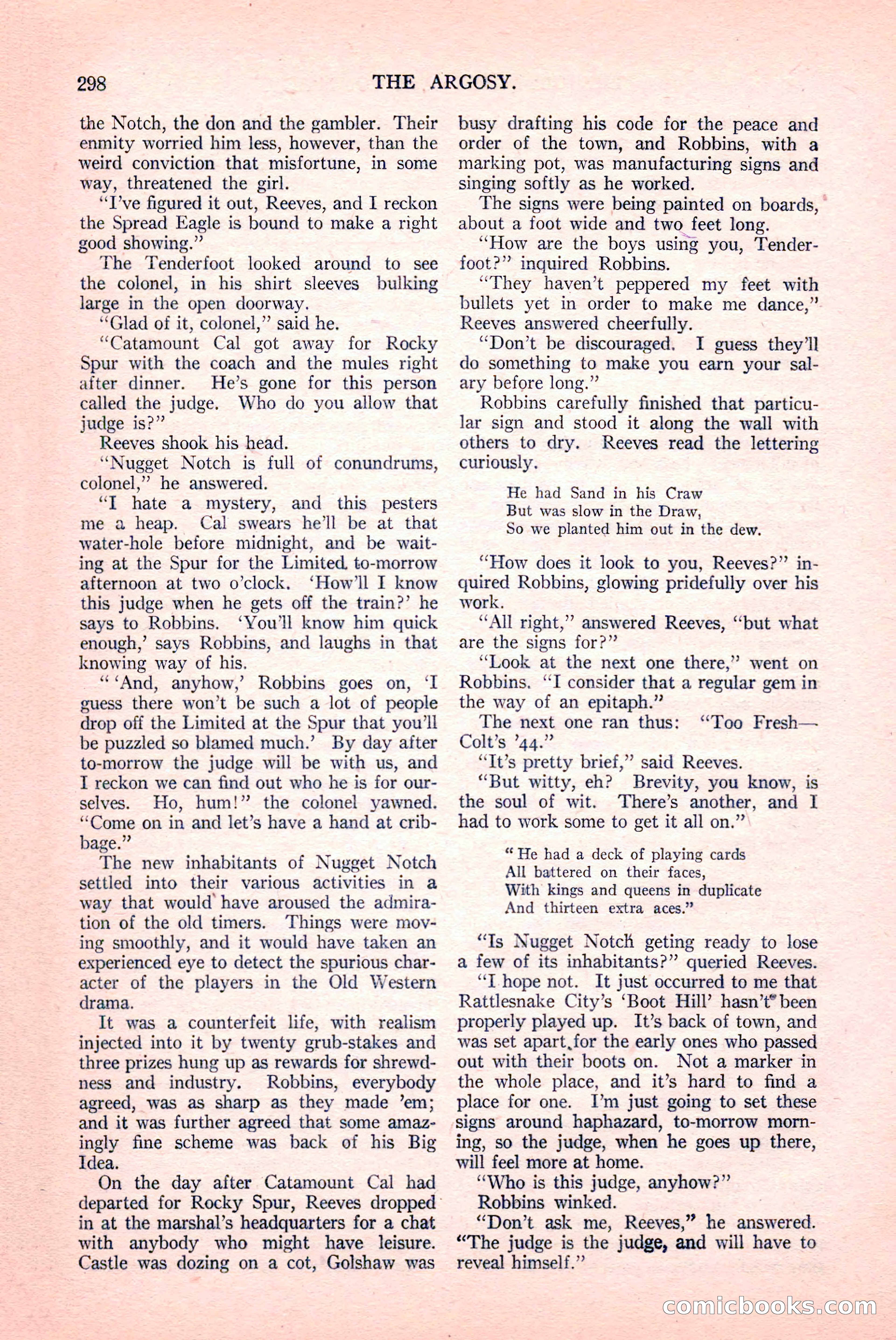
A restored page from Pulp Fiction, 1916. Page through the whole issue in the reader above.
📄 Transcribed text from this page (OCR, searchable)
Machine-transcribed from the original scan — historical spelling and the odd misread are preserved.
298 the Notch, the don and the gambler. Their enmity worried him less, however, than the weird conviction that misfortune, in some way, threatened the girl. “T’ve figured it out, Reeves, and I reckon the Spread Eagle is bound to make a right good showing.” The Tenderfoot looked around to see the colonel, in his shirt sleeves bulking large in the open doorway. ‘“Glad of it, colonel,” said he. “Catamount Cal got away for Rocky Spur with the coach and the mules right after dinner. He’s gone for this person called the judge. Who do you allow that judge is?” Reeves shook his head. “Nugget Notch is full of conundrums, colonel,” he answered. “T hate a mystery, and this pesters me a heap. Cal swears he'll be at that water-hole before midnight, and be wait- ing at the Spur for the Limited, to-morrow afternoon at two o’clock. ‘How’ll I know this judge when he gets off the train?’ he says to Robbins. ‘You'll know him quick enough,’ says Robbins, and laughs in that knowing way of his. ““And, anyhow,’ Robbins goes on, ‘I guess there won’t be such a lot of people drop off the Limited at the Spur that you'll be puzzled so blamed much.’ By day after to-morrow the judge will be with us, and I reckon we can find out who he is for our- selves. Ho, hum!” the colonel yawned. “Come on in and let’s have a hand at crib- bage.” The new inhabitants of Nugget Notch settled into their various activities in a way that would have aroused the admira- tion of the old timers. Things were moy- ing smoothly, and it would have taken an experienced eye to detect the spurious char- acter of the players in the Old Western drama. It was a counterfeit life, with realism injected into it by twenty grub-stakes and three prizes hung up as rewards for shrewd- ness and industry. Robbins, everybody agreed, was as sharp as they made ’em; and it was further agreed that some amaz- ingly fine scheme was back of his Big Idea. On the day after Catamount Cal had departed for Rocky Spur, Reeves dropped’ in at the marshal’s headquarters for a chat with anybody who might have leisure. Castle was dozing on a cot, Golshaw was THE ARGOSY. busy drafting his code for the peace and order of the town, and Robbins, with a marking pot, was manufacturing signs and singing softly as he worked. The signs were being painted on boards, about a foot wide and two feet long. ‘How are the boys using you, Tender- foot?” inquired Robbins. “They haven’t peppered my feet with bullets yet in order to make me dance,” Reeves answered cheerfully. “Don’t be discouraged. I guess they'll do something to make you earn your sal- ary before long.” Robbins carefully finished that particu- lar sign and stood it along the wall with others to dry. Reeves read the lettering curiously. He had Sand in his Craw But was slow in the Draw, So we planted him out in the dew. “How does it look to you, Reeves?” in- quired Robbins, glowing pridefully over his work. “All right,” answered Reeves, “but what are the signs for?” “Look at the next one there,” went on Robbins. “I consider that a regular gem in the way of an epitaph.” The next one ran thus: Colt’s 744.” “Tt’s pretty brief,” said Reeves. “But witty, eh? Brevity, you know, is the soul of wit. ‘There’s another, and I had to work some to get it all on.” “Too Fresh— “He had a deck of playing cards All battered on their faces, With kings and queens in duplicate And thirteen extra aces.” “Is Nugget Notch geting ready to lose a few of its inhabitants?” queried Reeves. “T hope not. It just occurred to me that Rattlesnake City’s ‘Boot Hill’ hasn’t® been properly played up. It’s back of town, and was set apart,for the early ones who passed out with their boots on. Not a marker in the whole place, and it’s hard to find a place for one. I’m just going to set these signs around haphazard, to-morrow morn- ing, so the judge, when he goes up there, will feel more at home. “Who is this judge, anyhow?” Robbins winked. “Don’t ask me, Reeves,” he answered. “The judge is the judge, and will have to reveal himself.” COMICIOOKS (C@)