
Pulp Fiction, 1916 · page 102 of 216
The Argosy, Vol. 82 No. 2 — page 102: what you’re looking at
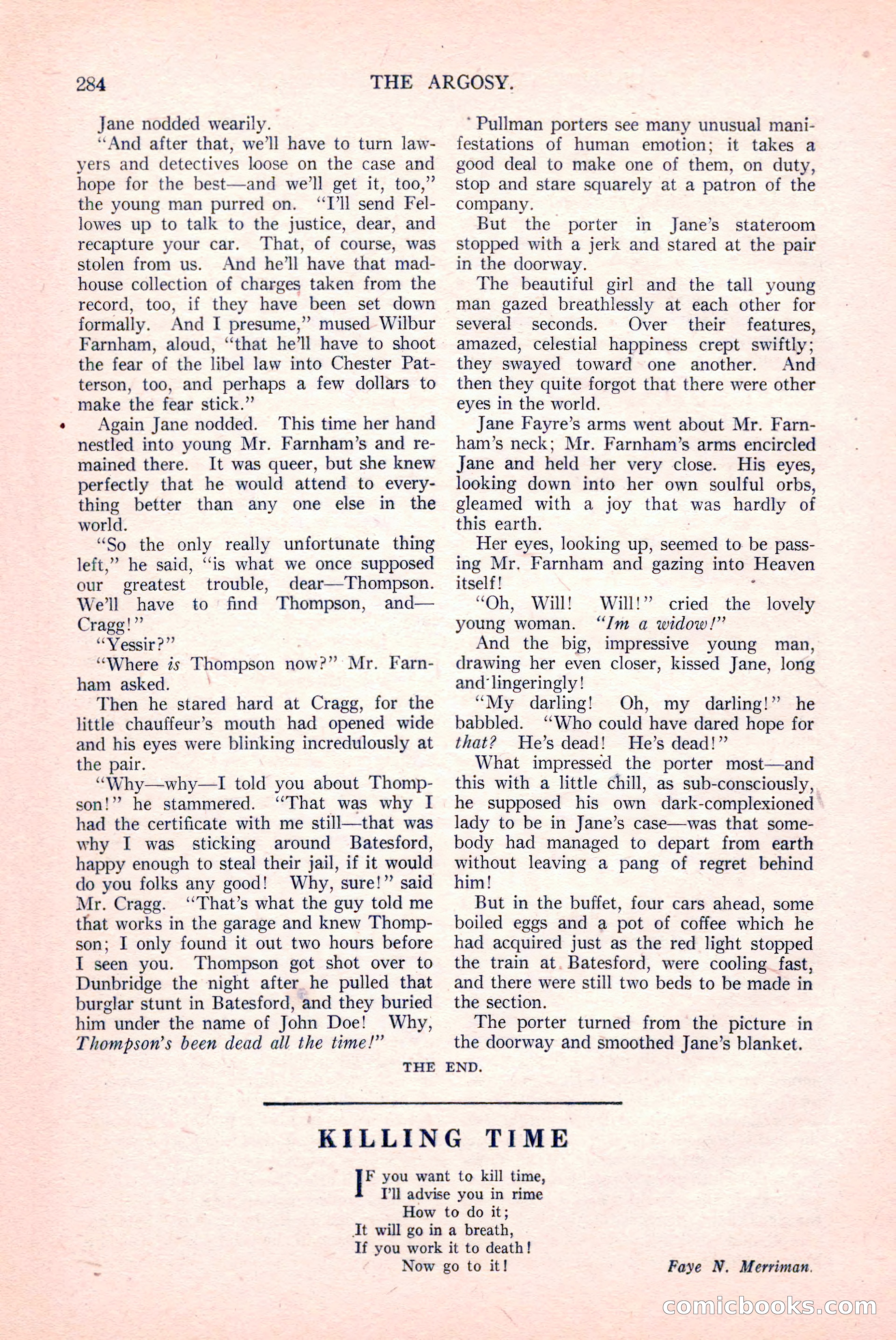
A restored page from Pulp Fiction, 1916. Page through the whole issue in the reader above.
📄 Transcribed text from this page (OCR, searchable)
Machine-transcribed from the original scan — historical spelling and the odd misread are preserved.
284 Jane nodded wearily. “And after that, we’ll have to turn law- yers and detectives loose on the case and hope for the best—and we’ll get it, too,” the young man purred on. “I'll send Fel- lowes up to talk to the justice, dear, and recapture your car. That, of course, was stolen from us. And he’ll have that mad- house collection of charges taken from the record, too, if they have been set down formally. And I presume,” mused Wilbur Farnham, aloud, “that he’ll have to shoot the fear of the libel law into Chester Pat- terson, too, and perhaps a few dollars to make the fear stick.” Again Jane nodded. This time her hand nestled into young Mr. Farnham’s and re- mained there. It was queer, but she knew perfectly that he would attend to every- thing better than any one else in the world. “So the only really unfortunate thing left,” he said, “is what we once supposed our greatest trouble, dear—Thompson. We'll have to find Thompson, and— Cragg!” “Yessir?”’ ‘Where is Thompson now?” Mr. Farn- ham asked. Then he stared hard at Cragg, for the little chauffeur’s mouth had opened wide and his eyes were blinking incredulously at the pair. “Why—why—I told you about Thomp- son!’ he stammered. “That was why I had the certificate with me still—that was why I was sticking around Batesford, happy enough to steal their jail, if it would do you folks any good! Why, sure!” said Mr. Cragg. ‘‘That’s what the guy told me that works in the garage and knew Thomp- son; I only found it out two hours before I seen you. Thompson got shot over to Dunbridge the night after he pulled that burglar stunt in Batesford, and they buried him under the name of John Doe! Why, Thompson’s been dead all the time!” THE ARGOSY. ‘Pullman porters see many unusual mani- festations of human emotion; it takes a good deal to make one of them, on duty, stop and stare squarely at a patron of the company. But the porter in Jane’s stateroom stopped with a jerk and stared at the pair in the doorway. The beautiful girl and the tall young man gazed breathlessly at each other for several seconds. Over their features, amazed, celestial happiness crept swiftly; they swayed toward one another. And then they quite forgot that there were other eyes in the world. Jane Fayre’s arms went about Mr. Farn- ham’s neck; Mr. Farnham’s arms encircled Jane and held her very close. His eyes, looking down into her own soulful orbs, gleamed with a joy that was hardly of this earth. Her eyes, looking up, seated to be pass- ing Mr. Farnham and gazing into Heaven itself! | “Oh, Will! Will!” cried the lovely young woman. “Jm a widow!” And the big, impressive young man, drawing her even closer, kissed Jane, long and ‘lingeringly! “My darling! Oh, my darling!” he babbled. ‘Who could have dared hope for that? He’s dead! He’s dead!” What impressed the porter most—and this with a little chill, as sub-consciously, he supposed his own dark-complexioned lady to be in Jane’s case—was that some- body had managed to depart from earth — leaving a pang of regret behind im! But in the buffet, four cars ahead, some boiled eggs and a pot of coffee which he had acquired just as the red light stopped the train at. Batesford, were cooling fast, and there were still two beds to be made in the section. The porter turned from the picture in the doorway and smoothed Jane’s blanket. THE END. KILLING TIME F you want to kill time, Pll advise you in rime How to do it; It will go in a breath, If you work it to death! Now go to it! Faye N. Merriman. ECORNICGLOOOKS (C@