
Pulp Fiction, 1916 · page 86 of 216
The Argosy, Vol. 81, No. 4 — page 86: what you’re looking at
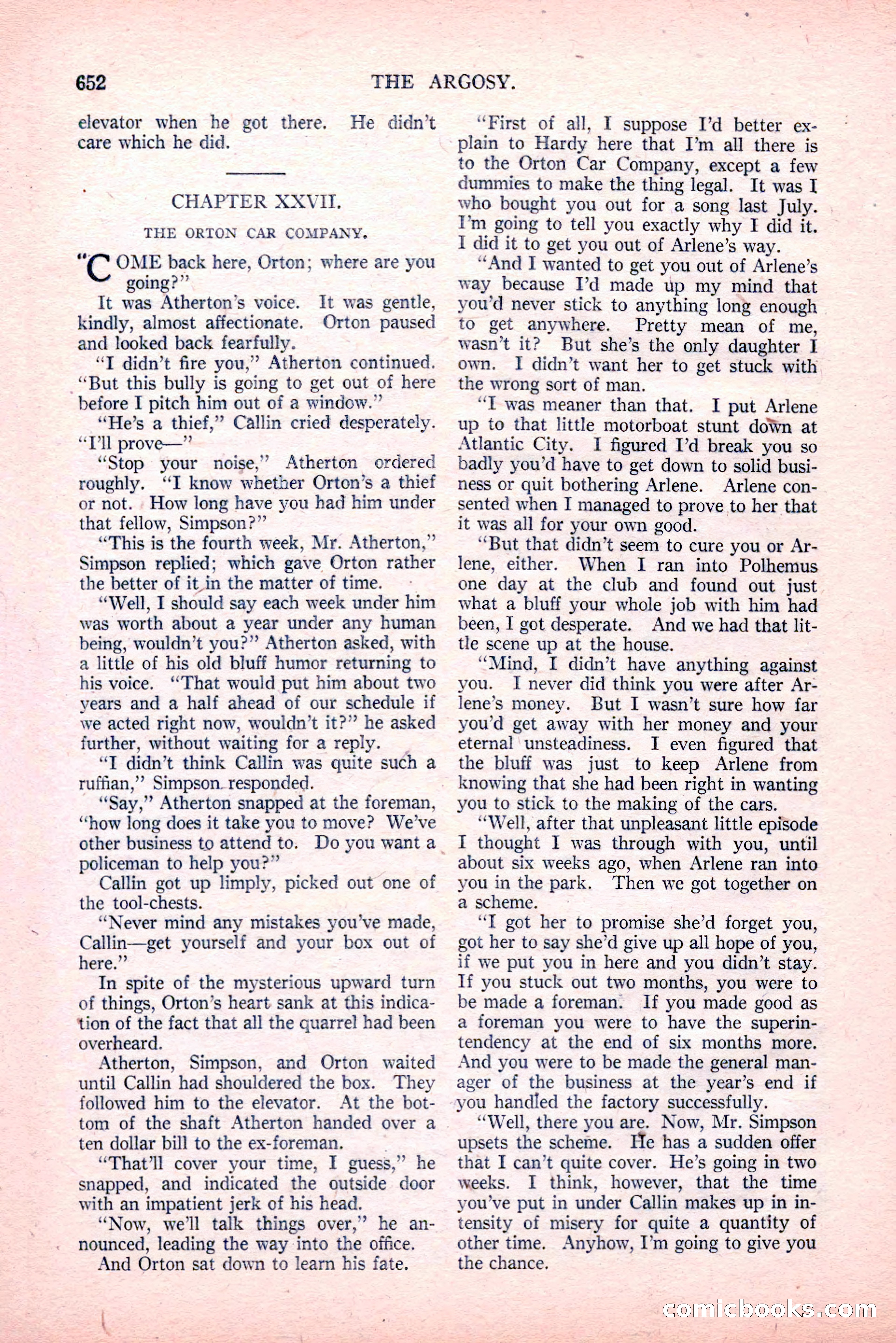
A restored page from Pulp Fiction, 1916. Page through the whole issue in the reader above.
📄 Transcribed text from this page (OCR, searchable)
Machine-transcribed from the original scan — historical spelling and the odd misread are preserved.
652 elevator when he got there. He didn’t care which he did. CHAPTER XXVII. THE ORTON CAR COMPANY. “(C OME back here, Orton; where are you going ?”’ It was Atherton’s voice. kindly, almost affectionate. and looked back fearfully. “T didn’t fire you,” Atherton continued. “But this bully is going to get out of here before I pitch him out of a window.” ‘“He’s a thief,” Callin cried desperately. “T'll prove—” “Stop your noise,” Atherton ordered roughly. “I know whether Orton’s a thief or not. How long have you had him under that fellow, Simpson?”’ “This is the fourth week, Mr. Atherton,” Simpson replied; which gave Orton rather the better of it.in the matter of time. “Well, I should say each week under him was worth about a year under any human being, wouldn’t you?” Atherton asked, with a little of his old bluff humor returning to his voice. “That would put him about two years and a half ahead of our schedule if we acted right now, wouldn’t it?” he asked further, without waiting for a reply. _ “T didn’t think Callin was quite such a ruffian,’ Simpson_responded. “Say,” Atherton snapped at the foreman, “how long does it take you to move? We've It was gentle, Orton paused other business to attend to. Do you want a. policeman to help you?” Callin got up limply, picked out one of the tool-chests. “Never mind any mistakes you’ve made, Callin—get yourself and your box out of here.”’ In spite of the mysterious upward turn of things, Orton’s heart sank at this indica- tion of the fact that all the quarrel had been overheard. Atherton, Simpson, and Orton waited until Callin had shouldered the box. They followed him to the elevator. At the bot- tom of the shaft Atherton handed over a ten dollar bill to the ex-foreman. “That'll cover your time, I guess,” he snapped, and indicated the outside door with an impatient jerk of his head. “Now, we'll talk things over,’ he an- nounced, leading the way into the office. And Orton sat down to learn his fate. THE ARGOSY. “First of all, I suppose I’d better ex- plain to Hardy here that I’m all there is to the Orton Car Company, except a few dummies to make the thing legal. It was I who bought you out for a song last July. I'm going to tell you exactly why I did it. I did it to get you out of Arlene’s way. ‘And I wanted to get you out of Arlene’s way because I’d made up my mind that you'd never stick to anything long enough to get anywhere. Pretty mean of me, wasn’t it? But she’s the only daughter I own. I didn’t want her to get stuck with the wrong sort of man. “IT was meaner than that. I put Arlene up to that little motorboat stunt down at Atlantic City. I figured I’d break you so badly you’d have to get down to solid busi- ness or quit bothering Arlene. Arlene con- sented when I managed to prove to her that it was all for your own good. ‘But that didn’t seem to cure you or Ar- lene, either. When I ran into Polhemus one day at the club and found out just what a bluff your whole job with him had been, I got desperate. And we had that lit- tle scene up at the house. ‘Mind, I didn’t have anything against you. I never did think you were after Ar- lene’s money. But I wasn’t sure how far you’d get away with her money and your eternal unsteadiness. I even figured that the bluff was just to keep Arlene from knowing that she had been right in wanting you to stick to the making of the cars. “Well, after that unpleasant little episode I thought I was through with you, until about six weeks ago, when Arlene ran into you in the park. Then we got together on a scheme. “T got her to promise she’d forget you, got her to say she’d give up all hope of you, if we put you in here and you didn’t stay. If you stuck out two months, you were to be made a foreman. If you made good as a foreman you were to have the superin- tendency at the end of six months more. And you were to be made the general man- ager of the business at the year’s end if you handled the factory successfully. “Well, there you are. Now, Mr. Simpson upsets the scheme. He has a sudden offer that I can’t quite cover. He’s going in two weeks. I think, however, that the time you’ve put in under Callin makes up in in- tensity of misery for quite a quantity of other time. Anyhow, I’m going to give you the chance. COLMMUC (E@) NOOLKS