
Pulp Fiction, 1916 · page 72 of 216
The Argosy, Vol. 81, No. 4 — page 72: what you’re looking at
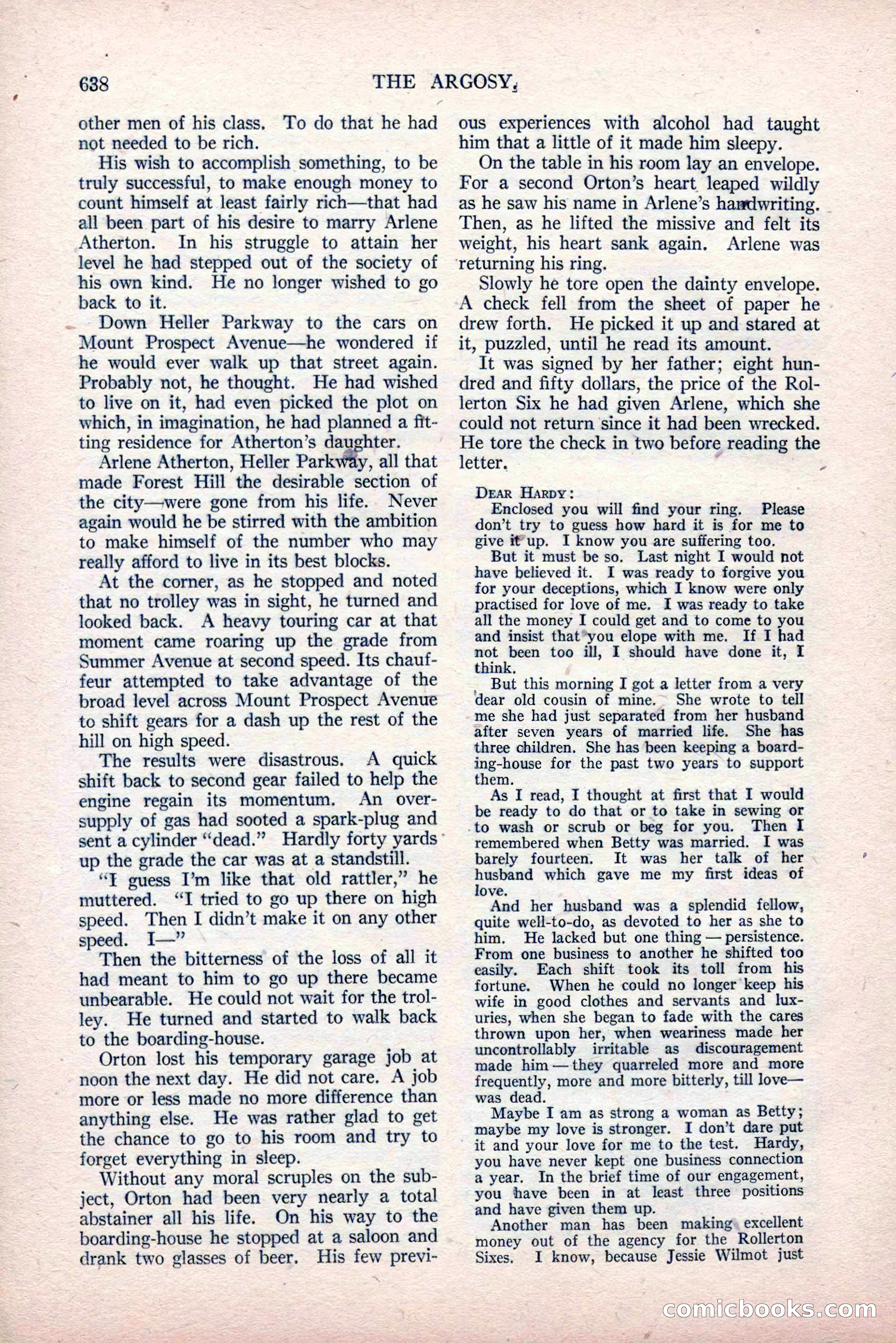
A restored page from Pulp Fiction, 1916. Page through the whole issue in the reader above.
📄 Transcribed text from this page (OCR, searchable)
Machine-transcribed from the original scan — historical spelling and the odd misread are preserved.
638 other men of his class. To do that he had not needed to be rich. His wish to accomplish something, to be truly successful, to make enough money to count himself at least fairly rich—that had all been part of his desire to marry Arlene Atherton. In his struggle to attain her level he had stepped out of the society of his own kind. He no longer wished to go back to it. Down Heller Parkway to the cars on Mount Prospect Avenue—he wondered if he would ever walk up that street again. Probably not, he thought. He had wished to live on it, had even picked the plot on which, in imagination, he had planned a fit- ting residence for Atherton’s daughter. Arlene Atherton, Heller Parkway, all that made Forest Hill the desirable section of the city—were gone from his life. Never again would he be stirred with the ambition to make himself of the number who may really afford to live in its best blocks. At the corner, as he stopped and noted that no trolley was in sight, he turned and looked back. A heavy touring car at that moment came roaring up the grade from Summer Avenue at second speed. Its chauf- feur attempted to take advantage of the broad level across Mount Prospect Avenue to shift gears for a dash up the rest of the hill on high speed. The results were disastrous. A quick shift back to second gear failed to help the engine regain its momentum. An over- supply of gas had sooted a spark-plug and sent a cylinder “dead.” Hardly forty yards up the grade the car was at a standstill. “E guess I’m like that old rattler,” he muttered. “I tried to go up there on high speed. Then I didn’t make it on any other speed. I—” . Then the bitterness of the loss of all it had meant to him to go up there became unbearable. He could not wait for the trol- ley. He turned and started to walk back to the boarding-house. Orton lost his temporary garage job at noon the next day. He did not care. A job more or less made no more difference than anything else. He was rather glad to get the chance to go to his room and try to forget everything in sleep. Without any moral scruples on the sub- ject, Orton had been very nearly a total abstainer all his life. On his way to the boarding-house he stopped at a saloon and drank two glasses of beer. His few previ- THE ARGOSY, ous experiences with alcohol had taught him that a little of it made him sleepy. On the table in his room lay an envelope. For a second Orton’s heart leaped wildly as he saw his name in Arlene’s hawdwriting. Then, as he lifted the missive and felt its weight, his heart sank again. Arlene was returning his ring. Slowly he tore open the dainty envelope. A check fell from the sheet of paper he drew forth. He picked it up and stared at it, puzzled, until he read its amount. It was signed by her father; eight hun- dred and fifty dollars, the price of the Rol- lerton Six he had given Arlene, which she could not return since it had been wrecked. He tore the check in two before reading the letter. . Dear Harpy: Enclosed you will find your ring. Please don’t try to guess how hard it is for me to give itup. I know you are suffering too. But it must be so. Last night I would not have believed it. I was ready to forgive you for your deceptions, which I know were only practised for love of me. I was ready to take all the money I could get and to come to you and insist that*you elope with me. If I had not been too ill, I should have done it, I think. _ But this morning I got a letter from a very dear old cousin of mine. She wrote to tell me she had just separated from her husband after seven years of married life. She has three children. She has been keeping a board- ca for the past two years to support them. As I read, I thought at first that I would be ready to do that or to take in sewing or -to wash or scrub or beg for you. Then I remembered when Betty was married. I was barely fourteen. It was her talk of her a which gave me my first ideas of ove. And her husband was a splendid fellow, quite well-to-do, as devoted to her as she to him. He lacked but one thing — persistence. From one business to another he shifted too easily. Each shift took its toll from his fortune. When he could no longer keep his wife in good clothes and servants and lux- uries, when she began to fade with the cares thrown upon her, when weariness made her uncontrollably irritable as discouragement made him—they quarreled more and more frequently, more and more bitterly, till love— was dead. Maybe I am as strong a woman as Betty; maybe my love is stronger. I don’t dare put it and your love for me to the test. Hardy, you have never kept one business connection a year. In the brief time of our engagement, you have been in at least three positions and have given them up. Another man has been making) excellent money out of the agency for the Rollerton Sixes. I know, because Jessie Wilmot just (€(0) 0)(0\(0) AMUN S (E©)