
Pulp Fiction, 1916 · page 70 of 216
The Argosy, Vol. 81, No. 4 — page 70: what you’re looking at
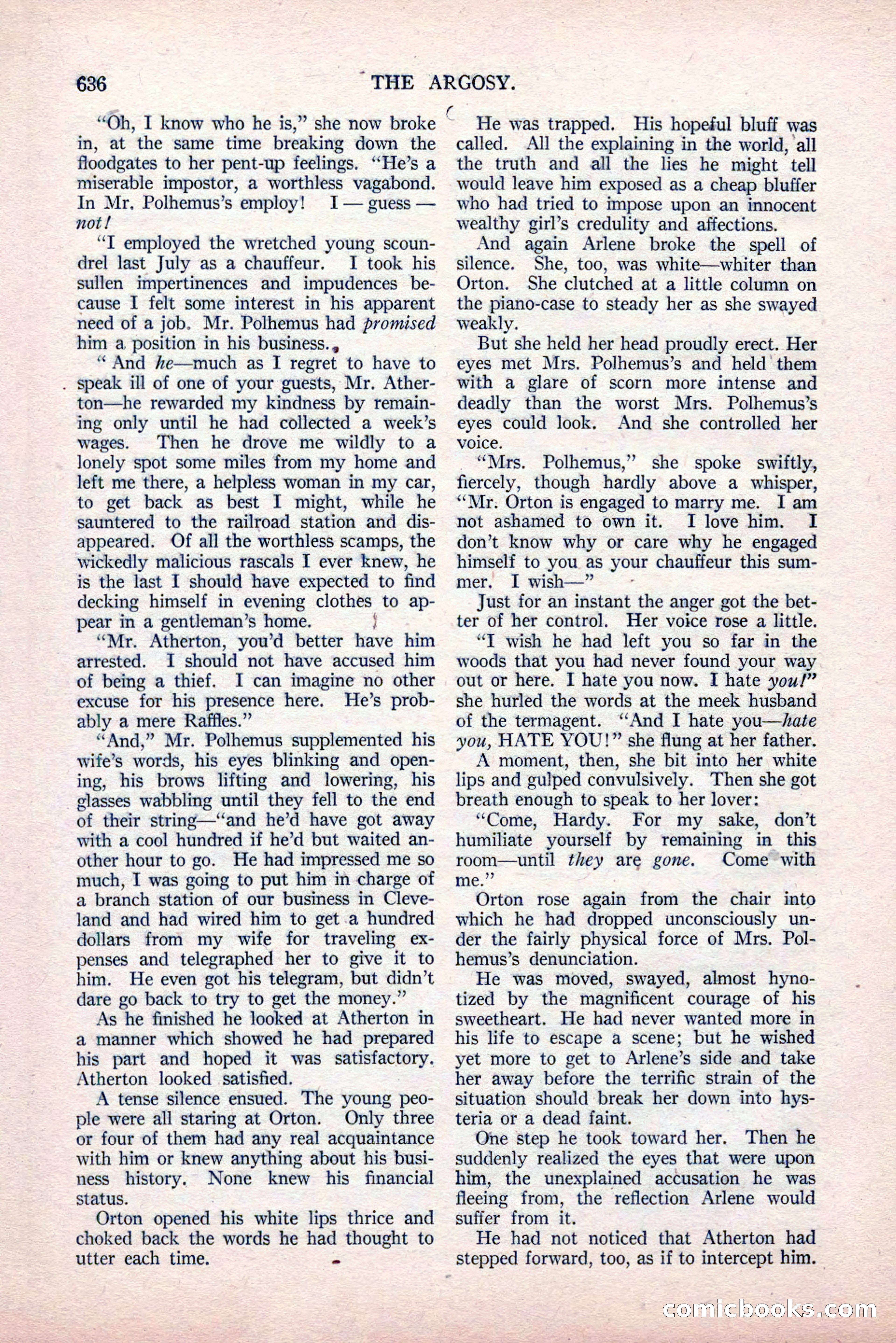
A restored page from Pulp Fiction, 1916. Page through the whole issue in the reader above.
📄 Transcribed text from this page (OCR, searchable)
Machine-transcribed from the original scan — historical spelling and the odd misread are preserved.
636 “Oh, I know who he is,” she now broke C in, at the same time breaking down the floodgates to her pent-up feelings. “He’s a miserable impostor, a worthless vagabond. In Mr. Polhemus’s employ! I— guess — not! “T employed the wretched young scoun- drel last July as a chauffeur. I took his sullen impertinences and impudences be- cause I felt some interest in his apparent need of a job. Mr. Polhemus had promised him a position in his business. , “ And Ae—much as I regret to have to . speak ill of one of your guests, Mr. Ather- ton—he rewarded my kindness by remain- ing only until he had collected a week’s wages. Then he drove me wildly to a lonely spot some miles from my home and left me there, a helpless woman in my car, to get back as best I might, while he sauntered to the railroad station and dis- appeared. Of all the worthless scamps, the wickedly malicious rascals I ever knew, he is the last I should have expected to find decking himself in evening clothes to ap- pear in a gentleman’s home. i “Mr. Atherton, you’d better have him arrested. I should not have accused him of being a thief. I can imagine no other excuse for his presence here. He’s prob- ably a mere Raffles.” “And,” Mr. Polhemus supplemented his wite’s words, his eyes blinking and open- ing, his brows lifting and lowering, his glasses wabbling until they fell to the end of their string—‘‘and he’d have got away with a cool hundred if he’d but waited an- other hour to go. He had impressed me so much, I was going to put him in charge of a branch station of our business in Cleve- Jand and had wired him to get a hundred dollars from my wife for traveling ex- penses and telegraphed her to give it to him. He even got his telegram, but didn’t dare go back to try to get the money.” As he finished he looked at Atherton in a manner which showed he had prepared his part and hoped it was satisfactory. Atherton looked satisfied. A tense silence ensued. The young peo- ple were all staring at Orton. Only three or four of them had any real acquaintance with him or knew anything about his busi- ness history. None knew his financial status. Orton opened his white lips thrice and choked back the words he had thought to utter each time. = THE ARGOSY. He was trapped. His hopeful bluff was called. All the explaining in the world, all the truth and all the lies he might tell would leave him exposed as a cheap bluffer who had tried to impose upon an innocent wealthy girl’s credulity and affections. And again Arlene broke the spell of silence. She, too, was white—whiter than Orton. She clutched at a little column on the piano-case to steady her as she swayed weakly. But she held her head proudly erect. Her eyes met Mrs. Polhemus’s and held them with a glare of scorn more intense and deadly than the worst Mrs. Polhemus’s eyes could look. And she controlled her voice. “Mrs. Polhemus,” she spoke swiftly, fiercely, though hardly above a whisper, **Mr. Orton is engaged to marry me. I am not ashamed to own it. I love him. I don’t know why or care why he engaged himself to you as your chauffeur this sum- mer. I wish—” Just for an instant the anger got the bet- ter of her control. Her voice rose a little. “T wish he had left you so far in the woods that you had never found your way out or here. I hate you now. I hate you!” she hurled the words at the meek husband of the termagent. ‘‘And I hate you—/sate you, HATE YOU!” she flung at her father. A moment, then, she bit into her white lips and gulped convulsively. Then she got breath enough to speak to her lover: “Come, Hardy. For my sake, don’t humiliate yourself by remaining in this room—until they are gone. Come with me.” Orton rose again from the chair into which he had dropped unconsciously un- der the fairly physical force of Mrs. Pol- hemus’s denunciation. He was moved, swayed, almost hyno- tized by the magnificent courage of his sweetheart. He had never wanted more in his life to escape a scene; but he wished yet more to get to Arlene’s side and take her away before the terrific strain of the situation should break her down into hys- teria or a dead faint. One step he took toward her. Then he suddenly realized the eyes that were upon him, the unexplained accusation he was fleeing from, the reflection Arlene would suffer from it. He had not noticed that Atherton had EOPMICGLOOKS stepped forward, too, as if to intercept him. (E@)