
Pulp Fiction, 1916 · page 51 of 216
The Argosy, Vol. 81, No. 4 — page 51: what you’re looking at
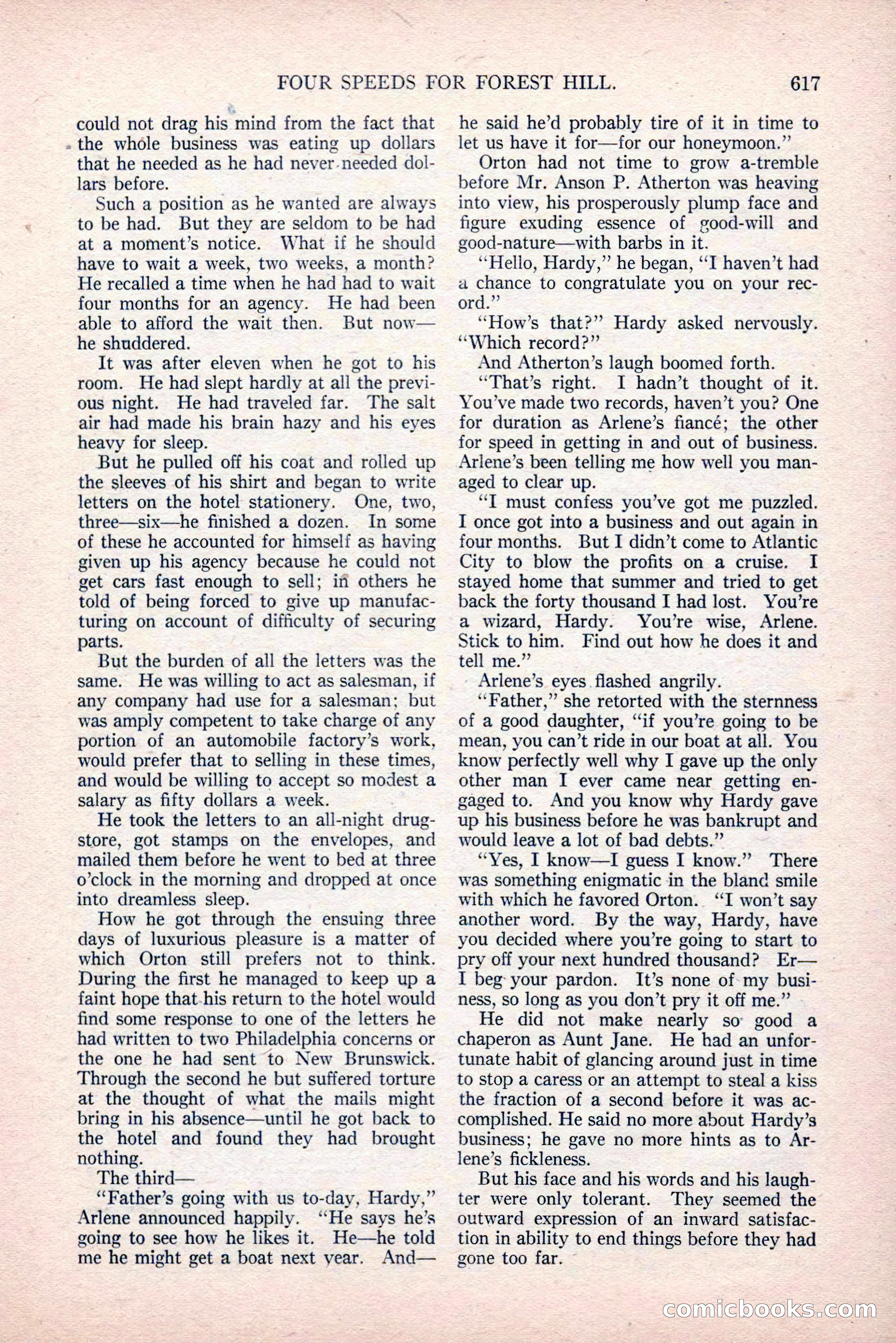
A restored page from Pulp Fiction, 1916. Page through the whole issue in the reader above.
📄 Transcribed text from this page (OCR, searchable)
Machine-transcribed from the original scan — historical spelling and the odd misread are preserved.
FOUR SPEEDS FOR FOREST HILL. could not drag his mind from the fact that . the whole business was eating up dollars that he needed as he had never-needed dol- lars before. 7 Such a position as he wanted are always to be had. But they are seldom to be had at a moment’s notice. What if he should have to wait a week, two weeks, a month? He recalled a time when he had had to wait four months for an agency. He had been able to afford the wait then. But now— he shuddered. It was after eleven when he got to his room. He had slept hardly at all the previ- ous night. He had traveled far. The salt air had made his brain hazy and his eyes heavy for sleep. But he pulled off his coat and rolled up the sleeves of his shirt and began to write letters on the hotel stationery. One, two, three—six—he finished a dozen. In some of these he accounted for himself as having given up his agency because he could not get cars fast enough to sell; in others he told of being forced to give up manufac- turing on account of difficulty of securing parts. But the burden of all the letters was the same. He was willing to act as salesman, if any company had use for a salesman; but was amply competent to take charge of any portion of an automobile factory’s work, would prefer that to selling in these times, and would be willing to accept so modest a salary as fifty dollars a week. He took the letters to an all-night drug- store, got stamps on the envelopes, and mailed them before he went to bed at three o’clock in the morning and dropped at once into dreamless sleep. How he got through the ensuing three days of luxurious pleasure is a matter of which Orton still prefers not to think. During the first he managed to keep up a faint hope that-his return to the hotel would find some response to one of the letters he had written to two Philadelphia concerns or the one he had sent to New Brunswick. Through the second he but suffered torture at the thought of what the mails might bring in his absence—until he got back to the hotel and found they had brought nothing. The third— “Father’s going with us to-day, Hardy,” Arlene announced happily. ‘He says he’s going to see how he likes it. He—he told me he might get a boat next year. And— 617 he said he’d probably tire of it in time to let us have it for—for our honeymoon.” Orton had not time to grow a-tremble before Mr. Anson P. Atherton was heaving into view, his prosperously plump face and figure exuding essence of good-will and good-nature—with barbs in it. ‘Hello, Hardy,” he began, “I haven’t had a chance to congratulate you on your rec- ord.” ‘““How’s that?” Hardy asked nervously. “Which record?” And Atherton’s laugh boomed forth. “That’s right. I hadn’t thought of it. You’ve made two records, haven’t you? One for duration as Arlene’s fiancé; the other for speed in getting in and out of business. Arlene’s been telling me how well you man- aged to clear up. “T must confess you’ve got me puzzled. I once got into a business and out again in four months. But I didn’t come to Atlantic City to blow the profits on a cruise. I stayed home that summer and tried to get back the forty thousand I had lost. You’re a wizard, Hardy. You’re wise, Arlene. Stick to him. Find out how he does it and tell me.” Arlene’s eyes flashed angrily. ‘‘Father,” she retorted with the sternness of a good daughter, “if you’re going to be mean, you can’t ride in our boat at all. You know perfectly well why I gave up the only other man I ever came near getting en- gaged to. And you know why Hardy gave up his business before he was bankrupt and would leave a lot of bad debts.” “Yes, I know—I guess I know.” There was something enigmatic in the bland smile with which he favored Orton. “I won’t say another word. By the way, Hardy, have you decided where you’re going to start to pry off your next hundred thousand? Er— I beg your pardon. It’s none of my busi- ness, so long as you don’t pry it off me.” He did not make nearly so good a chaperon as Aunt Jane. He had an unfor- tunate habit of glancing around just in time to stop a caress or an attempt to steal a kiss the fraction of a second before it was ac- complished. He said no more about Hardy’s business; he gave no more hints as to Ar- lene’s fickleness. But his face and his words and his laugh- ter were only tolerant. They seemed the outward expression of an inward satisfac- tion in ability to end things before they had gone too far. © (EO) OOOLKS AUG Eo