
Pulp Fiction, 1916 · page 43 of 216
The Argosy, Vol. 81, No. 4 — page 43: what you’re looking at
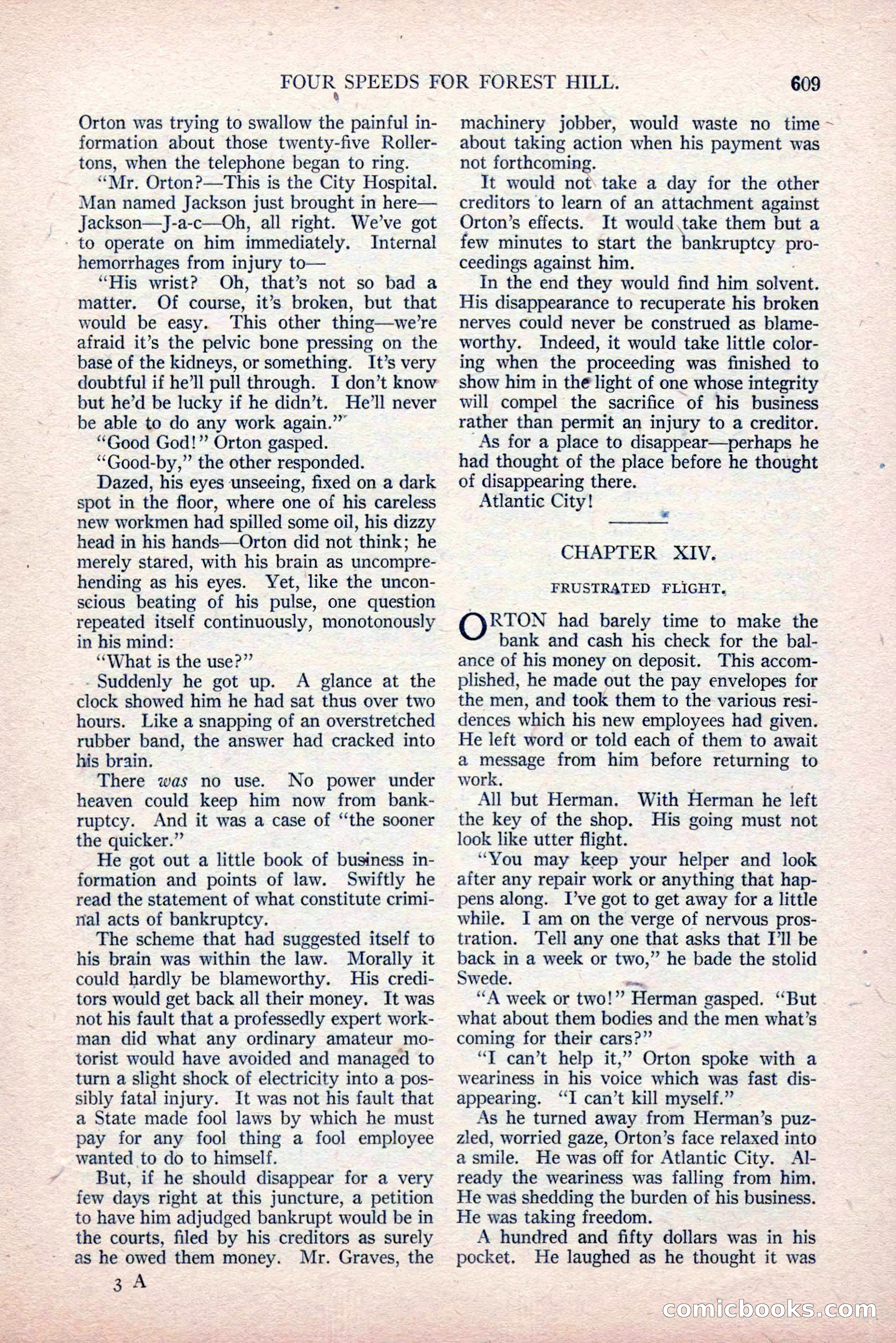
A restored page from Pulp Fiction, 1916. Page through the whole issue in the reader above.
📄 Transcribed text from this page (OCR, searchable)
Machine-transcribed from the original scan — historical spelling and the odd misread are preserved.
FOUR SPEEDS FOR FOREST HILL. Orton was trying to swallow the painful in- formation about those twenty-five Roller- tons, when the telephone began to ring. “Mr. Orton?—This is the City Hospital. Man named Jackson just brought in here— Jackson—J-a-c—Oh, all right. We’ve got - to operate on him immediately. Internal hemorrhages from injury to— “His wrist? Oh, that’s not so bad a matter. Of course, it’s broken, but that would be easy. This other thing—we’re afraid it’s the pelvic bone pressing on the base of the kidneys, or something. It’s very doubtful if he’ll pull through. I don’t know but he’d be lucky if he didn’t. He’ll never be able to do any work again.’”” “Good God!” Orton gasped. “Good-by,” the other responded. Dazed, his eyes unseeing, fixed on a dark spot in the floor, where one of his careless new workmen had spilled some oil, his dizzy head in his hands—Orton did not think; he merely stared, with his brain as uncompre- hending as his eyes. Yet, like the uncon- scious beating of his pulse, one question repeated itself continuously, monotonously in his mind: ‘What is the use?” - Suddenly he got up. A glance at the clock showed him he had sat thus over two hours. Like a snapping of an overstretched rubber band, the answer had cracked into his brain. There was no use. No power under heaven could keep him now from bank- ruptcy. And it was a case of “‘the sooner the quicker.” He got out a little book of business in- formation and points of law. Swiftly he read the statement of what constitute crimi- nal acts of bankruptcy. The scheme that had suggested itself to his brain was within the law. Morally it could hardly be blameworthy. His credi- tors would get back all their money. It was not his fault that a professedly expert work- man did what any ordinary amateur mo- torist would have avoided and managed to turn a slight shock of electricity into a pos- sibly fatal injury. It was not his fault that a State made fool laws by which he must pay for any fool thing a fool employee wanted to do to himself. But, if he should disappear for a very few days right at this juncture, a petition to have him adjudged bankrupt would be in the courts, filed by his creditors as surely as he owed them money. Mr. Graves, the 3 A 609 machinery jobber, would waste no time ~ about taking action when his payment was not forthcoming. It would not. take a day for the other creditors to learn of an attachment against Orton’s effects. It would take them but a few minutes to start the bankruptcy pro- ceedings against him. In the end they would find him solvent. His disappearance to recuperate his broken nerves could never be construed as blame- worthy. Indeed, it would take little color- ing when the proceeding was finished to show him in thé light of one whose integrity will compel the sacrifice of his business rather than permit an injury to a creditor. As for a place to disappear—perhaps he had thought of the place before he thought of disappearing there. Atlantic City! CHAPTER XIV. FRUSTRATED FLIGHT. QO 8TON had barely time to make the bank and cash his check for the bal- ance of his money on deposit. This accom- plished, he made out the pay envelopes for the men, and took them to the various resi- dences which his new employees had given. He left word or told each of them to await a message from him before returning to work, 3 All but Herman. With Herman he left the key of the shop. His going must not look like utter flight. “You may keep your helper and look after any repair work or anything that hap- pens along. I’ve got to get away for a little while. I am on the verge of nervous pros- tration. Tell any one that asks that Ill be back in a week or two,” he bade the stolid Swede. “A week or two!” Herman gasped. “But what about them bodies and the men what’s coming for their cars?” “Tt can’t help it,” Orton spoke with a weariness in his voice which was fast dis- appearing. “I can’t kill myself.” As he turned away from Herman’s puz- zied, worried gaze, Orton’s face relaxed into a smile. He was off for Atlantic City. Al- ready the weariness was falling from him. He was shedding the burden of his business. He was taking freedom. A hundred and fifty dollars was in his pocket. He laughed as he thought it was COPMICLOOKS (C@)