
Pulp Fiction, 1916 · page 41 of 216
The Argosy, Vol. 81, No. 4 — page 41: what you’re looking at
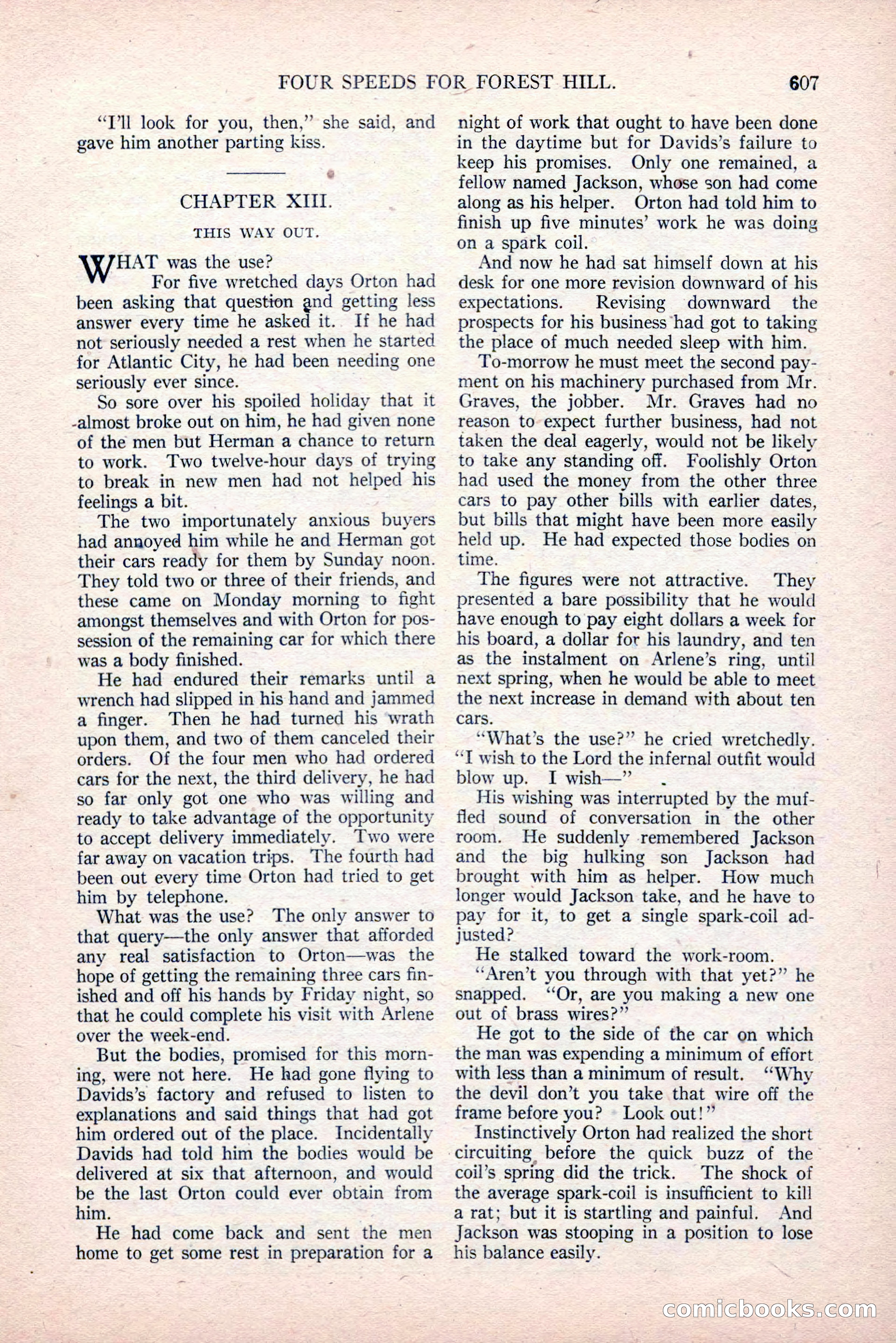
A restored page from Pulp Fiction, 1916. Page through the whole issue in the reader above.
📄 Transcribed text from this page (OCR, searchable)
Machine-transcribed from the original scan — historical spelling and the odd misread are preserved.
FOUR SPEEDS FOR FOREST HILL. “T’ll look for you, then,” she said, and gave him another parting kiss. CHAPTER XIII. THIS WAY OUT. HAT was the use? For five wretched days Orton had been asking that question and getting less answer every time he asked it. If he had not seriously needed a rest when he started for Atlantic City, he had been needing one seriously ever since. So sore over his spoiled holiday that it -almost broke out on him, he had given none of the men but Herman a chance to return to work. Two twelve-hour days of trying to break in new men had not helped his feelings a bit. The two importunately anxious buyers had annoyed him while he and Herman got their cars ready for them by Sunday noon. They told two or three of their friends, and these came on Monday morning to fight amongst themselves and with Orton for pos- session of the remaining car for which there was a body finished. He had endured their remarks until a wrench had slipped in his hand and jammed a finger. Then he had turned his wrath upon them, and two of them canceled their orders. Of the four men who had ordered cars for the next, the third delivery, he had so far only got one who was willing and ready to take advantage of the opportunity to accept delivery immediately. Two were far away on vacation trips. The fourth had been out every time Orton had tried to get him by telephone. What was the use? The only answer to that query—the only answer that afforded any real satisfaction to Orton—was the hope of getting the remaining three cars fin- ished and off his hands by Friday night, so that he could complete his visit with Arlene over the week-end. But the bodies, promised for this morn- ing, were not here. He had gone flying to Davids’s factory and refused to listen to explanations and said things that had got him ordered out of the place. Incidentally Davids had told him the bodies would be delivered at six that afternoon, and would be the last Orton could ever obtain from him. He had come back and sent the men home to get some rest in preparation for a 607 night of work that ought to have been done in the daytime but for Davids’s failure to keep his promises. Only one remained, a fellow named Jackson, whose son had come along as his helper. Orton had told him to finish up five minutes’ work he was doing on a spark coil. And now he had sat himself down at his desk for one more revision downward of his expectations. Revising downward the prospects for his business had got to taking the place of much needed sleep with him. To-morrow he must meet the second pay- ment on his machinery purchased from Mr. Graves, the jobber. Mr. Graves had no reason to expect further business, had not taken the deal eagerly, would not be likely to take any standing off. Foolishly Orton had used the money from the other three cars to pay other bills with earlier dates, but bills that might have been more easily held up. He had expected those bodies on time. The figures were not attractive. They presented a bare possibility that he would have enough to pay eight dollars a week for his board, a dollar for his laundry, and ten as the instalment on Arlene’s ring, until next spring, when he would be able to meet the next increase in demand with about ten cars. ‘“What’s the use?” he cried wretchedly. - ‘‘T wish to the Lord the infernal outfit would blow up. I wish—” . His wishing was interrupted by the muf- fled sound of conversation in the other room. He suddenly remembered Jackson and the big hulking son Jackson had brought with him as helper. How much longer would Jackson take, and he have to pay for it, to get a single spark-coil ad- justed? He stalked toward the work-room. ‘‘Aren’t you through with that yet?” he snapped. “Or, are you making a new one out of brass wires?” He got to the side of the car on which the man was expending a minimum of effort with less than a minimum of result. “Why the devil don’t you take that wire off the frame before you? © Look out!” Instinctively Orton had realized the short circuiting before the quick buzz of the coil’s spring did the trick. The shock of the average spark-coil is insufficient to kill a rat; but it is startling and painful. And Jackson was stooping in a position to lose his balance easily. ECOPNICLOOOLK< (E@)