
Pulp Fiction, 1916 · page 39 of 216
The Argosy, Vol. 81, No. 4 — page 39: what you’re looking at
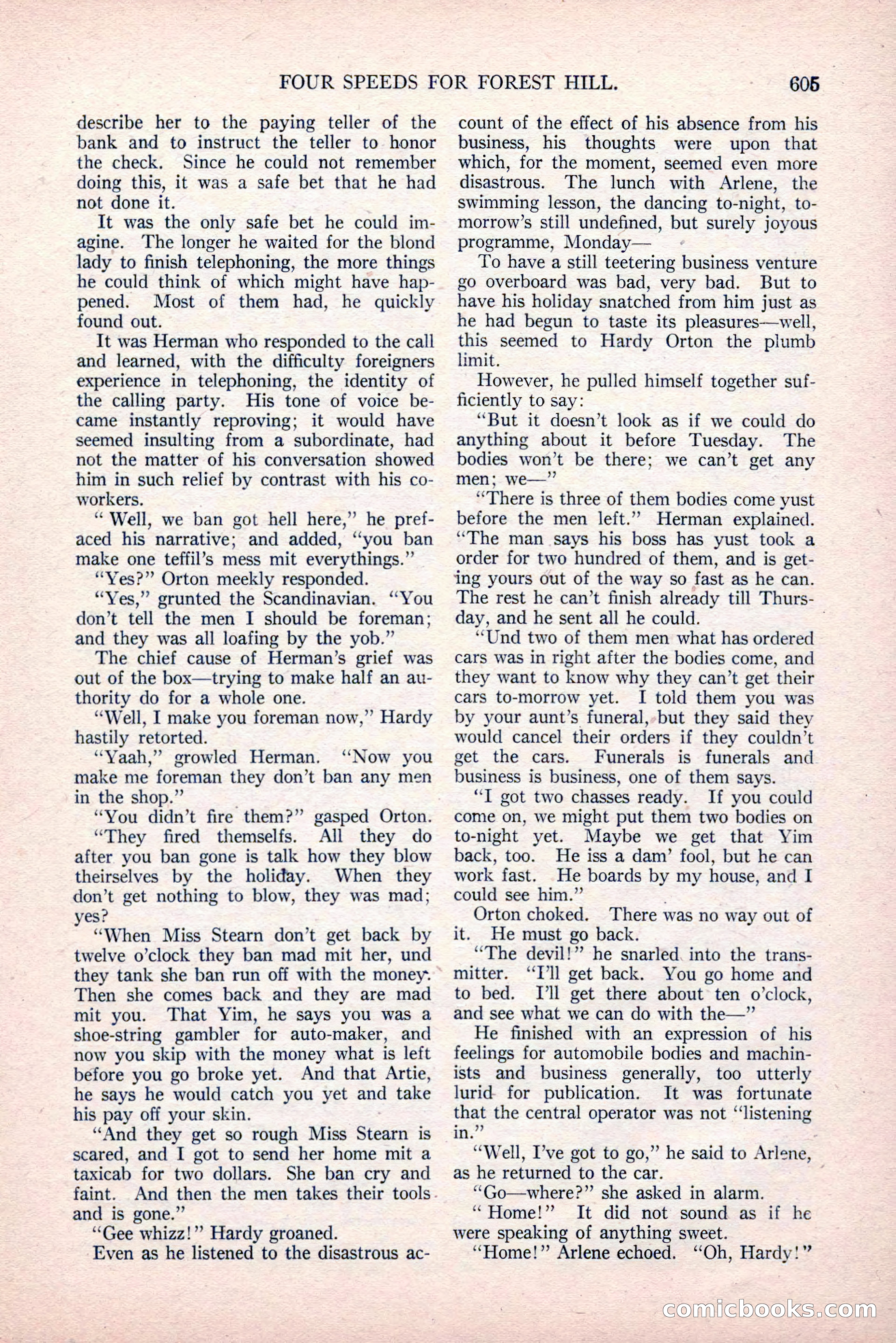
A restored page from Pulp Fiction, 1916. Page through the whole issue in the reader above.
📄 Transcribed text from this page (OCR, searchable)
Machine-transcribed from the original scan — historical spelling and the odd misread are preserved.
FOUR SPEEDS FOR FOREST HILL. describe her to the paying teller of the bank and to instruct the teller to honor the check. Since he could not remember doing this, it was a safe bet that he had not done it. It was the only safe bet he could im- agine. ‘The longer he waited for the blond lady to finish telephoning, the more things he could think of which might have hap- pened. Most of them had, he quickly found out. It was Herman who responded to the call and learned, with the difficulty foreigners experience in telephoning, the identity of the calling party. His tone of voice be- came instantly reproving; it would have seemed insulting from a subordinate, had not the matter of his conversation showed him in such relief by contrast with his co- workers. “ Well, we ban got hell here,” he pref- aced his narrative; and added, “you ban make one teffil’s mess mit everythings.” “Yes?” Orton meekly responded. “Ves,” grunted the Scandinavian. “You don’t tell the men I should be foreman; and they was all loafing by the yob.” The chief cause of Herman’s grief was out of the box—trying to make half an au- thority do for a whole one. “Well, I make you foreman now,” Hardy hastily retorted. “Vaah,” growled Herman. ‘‘Now you make me foreman they don’t ban any men in the shop.” “Vou didn’t fire them?” gasped Orton. “They fired themselfs. All they do after you ban gone is talk how they blow theirselves by the holiday. When they don’t get nothing to blow, they was mad; yes? “When Miss Stearn don’t get back by twelve o’clock they ban mad mit her, und they tank she ban run off with the money. Then she comes back and they are mad mit you. That Yim, he says you was a shoe-string gambler for auto-maker, and now you skip with the money what is left before you go broke yet. And that Artie, he says he would catch you yet and take his pay off your skin. “And they get so rough Miss Stearn is scared, and I got to send her home mit a taxicab for two dollars. She ban cry and faint. and is gone.” “Gee whizz!” Hardy groaned. Even as he listened to the disastrous ac- And then the men takes their tools- count of the effect of his absence from his business, his thoughts were upon that which, for the moment, seemed even more disastrous. The lunch with Arlene, the swimming lesson, the dancing to-night, to- morrow’s still undefined, but surely joyous programme, Monday—_ To have a still teetering business venture go overboard was bad, very bad. But to have his holiday snatched from him just as he had begun to taste its pleasures—vwell, this seemed to Hardy Orton the plumb limit. However, he pulled himself together suf- ficiently to say: “But it doesn’t look as if we could do anything about it before Tuesday. The bodies won’t be there; we can’t get any men; we—”’ ‘There is three of them bodies come yust before the men left.””’ Herman explained. ‘The man says his boss has yust took a order for two hundred of them, and is get- ing yours out of the way so fast as he can. The rest he can’t finish already till Thurs- 3 day, and he sent all he could. ‘Und two of them men what has ordered cars was in right after the bodies come, and they want to know why they can’t get their cars to-morrow yet. I told them you was by your aunt’s funeral,-but they said they would cancel their orders if they couldn’t get the cars. Funerals is funerals and business is business, one of them says. “I got two chasses ready. If you could come on, we might put them two bodies on to-night yet. Maybe we get that Yim back, too. He iss a dam’ fool, but he can work fast. He boards by my house, and I could see him.” Orton choked. There was no way out of it. He must go back. “The devil!” he snarled. into the trans- mitter. “I'll get back. You go home and to bed. I'll get there about ten o’clock, and see what we can do with the—” He finished with an expression of his feelings for automobile bodies and machin- ists and business generally, too utterly lurid for publication. It was fortunate that the central operator was not “‘listening ag “Well, I’ve got to go,” he said to Arlene, as he returned to the car. ‘“Go—where?” she asked in alarm. “Home!” It did not sound as if he were speaking of anything sweet. “Home!” Arlene echoed. “Oh, Hardy!” CORNICLOOKS 605 (C@)