
Pulp Fiction, 1916 · page 36 of 216
The Argosy, Vol. 81, No. 4 — page 36: what you’re looking at
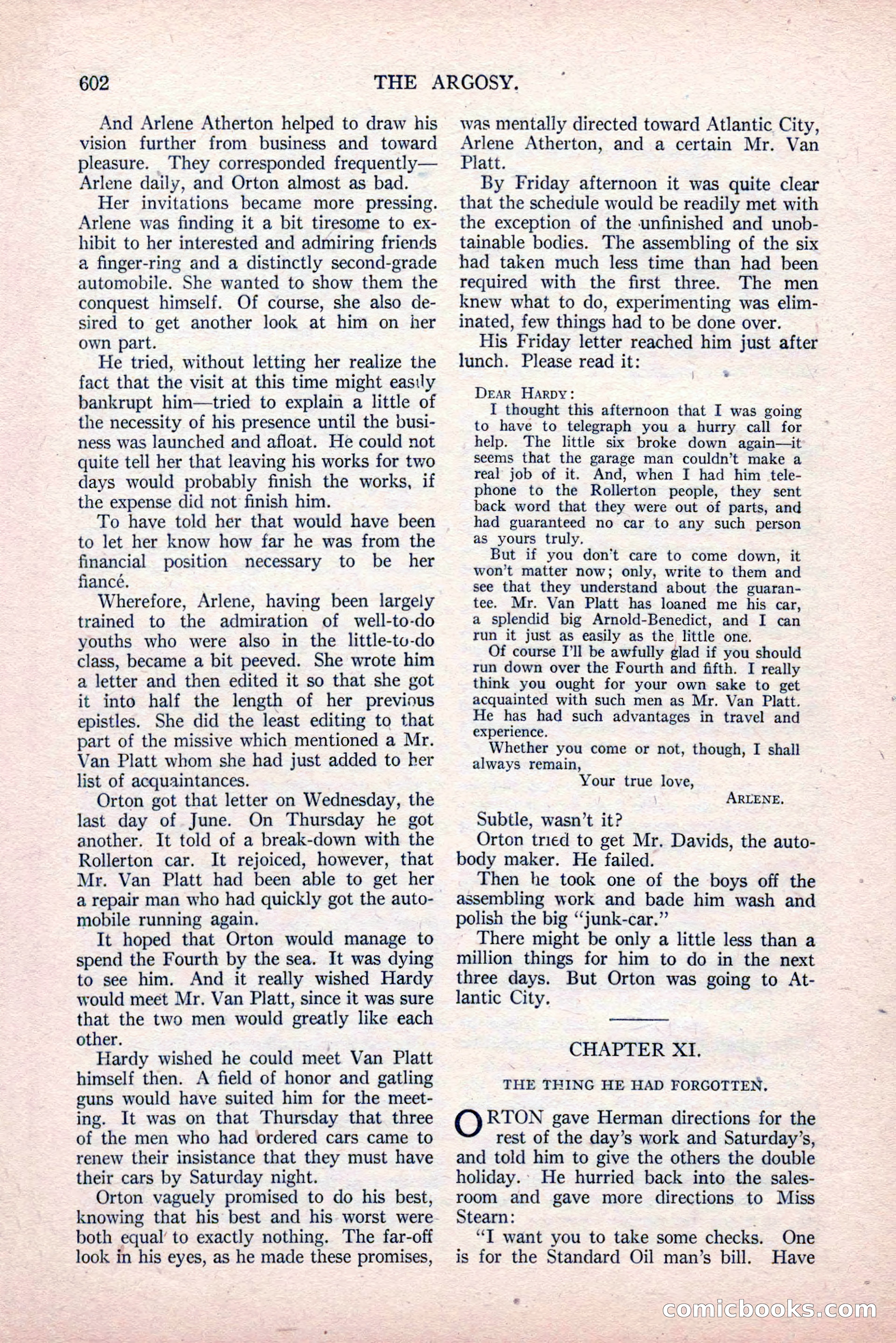
A restored page from Pulp Fiction, 1916. Page through the whole issue in the reader above.
📄 Transcribed text from this page (OCR, searchable)
Machine-transcribed from the original scan — historical spelling and the odd misread are preserved.
602 And Arlene Atherton helped to draw his vision further from business and toward pleasure. They corresponded frequently— Arlene daily, and Orton almost as bad. Her invitations became more pressing. Arlene was finding it a bit tiresome to ex- hibit to her interested and admiring friends a finger-ring and a distinctly second-grade automobile. She wanted to show them the conquest himself. Of course, she also de- sired to get another look at him on her own part. He tried, without letting her realize the fact that the visit at this time might easily bankrupt him—tried to explain a little of the necessity of his presence until the busi- ness was launched and afloat. He could not quite tell her that leaving his works for two days would probably finish the works, if the expense did not finish him. To have told her that would have been to let her know how far he was from the financial position necessary to be her flance. Wherefore, Arlene, having been largely trained to the admiration of well-to-do youths who were also in the little-to-do class, became a bit peeved. She wrote him a letter and then edited it so that she got it into half the length of her previous epistles. She did the least editing to that part of the missive which mentioned a Mr. Van Platt whom she had just added to her list of acquaintances. Orton got that letter on Wednesday, the last day of June. On Thursday he got another. It told of a break-down with the Rollerton car. It rejoiced, however, that Mr. Van Platt had been able to get her a repair man who had quickly got the auto- mobile running again. It hoped that Orton would manage to spend the Fourth by the sea. It was dying to see him. And it really wished Hardy would meet Mr. Van Platt, since it was sure that the two men would greatly like each other. Hardy wished he could meet Van Platt himself then. A field of honor and gatling guns would have suited him for the meet- ing. It was on that Thursday that three of the men who had ordered cars came to renew their insistance that they must have their cars by Saturday night. Orton vaguely promised to do his best, knowing that his best and his worst were both equal’ to exactly nothing. The far-off look in his eyes, as he made these promises, THE ARGOSY. was mentally directed toward Atlantic City, Arlene Atherton, and a certain Mr. Van Platt. By Friday afternoon it was quite clear that the schedule would be readily met with the exception of the unfinished and unob- tainable bodies. The assembling of the six had taken much less time than had been required with the first three. The men knew what to do, experimenting was elim- inated, few things had to be done over. His Friday letter reached him just after lunch. Please read it: Dear Harpy: I thought this afternoon that I was going to have to telegraph you a hurry call for help. The little six broke down again—it seems that the garage man couldn’t make a real job of it. And, when I had him tele- phone to the Rollerton people, they sent back word that they were out of parts, and had guaranteed no car to any such person as yours truly. But if you don’t care to come down, it won’t matter now; only, write to them and see that they understand about the guaran- tee. Mr. Van Platt has loaned me his car, a splendid big Arnold-Benedict, and I can run it just as easily as the little one. Of course I'll be awfully glad if you should run down over the Fourth and fifth. I really think you ought for your own sake to get acquainted with such men as Mr. Van Platt. He has had such advantages in travel and experience. Whether you come or not, though, I shall always remain, Your true love, ARLENE, Subtle, wasn’t it? Orton tried to get Mr. Davids, the auto- body maker. He failed. Then he took one of the boys off the assembling work and bade him wash and polish the big “‘junk-car.”’ There might be only a little less than a million things for him to do in the next three days. But Orton was going to At- lantic City. CHAPTER XI, THE THING HE HAD FORGOTTEN, RTON gave Herman directions for the rest of the day’s work and Saturday’s, and told him to give the others the double holiday.. He hurried back into the sales- room and gave more directions to Miss Stearn: “T want you to take some checks. One is for the Standard Oil man’s bill. Have EOPMIELOOOKS (E@)