
Pulp Fiction, 1916 · page 24 of 216
The Argosy, Vol. 81, No. 4 — page 24: what you’re looking at
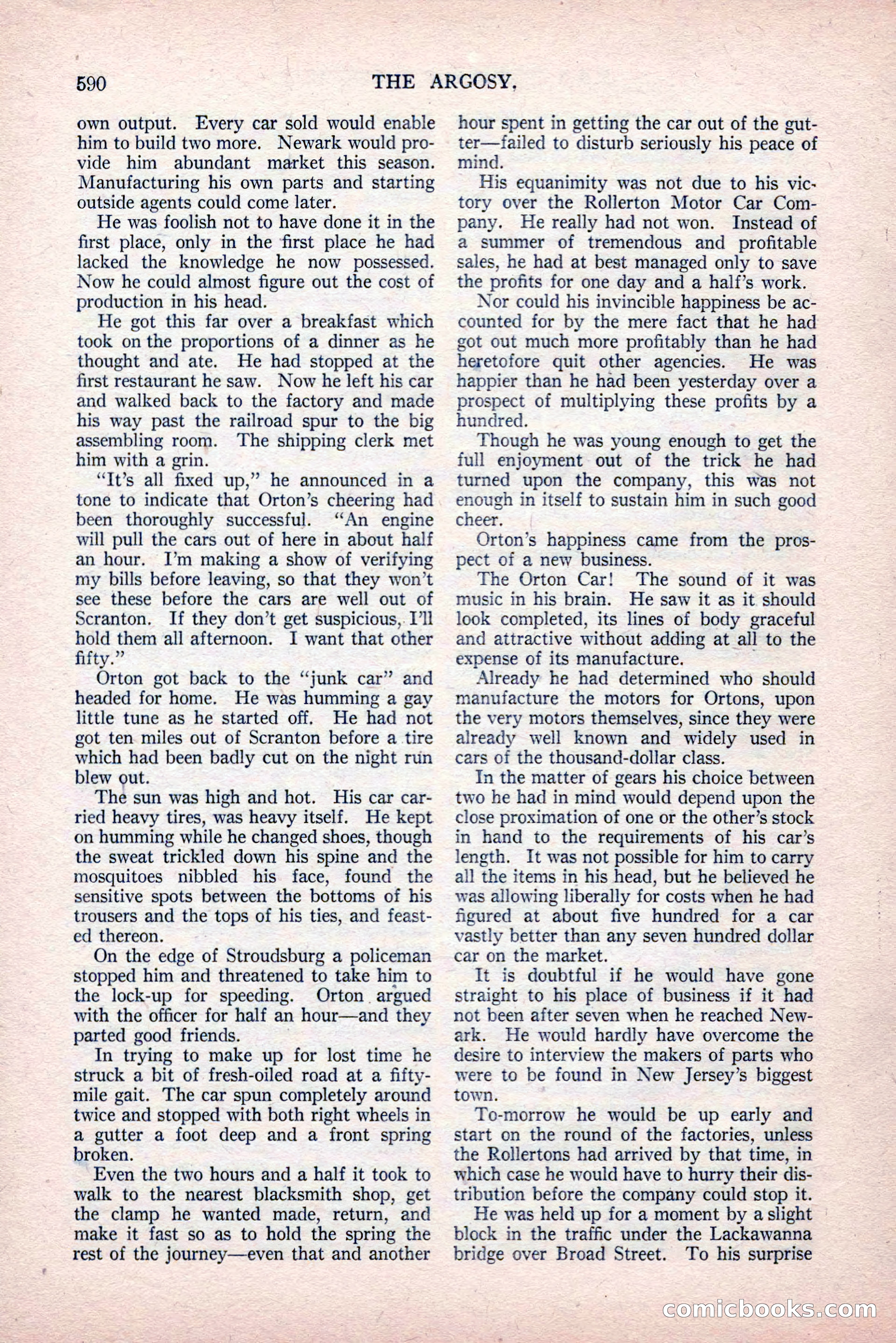
A restored page from Pulp Fiction, 1916. Page through the whole issue in the reader above.
📄 Transcribed text from this page (OCR, searchable)
Machine-transcribed from the original scan — historical spelling and the odd misread are preserved.
590 own output. Every car sold would enable him to build two more. Newark would pro- vide him abundant market this season. Manufacturing his own parts and starting outside agents could come later. He was foolish not to have done it in the first place, only in the first place he had lacked the knowledge he now possessed. Now he could almost figure out the cost of production in his head. He got this far over a breakfast which took on the proportions of a dinner as he thought and ate. He had stopped at the first restaurant he saw. Now he left his car and walked back to the factory and made his way past the railroad spur to the big assembling room. The shipping clerk met him with a grin. “Tt’s all fixed up,” he announced in a tone to indicate that Orton’s cheering had been thoroughly successful. “An engine will pull the cars out of here in about half an hour. I’m making a show of verifying my bills before leaving, so that they won’t see these before the cars are well out of Scranton. If they don’t get suspicious,. I'll hold them all afternoon. I want that other fifty.” Orton got back to the “junk car” and headed for home. He was humming a gay little tune as he started off. He had not got ten miles out of Scranton before a tire which had been badly cut on the night run blew out. The sun was high and hot. His car car- ried heavy tires, was heavy itself. He kept on humming while he changed shoes, though the sweat trickled down his spine and the mosquitoes nibbled his face, found the sensitive spots between the bottoms of his trousers and the tops of his ties, and feast- ed thereon. On the edge of Stroudsburg a policeman stopped him and threatened to take him to the lock-up for speeding. Orton argued with the officer for half an hour—and they parted good friends. In trying to make up for lost time he struck a bit of fresh-oiled road at a fifty- mile gait. The car spun completely around twice and stopped with both right wheels in a gutter a foot deep and a front spring broken. Even the two hours and a half it took to walk to the nearest blacksmith shop, get the clamp he wanted made, return, and make it fast so as to hold the spring the rest of the journey—even that and another THE ARGOSY, hour spent in getting the car out of the gut- ter—failed to disturb seriously his peace of mind. His equanimity was not due to his vic- tory over the Rollerton Motor Car Com- pany. He really had not won. Instead of a summer of tremendous and profitable sales, he had at best managed only to save the profits for one day and a half’s work. Nor could his invincible happiness be ac- counted for by the mere fact that he had got out much more profitably than he had heretofore quit other agencies. He was happier than he had been yesterday over a prospect of multiplying these profits by a hundred. Though he was young enough to get the full enjoyment out of the trick he had turned upon the company, this was not enough in itself to sustain him in such good cheer. Orton’s happiness came from the pros- pect of a new business. The Orton Car! The sound of it was music in his brain. He saw it as it should look completed, its lines of body graceful and attractive without adding at all to the expense of its manufacture. Already he had determined who should manufacture the motors for Ortons, upon the very motors themselves, since they were already well known and widely used in cars of the thousand-dollar class. In the matter of gears his choice between two he had in mind would depend upon the close proximation of one or the other’s stock in hand to the requirements of his car’s length. It was not possible for him to carry all the items in his head, but he believed he was allowing liberally for costs when he had figured at about five hundred for a car vastly better than any seven hundred dollar car on the market. It is doubtful if he would have gone straight to his place of business if it had not been after seven when he reached New- ark. He would hardly have overcome the desire to interview the makers of parts who were to be found in New Jersey’s biggest town. To-morrow he would be up early and start on the round of the factories, unless the Rollertons had arrived by that time, in which case he would have to hurry their dis- tribution before the company could stop it. He was held up for a moment by a slight block in the traffic under the Lackawanna bridge over Broad Street. To his surprise EOPMICLOOOKS (E@)