
Pulp Fiction, 1916 · page 200 of 216
The Argosy, Vol. 81, No. 4 — page 200: what you’re looking at
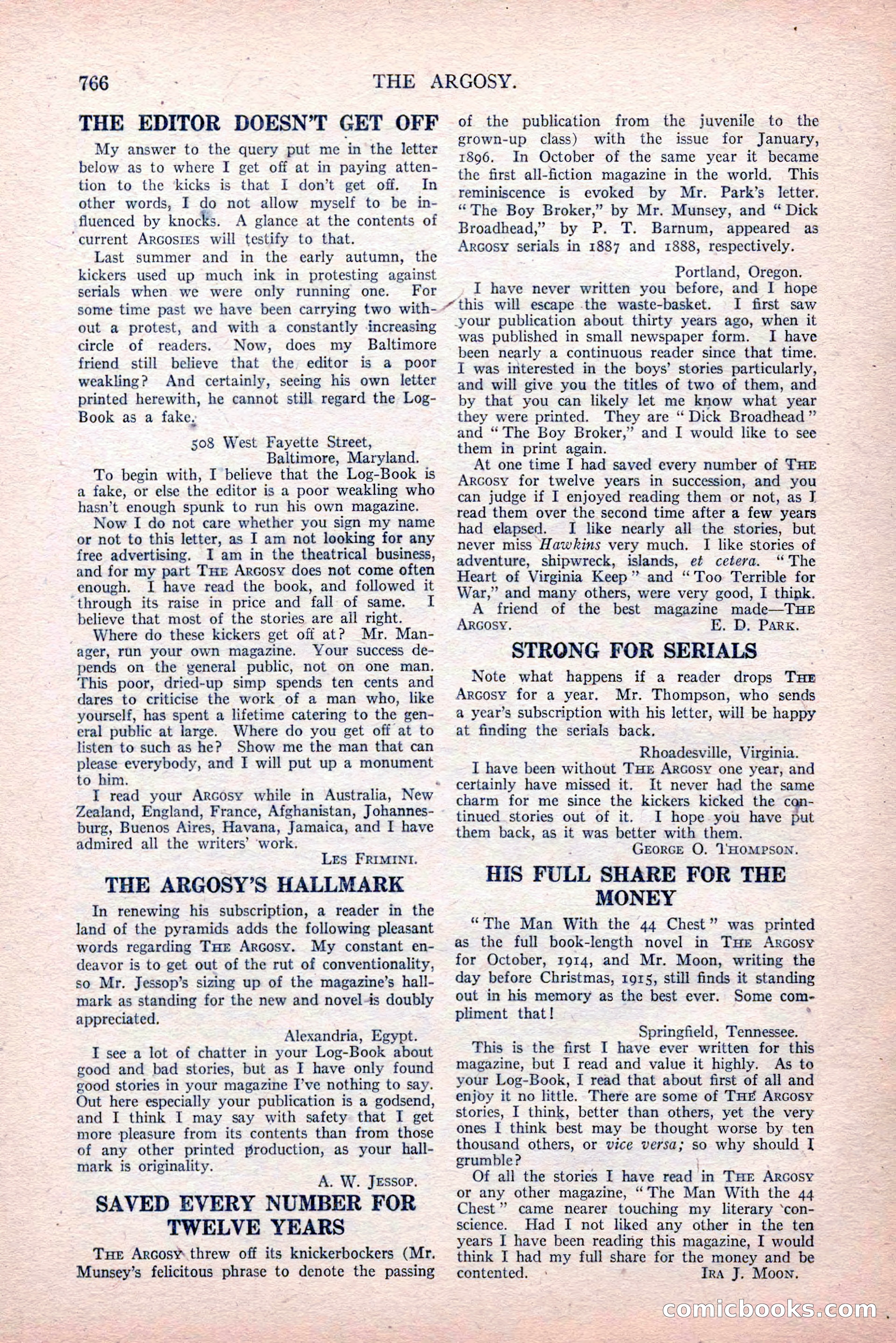
A restored page from Pulp Fiction, 1916. Page through the whole issue in the reader above.
📄 Transcribed text from this page (OCR, searchable)
Machine-transcribed from the original scan — historical spelling and the odd misread are preserved.
766 THE EDITOR DOESN’T GET OFF My answer to the query put me in the letter below as to where I get off at in paying atten- tion to the ‘kicks is that I don’t get off. In other words, I do not allow myself to be in- fluenced by knocks. A glance at the contents of ‘current Arcosies will testify to that. Last summer and in the early autumn, the kickers used up much ink in protesting against serials when we were only running one. For some time past we have been carrying two with- out a protest, and with a constantly increasing circle of readers. Now, does my Baltimore friend still believe that the editor is a poor weakling? And certainly, seeing his own leiter printed herewith, he cannot still regard the Log- Book as a fake, 508 West Fayette Street, Baltimore, Maryland. To begin with, I believe that the Log-Book is a fake, or else the editor is a poor weakling who hasn’t enough spunk to run his own magazine. Now I do not care whether you sign my name or not to this letter, as I am not looking for any free advertising. I am in the theatrical business, and for my part THe Arcosy does not come often enough. I have read the book, and followed it ‘through its raise in price and fall of same. I believe that most of the stories are all right. Where do these kickers get off at? Mr. Man- ager, run your own magazine. Your success de- pends on the general public, not on one man. This poor, dried-up simp spends ten cents and dares to criticise the work of a man who, like yourself, has spent a lifetime catering to the gen- eral public at large. Where do you get off at to listen to such as he? Show me the man that can please everybody, and I will put up a monument to him. I read your Arcosy while in Australia, New Zealand, England, France, Afghanistan, Johannes- burg, Buenos Aires, Havana, Jamaica, and I have admired all the writers’ ‘work. LEs FRIMINI. THE ARGOSY’S HALLMARK In renewing his subscription, a reader in the land of the pyramids adds the following pleasant words regarding THe Arcosy. My constant en- deavor is to get out of the rut of conventionality, so Mr. Jessop’s sizing up of the magazine’s hall- mark as standing for the new and novel-is doubly appreciated. Alexandria, Egypt. IT see a lot of chatter in your Log-Book about good and bad stories, but as I have only found good stories in your magazine I’ve nothing to say. Out here especially your publication is a godsend, and I think I may say with safety that I get more pleasure from its contents than from those of any other printed production, as your hall- mark is originality. A. W. JEssop. SAVED EVERY NUMBER FOR TWELVE YEARS Tue Arcosy threw off its knickerbockers (Mr. Munsey’s felicitous phrase to denote the passing “this will escape the waste-basket. -your publication about thirty years ago, when it THE ARGOSY. of the publication from the juvenile to the grown-up class) with the issue for January, 1896. In October of the same year it became the first all-fiction magazine in the world. This reminiscence is evoked by Mr. Park’s letter. “The Boy Broker,” by Mr. Munsey, and “ Dick Broadhead,” by P. T. Barnum, appeared as Arcosy serials in 1887 and 1888, respectively. Portland, Oregon, I have never written you before, and I hope I first saw was published in small newspaper form. I have been nearly a continuous reader since that time. I was interested in the boys’ stories particularly, and will give you the titles of two of them, and by that you can likely let me know what year they were printed. They are “ Dick Broadhead ” and “ The Boy Broker,” and I would like to see them in print again. At one time I had saved every number of THE Arcosy for twelve years in succession, and you can judge if I enjoyed reading them or not, as J read them over the second time after a few years had elapsed. I like nearly all the stories, but never miss Hawkins very much. I like stories of adventure, shipwreck, islands, et cetera. “‘ The Heart of Virginia Keep” and “Too Terrible for War,” and many others, were very good, I think. A friend of the best magazine made—THE ARGOSY, E. D. Park. STRONG FOR SERIALS Note what happens if a reader drops THE Arcosy for a year. Mr. Thompson, who sends a year’s subscription with his letter, will be happy at finding the serials back. Rhoadesville, Virginia. I have been without THe Arcosy one year, and certainly have missed it. It never had the same charm for me since the kickers kicked the cqn- tinued stories out of it. I hope you have put them back, as it was better with them. GEORGE O. T'HOMPSON. HIS FULL SHARE FOR THE MONEY “The Man With the 44 Chest” was printed as the full book-length novel in Tue Arscosy for October, 1914, and Mr. Moon, writing the day before Christmas, 1915, still finds it standing out in his memory as the best ever. Some com- pliment that! , Springfield, Tennessee. This is the first I have ever written for this magazine, but I read and value it highly. As to your Log-Book, I read that about first of all and enjoy it no little. There are some of THE Arcosy stories, I think, better than others, yet the very ones I think best may be thought worse by ten thousand others, or vice versa; so why should I grumble? ' Of all the stories I have read in THE Arcosy or any other magazine, “The Man With the 44 Chest” came nearer touching my literary ‘con- science. Had I not liked any other in the ten years I have been reading this magazine, I would think I had my full share for the money and be contented. Ira J. Moon. Gomichbooks (E(0)