
Pulp Fiction, 1916 · page 197 of 216
The Argosy, Vol. 81, No. 4 — page 197: what you’re looking at
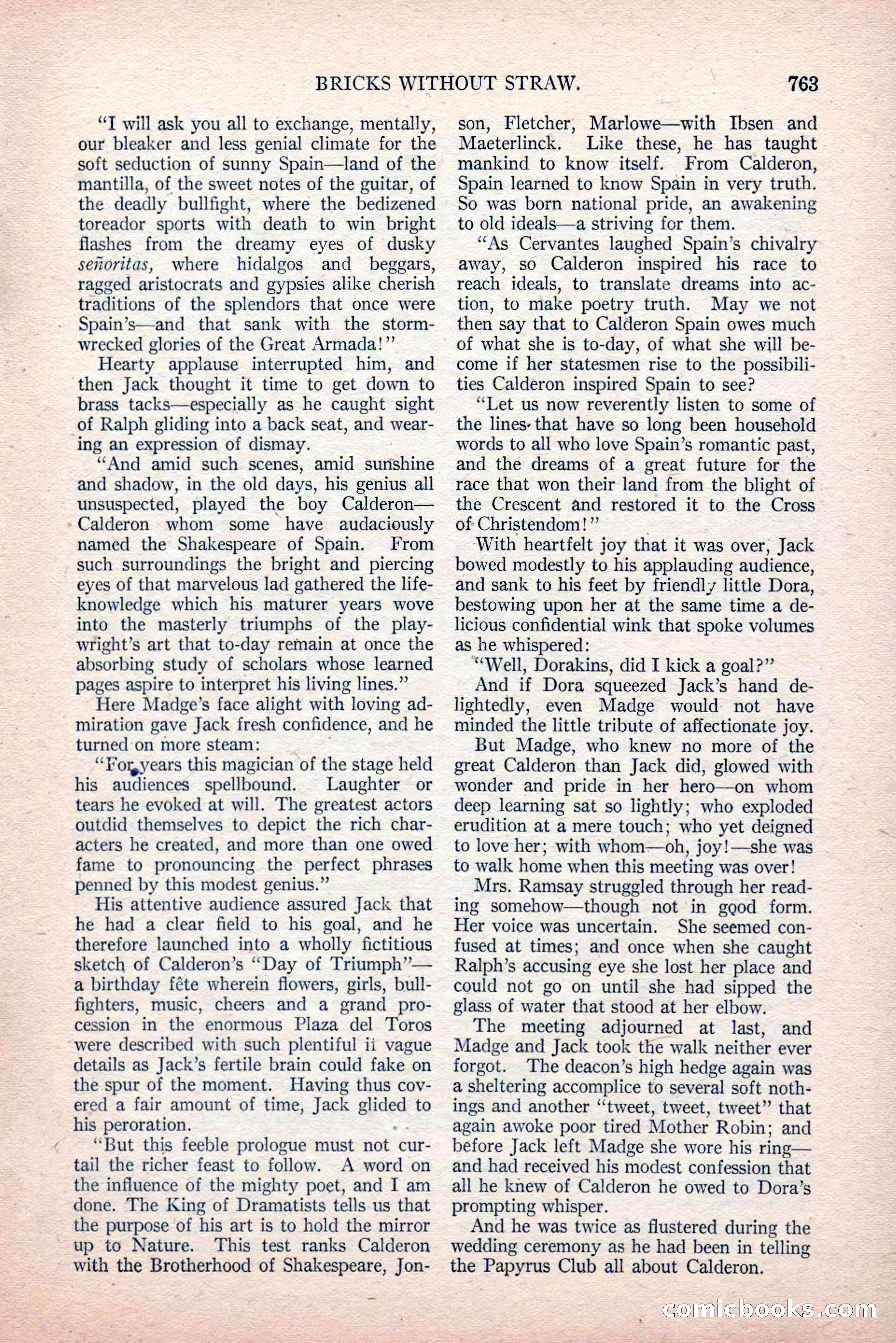
A restored page from Pulp Fiction, 1916. Page through the whole issue in the reader above.
📄 Transcribed text from this page (OCR, searchable)
Machine-transcribed from the original scan — historical spelling and the odd misread are preserved.
BRICKS WITHOUT STRAW. “T will ask you all to exchange, mentally, our bleaker and less genial climate for the soft seduction of sunny Spain—land of the mantilla, of the sweet notes of the guitar, of the deadly bullfight, where the bedizened toreador sports with death to win bright flashes from the dreamy eyes of dusky senoritas, where hidalgos and_ beggars, ragged aristocrats and gypsies alike cherish traditions of the splendors that once were Spain’s—and that sank with the storm- wrecked glories of the Great Armada!”’ Hearty applause interrupted him, and then Jack thought it time to get down to brass tacks—especially as he caught sight of Ralph gliding into a back seat, and wear- ing an expression of dismay. “And amid such scenes, amid sunshine and shadow, in the old days, his genius all unsuspected, played the boy Calderon— Calderon whom some have audaciously named the Shakespeare of Spain. From such surroundings the bright and piercing eyes of that marvelous lad gathered the life- knowledge which his maturer years wove into the masterly triumphs of the play- wright’s art that to-day remain at once the absorbing study of scholars whose learned pages aspire to interpret his living lines.” Here Madge’s face alight with loving ad- miration gave Jack fresh confidence, and he turned on more steam: “Foryears this magician of the stage held his audiences spellbound. Laughter or tears he evoked at will. The greatest actors outdid themselves to depict the rich char- acters he created, and more than one owed fame to pronouncing the perfect phrases penned by this modest genius.” His attentive audience assured Jack that he had a clear field to his goal, and he therefore launched into a wholly fictitious sketch of Calderon’s “Day of Triumph”— a birthday féte wherein flowers, girls, bull- fighters, music, cheers and a grand pro- cession in the enormous Plaza del Toros were described with such plentiful ii vague details as Jack’s fertile brain could fake on the spur of the moment. Having thus cov- ered a fair amount of time, Jack glided to his peroration. “But this feeble prologue must not” cur- tail the richer feast to follow. A word on the influence of the mighty poet, and I am done. The King of Dramatists tells us that the purpose of his art is to hold the mirror up to Nature. This test ranks Calderon with the Brotherhood of Shakespeare, Jon- 763 Marlowe—with Ibsen and Maeterlinck. Like these, he has taught mankind to know itself. From Calderon, Spain learned to know Spain in very truth. So was born national pride, an awakening to old ideals—a striving for them. ‘““As Cervantes laughed Spain’s chivalry away, so Calderon inspired his race to reach ideals, to translate dreams into ac- tion, to make poetry truth. May we not then say that to Calderon Spain owes much of what she is to-day, of what she will be- come if her statesmen rise to the possibili- ties Calderon inspired Spain to see? “Let us now reverently listen to some of the lines: that have so long been household words to all who love Spain’s romantic past, and the dreams of a great future for the race that won their land from the blight of the Crescent and restored it to the Cross of Christendom!” With heartfelt joy that it was over, Jack bowed modestly to his applauding audience, and sank to his feet by friend], little Dora, bestowing upon her at the same time a de- licious confidential wink that spoke volumes as he whispered: “Well, Dorakins, did I kick a goal?” And if Dora squeezed Jack’s hand de- lightedly, even Madge would not have minded the little tribute of affectionate joy. But Madge, who knew no more of the great Calderon than Jack did, glowed with wonder and pride in her hero—on whom deep learning sat so lightly; who exploded erudition at a mere touch; who yet deigned to love her; with whom—oh, joy!—she was to walk home when this meeting was over! Mrs. Ramsay struggled through her read- ing somehow—though not in good form. Her voice was uncertain. She seemed con- fused at times; and once when she caught Ralph’s accusing eye she lost her place and could not go on until she had sipped the glass of water that stood at her elbow. The meeting adjourned at last, and Madge and Jack took the walk neither ever forgot. The deacon’s high hedge again was a sheltering accomplice to several soft noth- ings and another ‘tweet, tweet, tweet” that again awoke poor tired Mother Robin; and before Jack left Madge she wore his ring— and had received his modest confession that all he knew of Calderon he owed to Dora’s prompting whisper. And he was twice as flustered during the wedding ceremony as he had been in telling the Papyrus Club all about Calderon. son, Fletcher, GEomichbooks (E@)