
Pulp Fiction, 1916 · page 18 of 216
The Argosy, Vol. 81, No. 4 — page 18: what you’re looking at
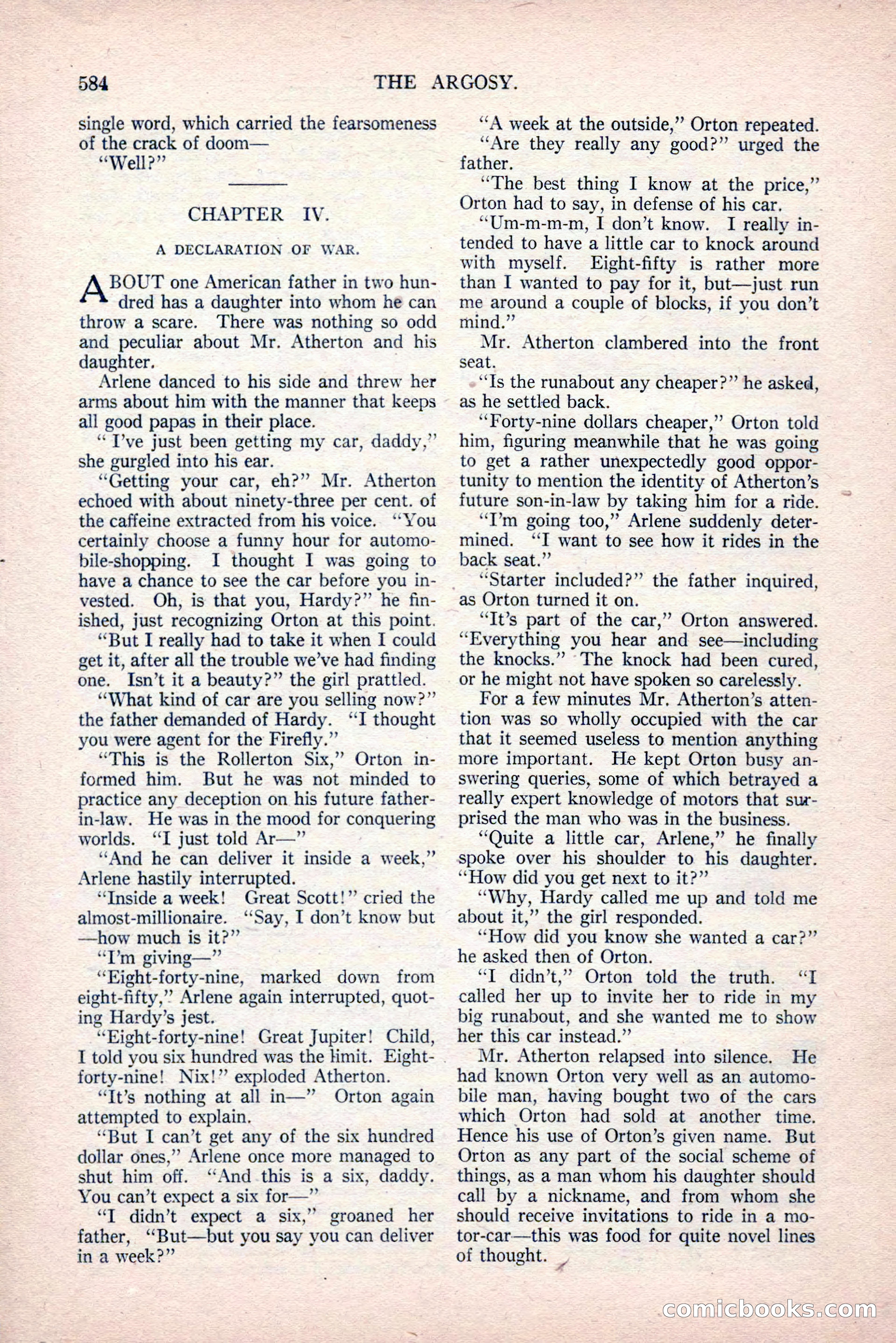
A restored page from Pulp Fiction, 1916. Page through the whole issue in the reader above.
📄 Transcribed text from this page (OCR, searchable)
Machine-transcribed from the original scan — historical spelling and the odd misread are preserved.
584 single word, which carried the fearsomeness of the crack of doom— “Well?” CHAPTER IV. A DECLARATION OF WAR. BOUT one American father in two hun- dred has a daughter into whom he can throw a scare. There was nothing so odd and peculiar about Mr. Atherton and his daughter. Arlene danced to his side and threw her arms about him with the manner that keeps all good papas in their place. ‘“T’ve just been getting my car, daddy,” she gurgled into his ear. “Getting your car, eh?” Mr. Atherton echoed with about ninety-three per cent. of the caffeine extracted from his voice. ‘*You certainly choose a funny hour for automo- bile-shopping. I thought I was going to have a chance to see the car before you in- vested. Oh, is that you, Hardy?” he fin- ished, just recognizing Orton at this point. “But I really had to take it when I could get it, after all the trouble we’ve had finding one. Isn’t it a beauty?” the girl prattled. “What kind of car are you selling now?” the father demanded of Hardy. “I thought you were agent for the Firefly.”’ “This is the Rollerton Six,” Orton in- formed him. But he was not minded to practice any deception on his future father- in-law. He was in the mood for conquering worlds. “TI just told Ar—” ‘And he can deliver it inside a week,” Arlene hastily interrupted. “Inside a week! Great Scott!” cried the almost-millionaire. “Say, I don’t know but —how much is it?” “Tm giving—”’ “FEight-forty-nine, marked down from eight-fifty,” Arlene again interrupted, quot- ing Hardy’s jest. ‘“Eight-forty-nine! Great Jupiter! Child, I told you six hundred was the mit. Eight- forty-nine! Nix!” exploded Atherton. “Tt’s nothing at all in—” Orton again attempted to explain. “But I can’t get any of the six hundred dollar ones,”’ Arlene once more managed to shut him off. ‘“‘And this is a six, daddy. You can’t expect a six for—”’ “T didn’t expect a six,” groaned her father, ‘“But—but you say you can deliver in a week?” THE ARGOSY. ‘““A week at the outside,” Orton repeated. ‘‘Are they really any good?” urged the father. ‘The best thing I know at the price,” Orton had to say, in defense of his car. ‘“Um-m-m-m, I don’t know. I really in- tended to have a little car to knock around with myself. Eight-fifty is rather more than I wanted to pay for it, but—just run me around a couple of blocks, if you don’t mind.” : Mr. Atherton clambered into the front seat. ‘‘Is the runabout any cheaper?” he asked, as he settled back. ‘Forty-nine dollars cheaper,” Orton told him, figuring meanwhile that he was going to get a rather unexpectedly good oppor- tunity to mention the identity of Atherton’s future son-in-law by taking him for a ride. ‘I’m going too,” Arlene suddenly deter- mined. ‘I want to see how it rides in the back seat.” “Starter included?” the father inquired, as Orton turned it on. ‘It’s part of the car,” Orton answered. “Everything you hear and see—including the knocks.” The knock had been cured, or he might not have spoken so carelessly. For a few minutes Mr. Atherton’s atten- tion was so wholly occupied with the car that it seemed useless to mention anything more important. He kept Orton busy an- swering queries, some of which betrayed a really expert knowledge of motors that sur- prised the man who was in the business. “Quite a little car, Arlene,” he finally spoke over his shoulder to his daughter. ‘“How did you get next to it?” “Why, Hardy called me up and told me about it,” the girl responded. ‘How did you know she wanted a car?” he asked then of Orton. “T didn’t,” Orton told the truth. “I called her up to invite her to ride in my big runabout, and she wanted me to show her this car instead.”’ Mr. Atherton relapsed into silence. He had known Orton very well as an automo- bile man, having bought two of the cars which Orton had sold at another time. Hence his use of Orton’s given name. But Orton as any part of the social scheme of things, as a man whom his daughter should call by a nickname, and from whom she should receive invitations to ride in a mo- tor-car—this was food for quite novel lines of thought. _ CONRMEDOOKS CO!