
Pulp Fiction, 1916 · page 172 of 216
The Argosy, Vol. 81, No. 4 — page 172: what you’re looking at
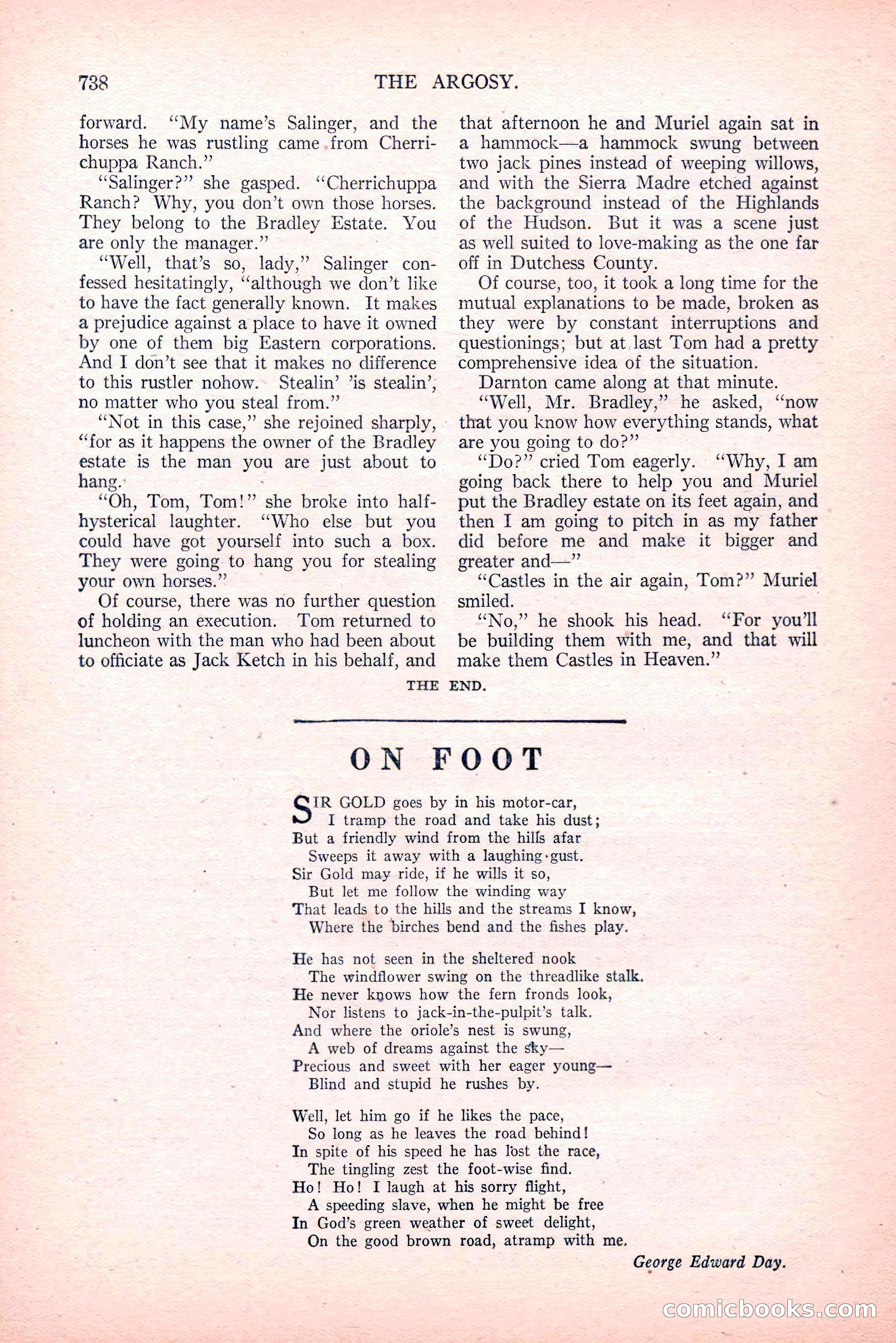
A restored page from Pulp Fiction, 1916. Page through the whole issue in the reader above.
📄 Transcribed text from this page (OCR, searchable)
Machine-transcribed from the original scan — historical spelling and the odd misread are preserved.
738 forward. “My name’s Salinger, and the horses he was rustling came .from Cherri- chuppa Ranch.” “Salinger?” she gasped. ‘‘Cherrichuppa Ranch? Why, you don’t own those horses. They belong to the Bradley Estate. You are only the manager.” “Well, that’s so, lady,” Salinger con- fessed hesitatingly, “although we don’t like to have the fact generally known. It makes a prejudice against a place to have it owned by one of them big Eastern corporations. And I don’t see that it makes no difference to this rustler nohow. Stealin’ ’is stealin’, no matter who you steal from.”’ “Not in this case,” “for as it happens the owner of the Bradley estate is the man st are just about to hang.’ “Oh, Tom, Tom!” she broke into half- hysterical laughter. ‘‘Who else but you could have got yourself into such a box. They were going to hang you for stealing your own horses.”’ Of course, there was no further question of holding an execution. Tom returned to luncheon with the man who had been about to officiate as Jack Ketch in his behalf, and THE ) she rejoined sharply, THE ARGOSY. that afternoon he and Muriel again sat in g between two jack pines instead of weeping willows, and with the Sierra Madre etched against the background instead of the Highlands of the Hudson. But it was a scene just as well suited to love-making as the one far off in Dutchess County. Of course, too, it took a long time for the mutual explanations to be made, broken as they were by constant interruptions and questionings; but at last Tom had a pretty comprehensive idea of the situation. Darnton came along at that minute. “Well, Mr. Bradley,” he asked, “now that you know how everything stands, what are you going to do?” “Do?” cried Tom eagerly. ‘‘Why, I am going back there to help you and Muriel put the Bradley estate on its feet again, and then I am going to pitch in as my father did before me and make it bigger and greater and—”’ “Castles in the air again, Tom?” Muriel smiled. “No,” he shook his head. ‘For you'll be building them with me, and that will make them Castles in Heaven.” END. ON FOOT IR GOLD goes by in his motor-car, I tramp the road and take his dust; But a friendly wind from the hills afar Sweeps it away with a laughing «gust. Sir Gold may ride, if he wills it so, But let me follow the winding way That leads to the hills and the streams I know, Where the birches bend and the fishes play. He has not seen in the sheltered nook The windflower swing on the threadlike stalk. He never knows how the fern fronds look, Nor listens to jack-in-the-pulpit’s talk. And where the oriole’s nest is swung, A web of dreams against the sky— Precious and sweet with her eager young— Blind and stupid he rushes by. Well, let him go if he likes the pace, So long as he leaves the road behind! In spite of his speed he has lost the race, The tingling zest the foot-wise find. Ho! Ho! I laugh at his sorry flight, A speeding slave, when he might be free In God’s green weather of sweet delight, On the good brown road, atramp with me, George Edward Day. MNIELOOO;KS COL (C@ Gc