
Pulp Fiction, 1916 · page 163 of 216
The Argosy, Vol. 81, No. 4 — page 163: what you’re looking at
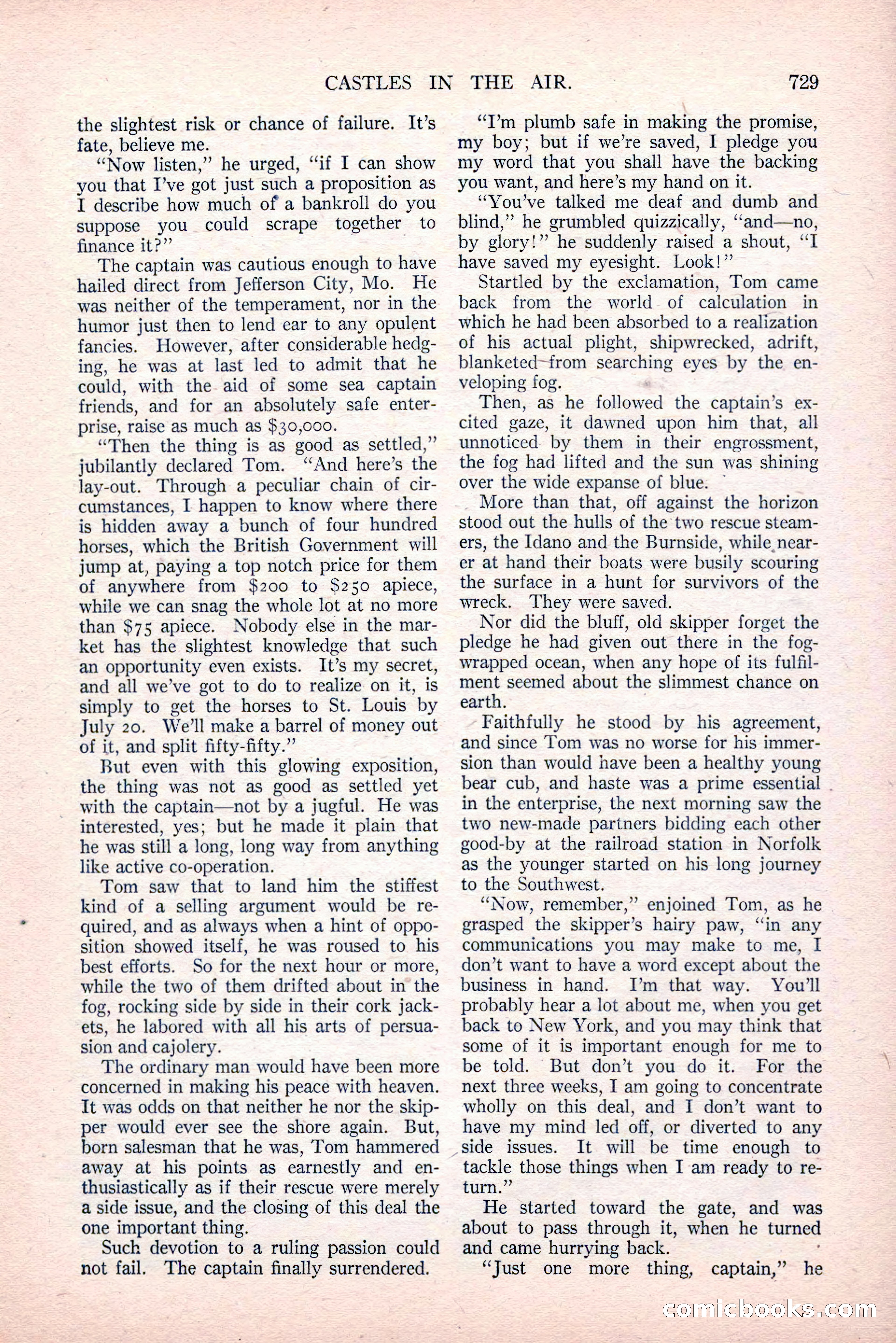
A restored page from Pulp Fiction, 1916. Page through the whole issue in the reader above.
📄 Transcribed text from this page (OCR, searchable)
Machine-transcribed from the original scan — historical spelling and the odd misread are preserved.
CASTLES IN THE AIR. 729 the slightest risk or chance of failure. It’s fate, believe me. “Now listen,” he urged, “if I can show you that I’ve got just such a proposition as I describe how much of a bankroll do you suppose you could scrape together to finance it?” The captain was cautious enough to have hailed direct from Jefferson City, Mo. He was neither of the temperament, nor in the humor just then to lend ear to any opulent fancies. However, after considerable hedg- ing, he was at last led to admit that he could, with the aid of some sea captain friends, and for an absolutely safe enter- prise, raise as much as $30,000. “Then the thing is as good as settled,” jubilantly declared Tom. “And here’s the lay-out. Through a peculiar chain of cir- cumstances, I happen to know where there is hidden away a bunch of four hundred horses, which the British Government will jump at, paying a top notch price for them of anywhere from $200 to $250 apiece, while we can snag the whole lot at no more than $75 apiece. Nobody else in the mar- ket has the slightest knowledge that such an opportunity even exists. It’s my secret, and all we’ve got to do to realize on it, is simply to get the horses to St. Louis by July 20. We'll make a barrel of money out of it, and split fifty-fifty.” But even with this glowing exposition, the thing was not as good as settled yet with the captain—not by a jugful. He was interested, yes; but he made it plain that he was still a long, long way from anything like active co-operation. Tom saw that to land him the stiffest kind of a selling argument would be re- quired, and as always when a hint of oppo- sition showed itself, he was roused to his best efforts. So for the next hour or more, while the two of them drifted about in the fog, rocking side by side in their cork jack- ets, he labored with all his arts of persua- sion and cajolery. The ordinary man would have been more concerned in making his peace with heaven. It was odds on that neither he nor the skip- per would ever see the shore again. But, born salesman that he was, Tom hammered away at his points as earnestly and en- thusiastically as if their rescue were merely a side issue, and the closing of this deal the one important thing. Such devotion to a ruling passion could not fail. The captain finally surrendered. _side issues. “T’m plumb safe in making the promise, my boy; but if we’re saved, I pledge you my word that you shall have the backing you want, and here’s my hand on it. “You've talked me deaf and dumb and blind,” he grumbled quizzically, ““and—no, by glory!” he suddenly raised a shout, “I have saved my eyesight. Look!” Startled by the exclamation, Tom came back from the world of calculation in which he had been absorbed to a realization of his actual plight, shipwrecked, adrift, blanketed-from searching eyes by the en- veloping fog. Then, as he followed the captain’s ex- cited gaze, it dawned upon him that, all unnoticed by them in their engrossment, the fog had lifted and the sun was shining over the wide expanse of blue. ~ More than that, off against the horizon stood out the hulls of the two rescue steam- ers, the Idano and the Burnside, while. near- er at hand their boats were busily scouring the surface in a hunt for survivors of the wreck. ‘They were saved. Nor did the bluff, old skipper forget the pledge he had given out there in the fog- wrapped ocean, when any hope of its fulfil- ment seemed about the slimmest chance on earth. Faithfully he stood by his agreement, and since Tom was no worse for his immer- sion than would have been a healthy young bear cub, and haste was a prime essential . in the enterprise, the next morning saw the two new-made partners bidding each other good-by at the railroad station in Norfolk as the younger started on his long journey to the Southwest. ““Now, remember,” enjoined Tom, as he grasped the skipper’s hairy paw, “in any communications you may make to me, I don’t want to have a word except about the business in hand. I’m that way. You'll probably hear a lot about me, when you get back to New York, and you may think that some of it is important enough for me to be told. But don’t you do it. For the next three weeks, I am going to concentrate wholly on this deal, and I don’t want to have my mind led off, or diverted to any It will be time enough to tackle those things when I am ready to re- turn.” He started toward the gate, and was about to pass through it, when he turned and came hurrying back. “Just one more thing, captain,” he ECORNICGLOOOKS (C@)