
Pulp Fiction, 1916 · page 151 of 216
The Argosy, Vol. 81, No. 4 — page 151: what you’re looking at
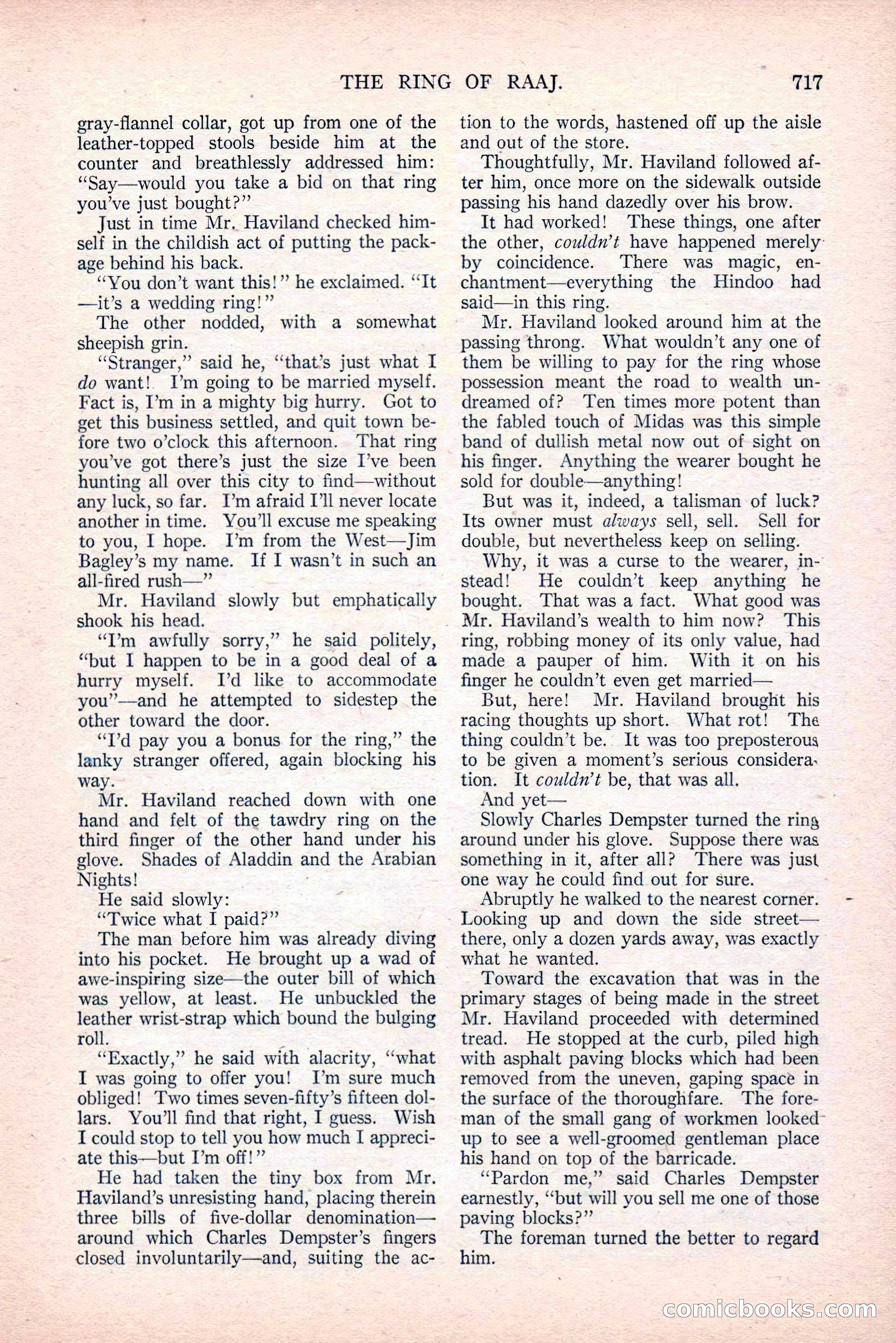
A restored page from Pulp Fiction, 1916. Page through the whole issue in the reader above.
📄 Transcribed text from this page (OCR, searchable)
Machine-transcribed from the original scan — historical spelling and the odd misread are preserved.
THE RING OF RAAJ. gray-flannel collar, got up from one of the leather-topped stools beside him at the counter and breathlessly addressed him: “Say—would you take a bid on that ring you’ve just bought?” Just in time Mr. Haviland checked him- self in the childish act of putting the pack- age behind his back. “Vou don’t want this!” he exclaimed. “It —it’s a wedding ring!” The other nodded, with a somewhat sheepish grin. “Stranger,” said he, ‘that’s just what I do want!. I’m going to be married myself. Fact is, I’m in a mighty big hurry. Got to get this business settled, and quit town be- fore two o’clock this afternoon. That ring you’ve got there’s just the size I’ve been hunting all over this city to find—without any luck, so far. I’m afraid I'll never locate another in time. You'll excuse me speaking to you, I hope. I’m from the West—Jim Bagley’s my name. If I wasn’t in such an all-fired rush—”’ Mr. Haviland slowly but emphatically shook his head. “T’m awfully sorry,” he said politely, “but I happen to be in a good deal of a hurry myself. Id like to accommodate you”—and he attempted to sidestep the other toward the door. “T’d pay you a bonus for the ring,” the lanky stranger offered, again blocking his way. Mr. Haviland reached down with one hand and felt of the tawdry ring on the third finger of the other hand under his glove. Shades of Aladdin and the Arabian Nights! : He said slowly: “Twice what I paid?” The man before him was already diving into his pocket. He brought up a wad of awe-inspiring size—the outer bill of which was yellow, at least. He unbuckled the leather wrist-strap which bound the bulging roll. “Exactly,” he said with alacrity, “what I was going to offer you! I’m sure much obliged! Two times seven-fifty’s fifteen dol- lars. You'll find that right, I guess. Wish I could stop to tell you how much I appreci- ate this—but I’m off!” He had taken the tiny box from Mr. Haviland’s unresisting hand, placing therein three bills of five-dollar denomination— around which Charles Dempster’s fingers closed involuntarily—and, suiting the ac- _ Mr. Haviland’s wealth to him now? 717 tion to the words, hastened off up the aisle and out of the store. Thoughtfully, Mr. Haviland followed af- ter him, once more on the sidewalk outside passing his hand dazedly over his brow. It had worked! These things, one after the other, couldn’t have happened merely: There was magic, en- the Hindoo had by coincidence. chantment—everything said—in this ring. Mr. Haviland looked around him at the passing throng. What wouldn’t any one of them be willing to pay for the ring whose possession meant the road to wealth un- dreamed of? ‘Ten times more potent than the fabled touch of Midas was this simple band of dullish metal now out of sight on his finger. Anything the wearer bought he sold for double—anything! But was it, indeed, a talisman of luck? Its owner must always sell, sell. Sell for double, but nevertheless keep on selling. Why, it was a curse to the wearer, in- stead! He couldn’t keep anything he bought. That was a fact. What good was This ring, robbing money of its only value, had made a pauper of him. With it on his finger he couldn’t even get married— But, here! Mr. Haviland brought his racing thoughts up short. What rot! The thing couldn’t be.. It was too preposterous to be given a moment’s serious considera. tion. It couldn’t be, that was all. And yet— Slowly Charles Dempster turned the ring around under his glove. Suppose there was something in it, after all? There was just one way he could find out for sure. Abruptly he walked to the nearest corner. Looking up and down the side street— there, only a dozen yards away, was exactly what he wanted. Toward the excavation that was in the primary stages of being made in the street Mr. Haviland proceeded with determined tread. He stopped at the curb, piled high with asphalt paving blocks which had been removed from the uneven, gaping space in the surface of the thoroughfare. The fore- man of the small gang of workmen looked- up to see a well-groomed gentleman place his hand on top of the barricade. “Pardon me,” said Charles Dempster earnestly, “‘but will you sell me one of those paving blocks?” The foreman turned the better to regard him. (C@ AMUG S DOO) EO