
Pulp Fiction, 1916 · page 148 of 216
The Argosy, Vol. 81, No. 4 — page 148: what you’re looking at
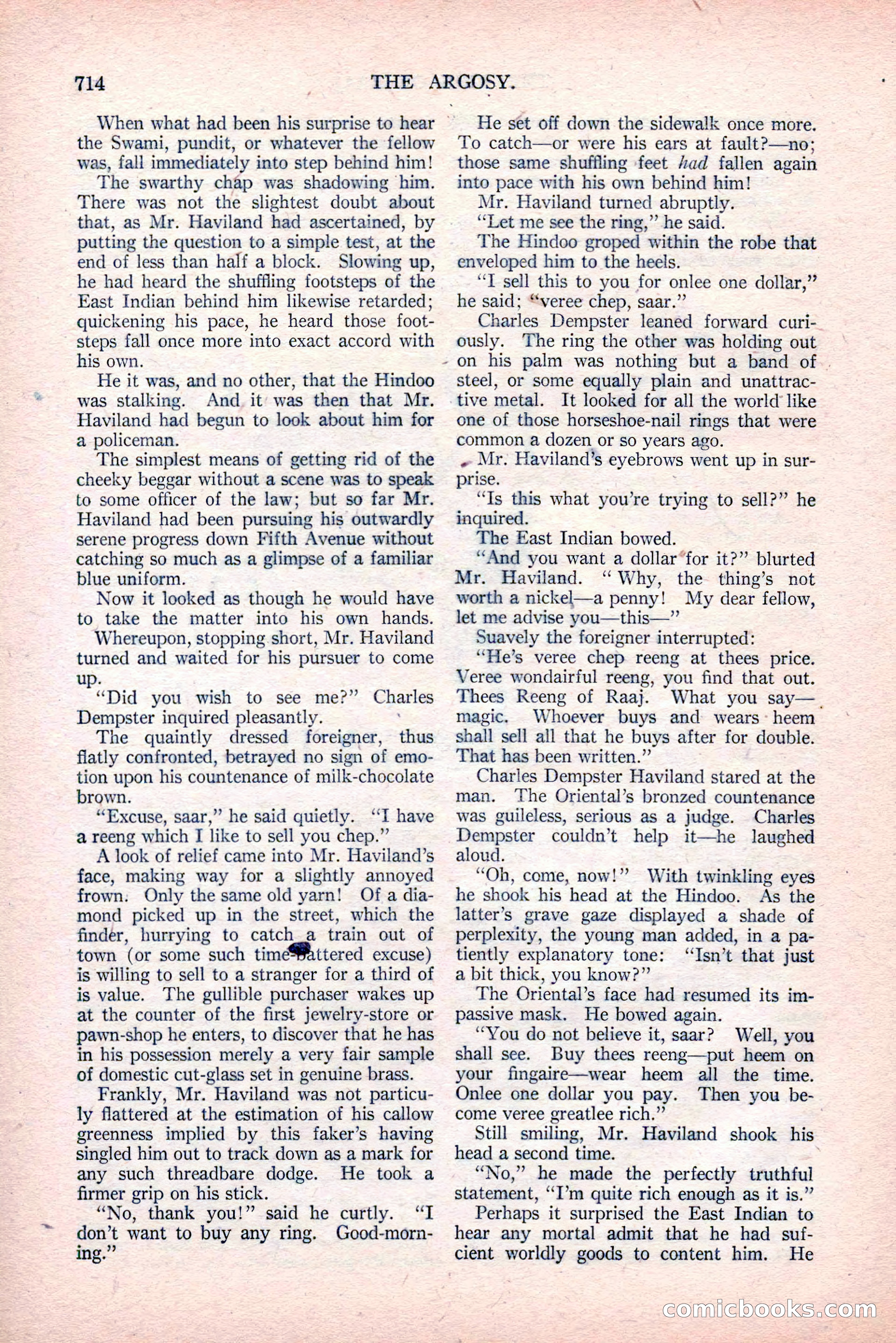
A restored page from Pulp Fiction, 1916. Page through the whole issue in the reader above.
📄 Transcribed text from this page (OCR, searchable)
Machine-transcribed from the original scan — historical spelling and the odd misread are preserved.
714 When what had been his surprise to hear | the Swami, pundit, or whatever the fellow was, fall immediately into step behind him! The swarthy chap was shadowing him. There was not the slightest doubt about that, as Mr. Haviland had ascertained, by putting the question to a simple test, at the end of less than half a block. Slowing up, he had heard the shuffling footsteps of the East Indian behind him likewise retarded; quickening his pace, he heard those foot- steps fall once more into exact accord with his own. He it was, and no other, that the Hindoo was stalking. And it’ was then that Mr. Haviland had begun to look about him for a policeman. The simplest means of getting rid of the cheeky beggar without a scene was to speak to some officer of the law; but so far Mr. Haviland had been pursuing his outwardly serene progress down Fifth Avenue without catching so much as a glimpse of a familiar blue uniform. Now it looked as though he would have to take the matter into his own hands. Whereupon, stopping. short, Mr. Haviland turned and waited for his pursuer to come “Did you wish to see me?” Charles Dempster inquired pleasantly. The quaintly dressed foreigner, thus flatly confronted, betrayed no sign of emo- tion upon his countenance of milk-chocolate brown. “Excuse, saar,” he said quietly. “I have a reeng which I like to sell you chep.”’ A look of relief came into Mr. Haviland’s face, making way for a slightly annoyed frown: Only the same old yarn! Of a dia- mond picked up in the street, which the finder, hurrying to catch_a train out of town (or some such timé*Wattered excuse) is willing to sell to a stranger for a third of is value. The gullible purchaser wakes up - at the counter of the first jewelry-store or pawn-shop he enters, to discover that he has in his possession merely a very fair sample of domestic cut-glass set in genuine brass. Frankly, Mr. Haviland was not particu- ly flattered at the estimation of his callow greenness implied by this faker’s having singled him out to track down as a mark for any such threadbare dodge. He took a firmer grip on his stick. “No, thank you!” said he curtly. “I don’t want to buy any ring. Good-morn- ing.” THE ARGOSY. He set off down the sidewalk once more. To catch—or were his ears at fault?—no; those same shuffling feet /ad fallen again into pace with his own behind him! Mr. Haviland turned abruptly. “Let me see the ring,” he said. The Hindoo groped within the robe that enveloped him to the heels. ‘‘T sell this to you for onlee one dollar,” he said; “veree chep, saar.” Charles Dempster leaned forward curi- ously. The ring the other was holding out steel, or some equally plain and unattrac- tive metal. It looked for all the world like one of those horseshoe-nail rings that were common a dozen or so years ago. ~ Mr. Haviland’s eyebrows went up in sur- prise. ‘Is this what you're trying to sell?” he inquired. The East Indian bowed. “And you want a dollar“for it?” blurted Mr. Haviland. ‘“ Why, the thing’s not worth a nickel—a penny! My dear fellow, let me advise you—this—”’ Suavely the foreigner interrupted: ‘“‘He’s veree chep reeng at thees price. Veree wondairful reeng, you find that out. Thees Reeng of Raaj. magic. Whoever buys and wears~ heem shall sell all that he buys after for double. That has been written.” Charles Dempster Haviland stared at the man. The Oriental’s bronzed countenance was guileless, serious as a judge. Charles Dempster couldn’t help it—he laughed aloud. “Oh, come, now!” With twinkling eyes he shook his head at the Hindoo. As the latter’s grave gaze displayed a shade of perplexity, the young man added, in a pa- tiently explanatory tone: “Isn’t that just a bit thick, you know?” The Oriental’s face had resumed its im- passive mask. He bowed again. ‘You do not believe it, saar? Well, you shall see. Buy thees reeng—put heem on your fingaire—wear heem all the time. Onlee one dollar you pay. Then you be- come veree greatlee rich.” Still smiling, Mr. Haviland shook his head a second time. “No,” he made the perfectly truthful statement, “I’m quite rich enough as it is.” Perhaps it surprised the East Indian to hear any mortal admit that he had suf- cient worldly goods to content him. He ECORMICLO® S What you say—_ - on his palm was nothing but a band of. (E@)