
Pulp Fiction, 1916 · page 125 of 216
The Argosy, Vol. 81, No. 4 — page 125: what you’re looking at
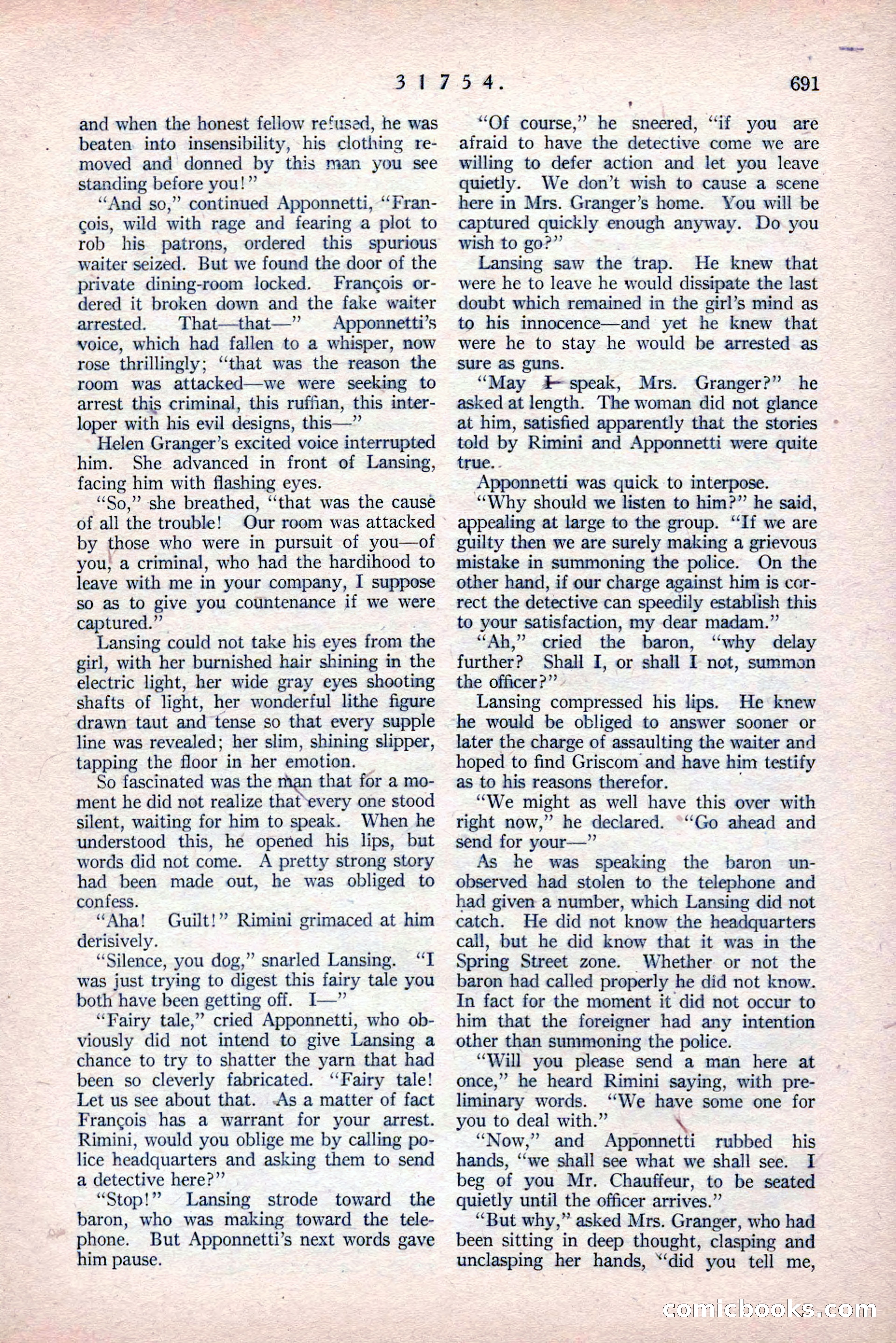
A restored page from Pulp Fiction, 1916. Page through the whole issue in the reader above.
📄 Transcribed text from this page (OCR, searchable)
Machine-transcribed from the original scan — historical spelling and the odd misread are preserved.
3 3-7-5 4. and when the honest fellow refused, he was beaten. into insensibility, his clothing re- moved and donned by this man you see standing before you!” “And so,” continued Apponnetti, “Fran- cois, wild with rage and fearing a plot to rob his patrons, ordered this spurious waiter seized. But we found the door of the private dining-room locked. Francois or- dered it broken down and the fake waiter arrested. That—that—” Apponnetti’s voice, which had fallen to a whisper, now rose thrillingly; “that was the reason the room was attacked—we were seeking to arrest this criminal, this ruffian, this inter- loper with his evil designs, this—”’ Helen Granger’s excited voice interrupted him. She advanced in front of Lansing, facing him with flashing eyes. “So,” she breathed, ‘‘that was the cause of all the trouble! Our room was attacked by those who were in pursuit of you—of you, a criminal, who had the hardihood to leave with me in your company, I suppose so as to give you countenance if we were captured.” Lansing could not take his eyes from the girl, with her burnished hair shining in the electric light, her wide gray eyes shooting shafts of light, her wonderful lithe figure drawn taut and tense so that every supple line was revealed; her slim, shining slipper, tapping the floor in her emotion. | So fascinated was the that for a mo- ment he did not realize that‘every one stood silent, waiting for him to speak. When he understood this, he opened his lips, but words did not come. A pretty strong story had been made out, he was obliged to confess. “Aha! derisively. “Silence, you dog,” snarled Lansing. “I was just trying to digest this fairy tale you both have been getting off. I—” “Fairy tale,” cried Apponnetti, who ob- viously did not intend to give Lansing a chance to try to shatter the yarn that had been so cleverly fabricated. ‘Fairy tale! Let us see about that. ~As a matter of fact Francois has a warrant for your arrest. Rimini, would you oblige me by calling po- lice headquarters and asking them to send a detective here?” “Stop!” Lansing strode toward the baron, who was making toward the tele- phone. But Apponnetti’s next words gave him pause. Guilt!” Rimini grimaced at him 691 “Of course,” he sneered, “if you are afraid to have the detective come we are willing to defer action and let you leave We don’t wish to cause a scene You will be quietly. here in Mrs. Granger’s home. captured quickly enough anyway. Do you — wish to go?” Lansing saw the trap. He knew that were he to leave he would dissipate the last doubt which remained in the girl’s mind as to his innocence—and yet he knew that were he to stay he would be arrested as sure as guns. “May speak, Mrs. Granger?” he asked at length. The woman did not glance at him, satisfied apparently that the stories told by Rimini and Apponnetti were quite Apponnetti was quick to interpose. ‘“‘Why should we listen to him?” he said, appealing at large to the group. “If we are guilty then we are surely making a grievous mistake in summoning the police. On the other hand, if our charge against him is cor- rect the detective can speedily establish this to your satisfaction, my dear madam.” “Ah,” cried the baron, ‘why delay further? Shall I, or shall I not, summon the officer?” Lansing compressed his lips. He knew he would be obliged to answer sooner or later the charge of assaulting the waiter and hoped to find Griscom and have him testify as to his reasons therefor. ‘“‘We might as well have this over with right now,” he declared. “““Go ahead and send for your—” As he was speaking the baron un- observed had stolen to the telephone and had given a number, which Lansing did not catch. He did not know the headquarters call, but he did know that it was in the Spring Street zone. Whether or not the baron had called properly he did not know. In fact for the moment it did not occur to him that the foreigner had any intention other than summoning the police. “Will you please send a man here at once,” he heard Rimini saying, with pre- liminary words. “We have some one for you to deal with.” \ “Now,” and Apponnetti rubbed his hands, “‘we shall see what we shall see. I beg of you Mr. Chauffeur, to be seated quietly until the officer arrives.” “But why,” asked Mrs. Granger, who had been sitting in deep thought, clasping and unclasping her hands, “‘did you tell me, COPMICGLOOOKS com