
Pulp Fiction, 1916 · page 111 of 216
The Argosy, Vol. 81, No. 4 — page 111: what you’re looking at
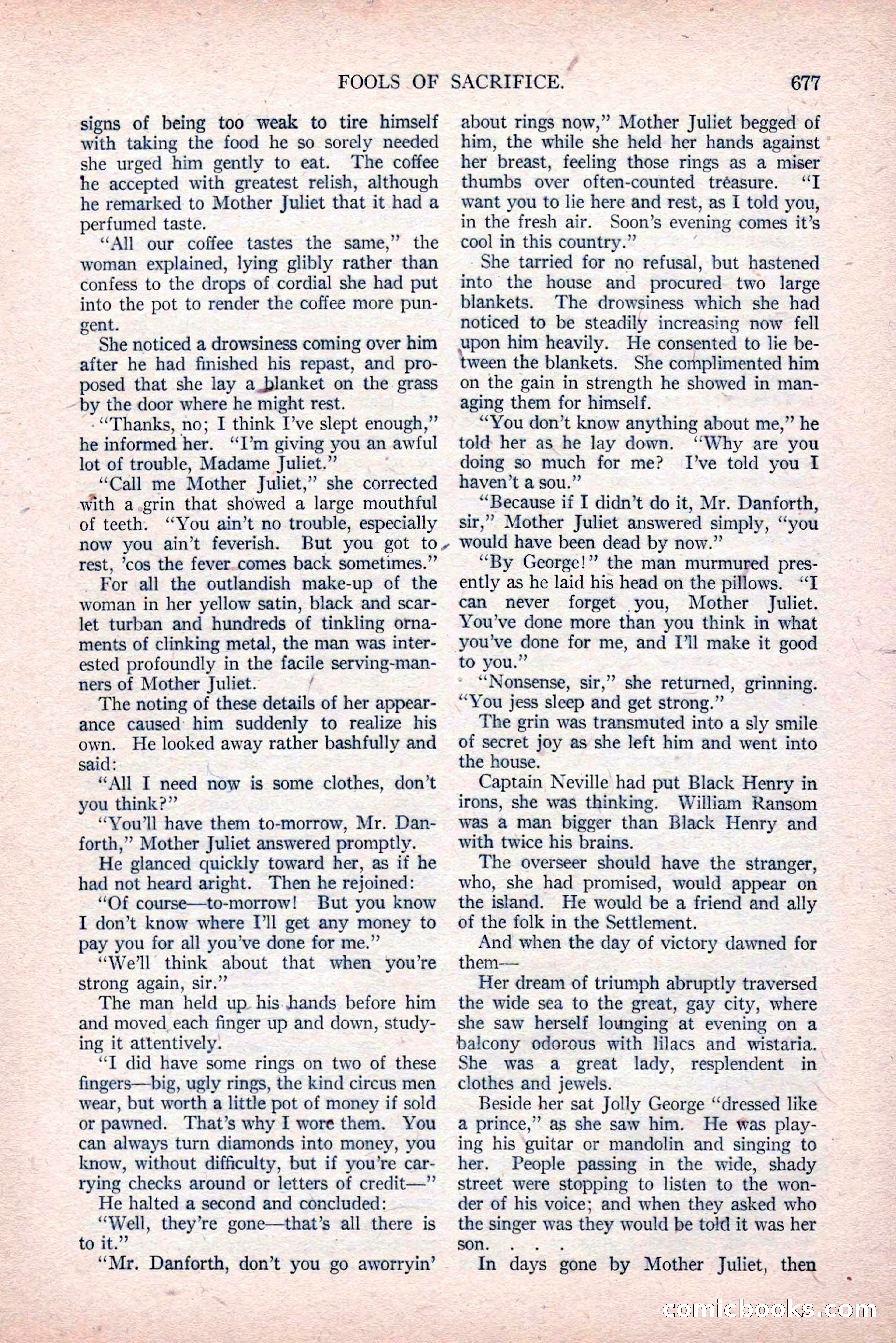
A restored page from Pulp Fiction, 1916. Page through the whole issue in the reader above.
📄 Transcribed text from this page (OCR, searchable)
Machine-transcribed from the original scan — historical spelling and the odd misread are preserved.
FOOLS OF signs of being too weak to tire himself with taking the food he so sorely needed she urged him gently to eat. The coffee he accepted with greatest relish, although he remarked to Mother Juliet that it had a perfumed taste. “All our coffee tastes the same,” the woman explained, lying glibly rather than confess to the drops of cordial she had put into the pot to render the coffee more pun- gent. She noticed a drowsiness coming over him after he had finished his repast, and pro- posed that she lay a_blanket on the grass -by the door where he might rest. -“Thanks, no; I think I’ve slept enough,” he informed her. “I’m giving you an awful lot of trouble, Madame Juliet.” “Call me Mother Juliet,” she corrected with a.grin that showed a large mouthful of teeth. ‘You ain’t no trouble, especially now you ain’t feverish. But you got to, rest, ’cos the fever. comes back sometimes.” _ For all the outlandish make-up of the woman in her yellow satin, black and scar- let turban and hundreds of tinkling orna- ments of clinking metal, the man was inter- ested profoundly in the facile serving-man- ners of Mother Juliet. / The noting of these details of her appear- ance caused: him suddenly to realize his own. He looked away rather bashfully and said: ‘All I need now is some clothes, don’t you think?” “Vou'll have them to-morrow, Mr. Dan- forth,” Mother Juliet answered promptly. He glanced quickly toward her, as if he had not heard aright. Then he rejoined: “Of course—to-morrow! But you know I don’t know where [’ll get any money to pay you for all you’ve done for me.” “We'll think about that when you’re strong again, sir.” The man held up. his hands before him and moved each finger up and down, study- ing it attentively. “TI did have some rings on two of these fingers—big, ugly rings, the kind circus men wear, but worth a little pot of money if sold or pawned. That’s why I wore them. You can always turn diamonds into money, you know, without difficulty, but if you’re car- rying checks around or letters of credit—” He halted a second and concluded: “Well, they’re gone—that’s all there is to it.” : “Mr. Danforth, don’t you go aworryin’ SACRIFICE. 677 about rings now,” Mother Juliet begged of him, the while she held her hands against ’ her breast, feeling those rings as a miser thumbs over often-counted tréasure. “I want you to lie here and rest, as I told you, in the fresh air. Soon’s evening comes it’s cool in this country.” She tarried for no refusal, but hastened into the house and procured two large blankets. The drowsiness which she had noticed to be steadily increasing now fell upon him heavily. He consented to lie be- tween the blankets. She complimented him on the gain in strength he showed in man- aging them for himself. , “You don’t know anything about me,” he told her as he lay down. ‘Why are you doing so much for me? I’ve told you I haven’t a sou.” “Because if I didn’t do it, Mr. Danforth, sir,” Mother Juliet answered simply, “you would have been dead by now.” “By George!” the man murmured pres- ently as he laid his head on the pillows. “TI can never forget you, Mother Juliet. You’ve done more than you think in what you’ve done for me, and [ll make it good to you.” ‘Nonsense, sir,” she returned, “You jess sleep and get strong.” The grin was transmuted into a sly smile of secret joy as she left him and went into the house. Captain Neville had put Black Henry in irons, she was thinking. William Ransom was a man bigger than Black Henry and with twice his brains. The overseer should have the stranger, who, she had promised, would appear on the island. He would be a friend and ally of the folk in the Settlement. And when the day of victory dawned for them— Her dream of triumph abruptly traversed the wide sea to the great, gay city, where she saw herself lounging at evening on a balcony odorous with lilacs and wistaria. She was a great lady, resplendent in clothes and jewels. Beside her sat Jolly George “dressed like a prince,” as she saw him. He was play- grinning. ing his guitar or mandolin and singing to — her. People passing in the wide, shady street were stopping to listen to the won- der of his voice; and when they asked who the singer was they would be told it was her ae ee In days gone by Mother Juliet, then COMIC OOKS : (©)