
Pulp Fiction, 1915 · page 74 of 246
The Argosy, September 1915 — page 74: what you’re looking at
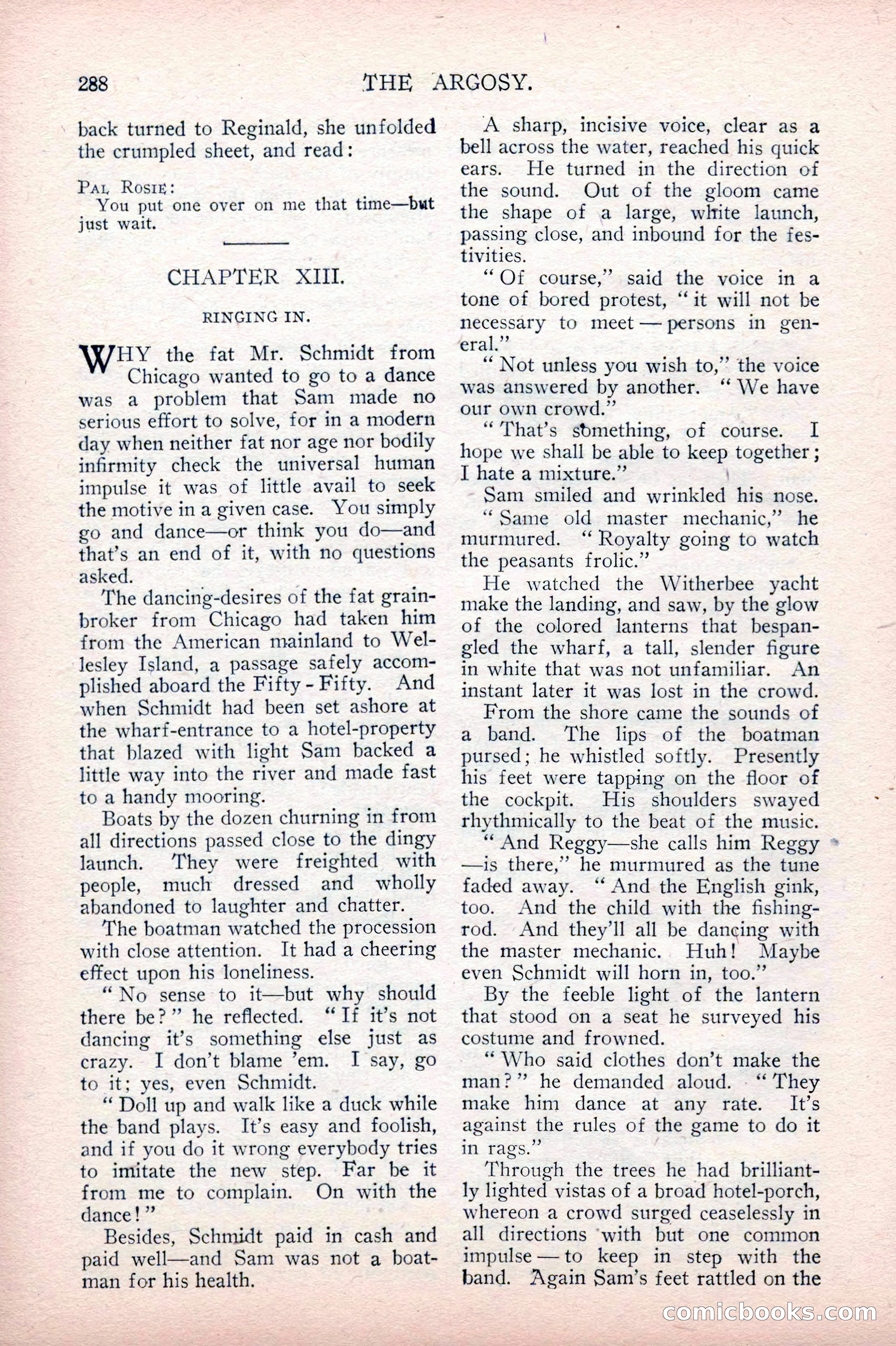
A restored page from Pulp Fiction, 1915. Page through the whole issue in the reader above.
📄 Transcribed text from this page (OCR, searchable)
Machine-transcribed from the original scan — historical spelling and the odd misread are preserved.
288 back turned to Reginald, she unfolded the crumpled sheet, and read: Pat, Rosie: You put one over on me that time—but just wait. CHAPTER. XIII. RINGING IN. HY the fat Mr. Schmidt from Chicago wanted to go to a dance was a problem that Sam made no serious effort to solve, for in a modern day when neither fat nor age nor bodily infirmity check the universal human impulse it was of little avail to seek the motive in a given case. You simply go and dance—or think you do—and that’s an end of it, with no questions asked. The dancing-desires of the fat grain- broker from Chicago had taken him from the American mainland to Wel- lesley Island, a passage safely accom- plished aboard the Fifty - Fifty. And when Schmidt had been set ashore at the wharf-entrance to a hotel-property that blazed with light Sam backed a little way into the river and made fast to a handy mooring. Boats by the dozen churning in from all directions passed close to the dingy launch. ‘They were freighted with people, much dressed and _ wholly abandoned to laughter and chatter. The boatman watched the procession with close attention. It had a cheering effect upon his loneliness. “No sense to it—but why should there be?” he reflected. “If it’s not dancing it’s something else just as crazy. I don’t blame ’em. I say, go to it; yes, even Schmidt. “ Doll up and walk like a duck while the band plays. It’s easy and foolish, and if you do it wrong everybody tries to imitate the new step. Far be it from me to complain. On with the dance!” Besides, Schmidt paid in cash and paid well—and Sam was not a boat- man for his health. THE ARGOSY. A sharp, incisive voice, clear as a bell across the water, reached his quick ears. He turned in the direction of the sound. Out of the gloom came the shape of a large, white launch, passing close, and inbound for the fes- tivities. “Of course,’ said the voice in a tone of bored protest, “‘it will not be necessary to meet— persons in gen- eral.” “Not unless you wish to,’’ the voice was answered by another. “ We have our own crowd.” “That’s something, of course. I hope we shall be able to keep together ; I hate a mixture.” Sam smiled and wrinkled his nose. “Same old master mechanic,” he murmured. ‘“‘ Royalty going to watch the peasants frolic.” He watched the Witherbee yacht make the landing, and saw, by the glow of the colored lanterns that bespan- gled the wharf, a tall, slender figure in white that was not unfamiliar. An instant later it was lost in the crowd. From the shore came the sounds of a band. The lips of the boatman pursed; he whistled softly. Presently his feet were tapping on the floor of the cockpit. His shoulders swayed rhythmically to the beat of the music. “And Reggy—she calls him Reggy * —is there,’ he murmured as the tune faded away. “And the English gink, too. And the child with the fishing- rod. And they'll all be dancing with the master mechanic. Huh! Maybe even Schmidt will horn in, too.” By the feeble light of the lantern that stood on a seat he surveyed his costume and frowned. | “Who said clothes don’t make the man?” he demanded aloud. - ‘ They make him dance at any rate. It’s against the rules of the game to do it in rags.” Through the trees he had brilliant- ly lighted vistas of a broad hotel-porch, whereon a crowd surged ceaselessly in all directions ‘with but one common impulse —to keep in step with the band. Again Sam’s feet rattled on the EOPMICLOOOKS (©)