
Pulp Fiction, 1915 · page 53 of 246
The Argosy, September 1915 — page 53: what you’re looking at
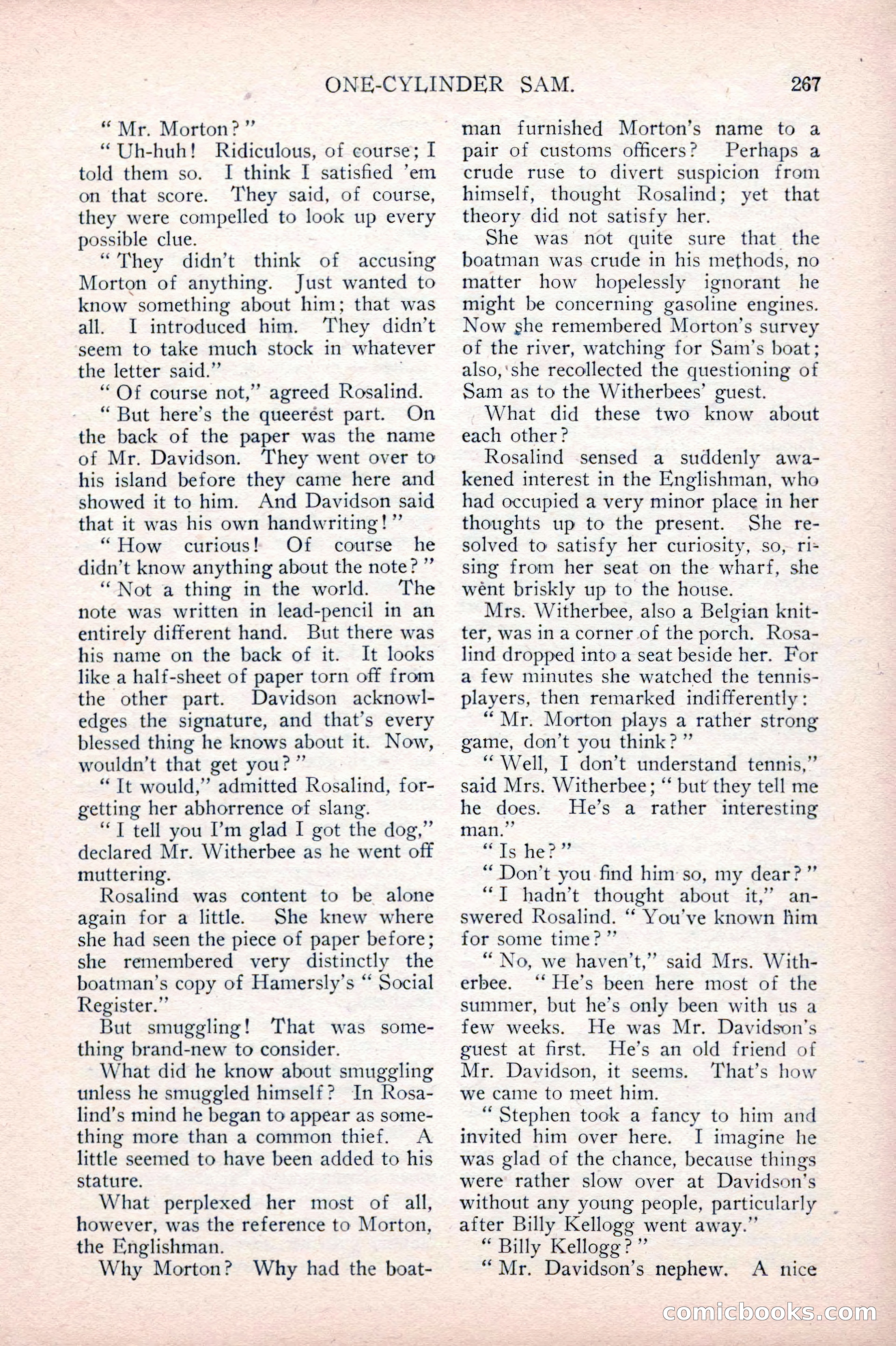
A restored page from Pulp Fiction, 1915. Page through the whole issue in the reader above.
📄 Transcribed text from this page (OCR, searchable)
Machine-transcribed from the original scan — historical spelling and the odd misread are preserved.
ONE-CYLINDER SAM. “Mr. Morton?” “Uh-huh! Ridiculous, of course; I told them so. I think I satisfied ’em on that score. They said, of course, they were compelled to look up every possible clue. “They didn’t think of accusing Morton of anything. Just wanted to know something about him; that was all. I introduced him. They didn’t seem to take much stock in whatever the letter said.” ; ‘Of course not,” agreed Rosalind. “ But here’s the queerést part. On the back of the paper was the name of Mr. Davidson. They went over to his island before they came here and showed it to him. And Davidson said that it was his own handwriting!” “How curious! Of course he didn’t know anything about the note? ” “Not a thing in the world. The note was written in lead-pencil in an entirely different hand. But there was his name on the back of it. It looks like a half-sheet of paper torn off from the other part. Davidson acknowl- edges the signature, and that’s every blessed thing he knows about it. Now, | wouldn’t that get you?” “Tt would,” admitted Rosalind, for- getting her abhorrence of slang. ‘“T tell you [’m glad I got the dog,” declared Mr. Witherbee as he went off muttering. Rosalind was content to be alone again for a little. She knew where she had seen the piece of paper before; she remembered very distinctly the boatman’s copy of Hamersly’s “ Social Register.” But smuggling! That was some- thing brand-new to consider. What did he know about smuggling unless he smuggled himself? In Rosa- lind’s mind he began to appear as some- thing more than a common thief. A little seemed to have been added to his stature. What perplexed her most of all, however, was the reference to Morton, the Englishman. Why Morton? Why had the boat- 267 ' man furnished Morton’s name to a pair of customs officers? Perhaps a crude ruse to divert suspicion from himself, thought Rosalind; yet that theory did not satisfy her. She was not quite sure that the boatman was crude in his methods, no » matter how hopelessly ignorant he might be concerning gasoline engines. Now she remembered Morton’s survey of the river, watching for Sam’s boat; also,‘she recollected the questioning of Sam as to the Witherbees’ guest. What did these two know about each other? Rosalind sensed a suddenly awa- kened interest in the Englishman, who had occupied a very minor place in her thoughts up to the present. She re- solved to satisfy her curiosity, so, ri- sing from her seat on the wharf, she went briskly up to the house. Mrs. Witherbee, also a Belgian knit- ter, was in a corner of the porch. Rosa- lind dropped into a seat beside her. For a few minutes she watched the tennis- players, then remarked indifferently: “Mr. Morton plays a rather strong game, don’t you think?” “Well, I don’t understand tennis,” said Mrs. Witherbee; “‘ but they tell me he does. He’s a rather interesting man.” ae fo | “Don’t you find him: so, my dear?” “T hadn't thought about it,” an- swered Rosalind. “ You’ve known him for some time?” “No, we haven't,” said Mrs. With- erbee. ‘‘ He’s been here most of the summer, but he’s only been with us a few weeks. He was Mr. Davidson's guest at first. He’s an old friend of Mr. Davidson, it seems. That’s how we came to meet him. “Stephen took a fancy to him and invited him over here. I imagine he was glad of the chance, because things were rather slow over at Davidson's without any young people, particularly after Billy Kellogg went away.” “ Billy Kellogg? ” “Mr. Davidson’s nephew. A nice GomiGcbooks (C@)