
Pulp Fiction, 1915 · page 49 of 246
The Argosy, September 1915 — page 49: what you’re looking at
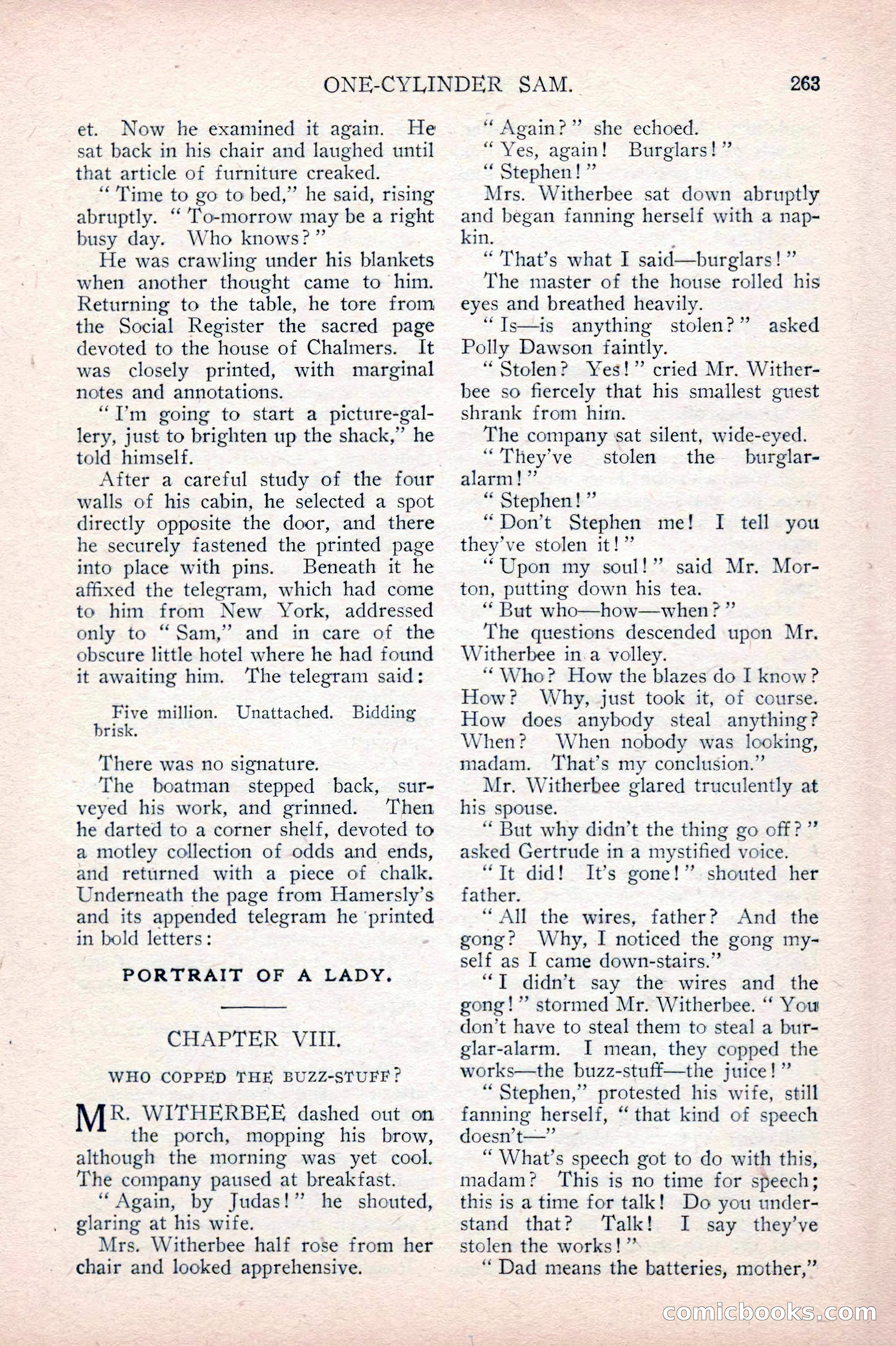
A restored page from Pulp Fiction, 1915. Page through the whole issue in the reader above.
📄 Transcribed text from this page (OCR, searchable)
Machine-transcribed from the original scan — historical spelling and the odd misread are preserved.
ONE-CYLINDER SAM. et. Now he examined it again. He sat back in his chair and laughed until that article of furniture creaked. ‘Time to go to bed,” he said, rising abruptly. ‘‘ To-morrow may be a right busy day. Who knows?” He was crawling under his blankets when another thought came to him. Returning to the table, he tore from the Social Register the sacred page devoted to the house of Chalmers. It was closely printed, with marginal notes and annotations. “Tm going to start a picture-gal- lery, just to brighten up the shack,” he told himself. After a careful study of the four walls of his cabin, he selected a spot directly opposite the door, and there he securely fastened the printed page into place with pins. Beneath it he affixed the telegram, which had come to him from New York, addressed only to “Sam,” and in care of the obscure little hotel where he had found it awaiting him. The telegram said: Five million. Unattached. Bidding brisk. There was no signature. The boatman stepped back, sur- veyed his work, and grinned. Then he darted to a corner shelf, devoted to a motley collection of odds and ends, and returned with a piece of chalk. Underneath the page from Hamersly’s and its appended telegram he ‘printed in bold letters: PORTRAIT OF A LADY. CHAPTER VIII. WHO COPPED THE BUZZ-STUFF ? Me: WITHERBEE dashed out on the porch, mopping his brow, although the morning was yet cool. The company paused at breakfast. “Again, by Judas!” he shouted, glaring at his wife. Mrs. Witherbee half rose from her chair and looked apprehensive. “Again?” she echoed. “Yes, again! Burglars!” ‘“ Stephen! ” Mrs. Witherbee sat down abruptly and began fanning herself with a nap- kin. “That’s what I said—burglars The master of the house rolled his eyes and breathed heavily. ‘““Is—is anything stolen?” asked Polly Dawson faintly. “Stolen? Yes!” cried Mr. Wither- bee so fiercely that his smallest guest shrank from hin. The company sat silent, wide-eyed. { “They've stolen the burglar- alarm!” “ Stephen! ” “Don’t Stephen me! I tell you they've stolen it!” ‘Upon my soul!” said Mr. Mor- ton, putting down his tea. * But who—how—when? ”’ The questions descended upon Mr. Witherbee in.a volley. ‘Who? How the blazes do I know? How? Why, just took it, of course. How does anybody steal anything? When? When nobody was looking, madam. ‘That’s my conclusion.” Mr. Witherbee glared truculently at his spouse. “ But why didn’t the thing go off?” asked Gertrude in a mystified voice. “Tt did! It’s gone!” shouted her father. “All the wires, father? And the gong? Why, I noticed the gong my- self as I came down-stairs.” ““T didn’t say the wires and the gong!” stormed Mr. Witherbee. “ You don’t have to steal them to steal a bur- glar-alarm. I mean, they copped the works—the buzz-stuff—the juice!” “Stephen,” protested his wife, still fanning herself, “that kind of speech doesn’ t—” “ What’s speech got to do with this, madam? This is no time for speech; this is a time for talk! Do you under- stand that? Talk! I say they’ve stolen the works!” ‘“Dad means the batteries, mother,” CORMICLOOOKS 263 (©)