
Pulp Fiction, 1915 · page 46 of 246
The Argosy, September 1915 — page 46: what you’re looking at
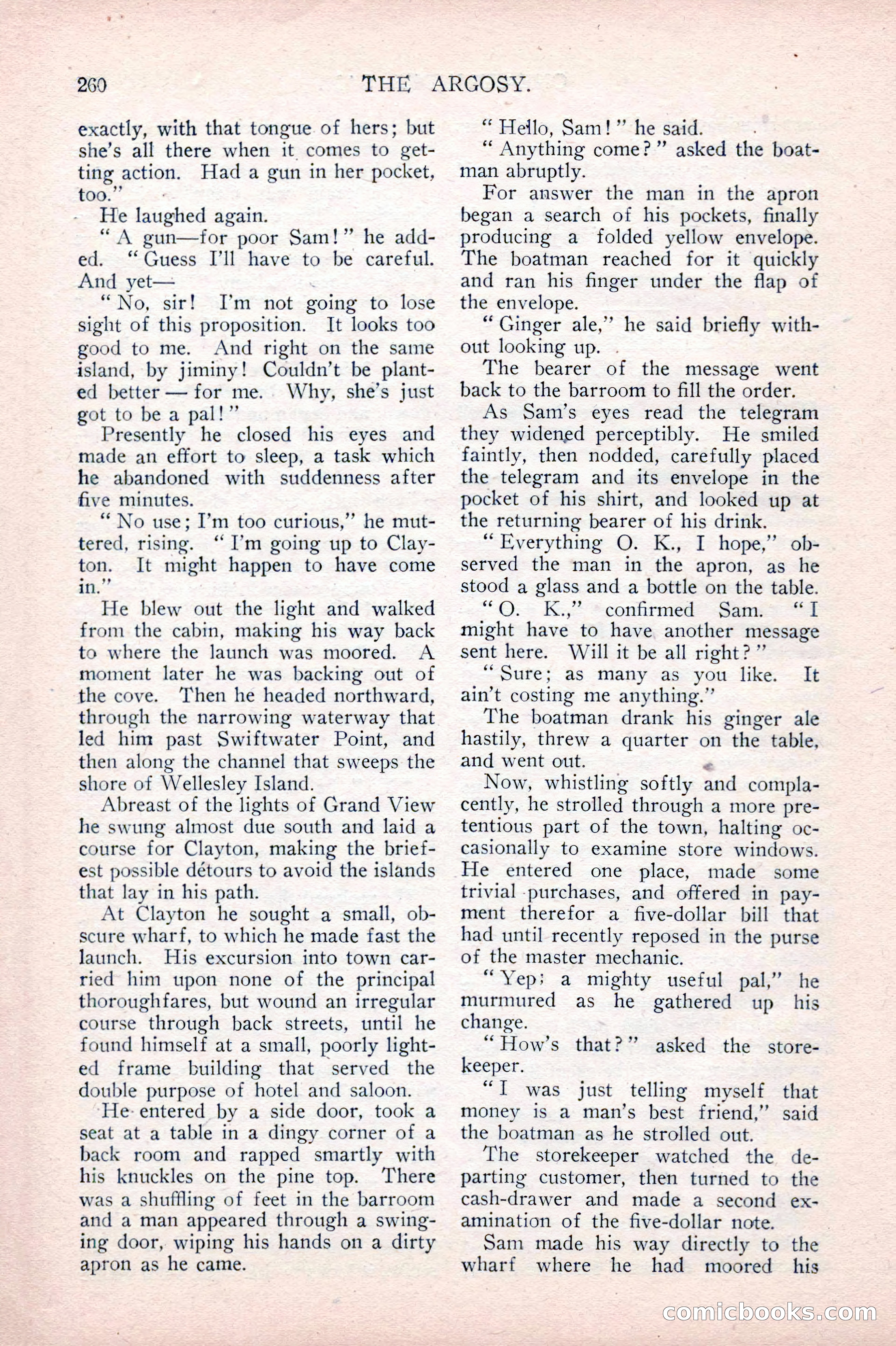
A restored page from Pulp Fiction, 1915. Page through the whole issue in the reader above.
📄 Transcribed text from this page (OCR, searchable)
Machine-transcribed from the original scan — historical spelling and the odd misread are preserved.
269 exactly, with that tongue of hers; but she’s all there when it comes to get- ting action. Had a gun in her pocket, too.” He laughed again. “A gun—for poor Sam!” he add- ed. “Guess I'll have to be careful. And yet— 7 “No, sir! I’m not going to lose sight of this proposition. It looks too good to me. And right on the same island, by jiminy! Couldn’t be plant- ed better — for me. Why, she’s just got to be a pal!”’ Presently he closed his eyes and made an effort to sleep, a task which he abandoned with suddenness after five minutes. “No use; I’m too curious,” he mut- tered, rising. “I’m going up to Clay- ton. It might happen to have come in. He blew out the light and walked from the cabin, making his way back to where the launch was moored. A moment later he was backing out of the cove. Then he headed northward, through the narrowing waterway that led him past Swiftwater Point, and then along the channel that sweeps the shore of Wellesley Island. Abreast of the lights of Grand View he swung almost due south and laid a course for Clayton, making the brief- est possible détours to avoid the islands that lay in his path. At Clayton he sought a small, ob- scure wharf, to which he made fast the launch. His excursion into town car- ried him upon none of the principal thoroughfares, but wound an irregular course through back streets, until he found himself at a small, poorly light- ed frame building that served the double purpose of hotel and saloon. He-entered by a side door, took a seat at a table in a dingy corner of a back room and rapped smartly with his knuckles on the pine top. There was a shuffling of feet in the barroom and a man appeared through a swing- ing door, wiping his hands on a dirty apron as he came. THE ARGOSY. * Hello, Sam!” he said. “ Anything come?” asked the boat- man abruptly. For answer the man in the apron began a search of his pockets, finally producing a folded yellow envelope. The boatman reached for it quickly and ran his finger under the flap of the envelope. “Ginger ale,” he said briefly with- out looking up. . The bearer of the message went back to the barroom to fill the order. As Sam’s eyes read the telegram they widened perceptibly. He smiled faintly, then nodded, carefully placed the telegram and its envelope in the pocket of his shirt, and looked up at the returning bearer of his drink. “Everything O. K., I hope,” ob- served the man in the apron, as he stood a glass and a bottle on the table. ©: K.,” =conhrmet Sane might have to have another message sent here. Will it be all right?” “Sure; as many as you like. ain’t costing me anything.” The boatman drank his ginger ale hastily, threw a quarter on the table, and went out. < Now, whistling softly and compla- cently, he strolled through a more pre- tentious part of the town, halting oc- casionally to examine store windows. He entered one place, made some trivial purchases, and offered in pay- ment therefor a five-dollar bill that had until recently reposed in the purse of the master mechanic. “Yep; a mighty useful pal,” he murmured as he gathered up his change. “How’s that?” keeper. “IT was just telling myself that money is a man’s best friend,” said the boatman as he strolled out. The storekeeper watched the de- parting customer, then turned to the cash-drawer and made a second ex- amination of the five-dollar note. It asked the store- Sam made his way directly to the | wharf where he had moored his VOOKS COMMUC (C@)