
Pulp Fiction, 1915 · page 40 of 246
The Argosy, September 1915 — page 40: what you’re looking at
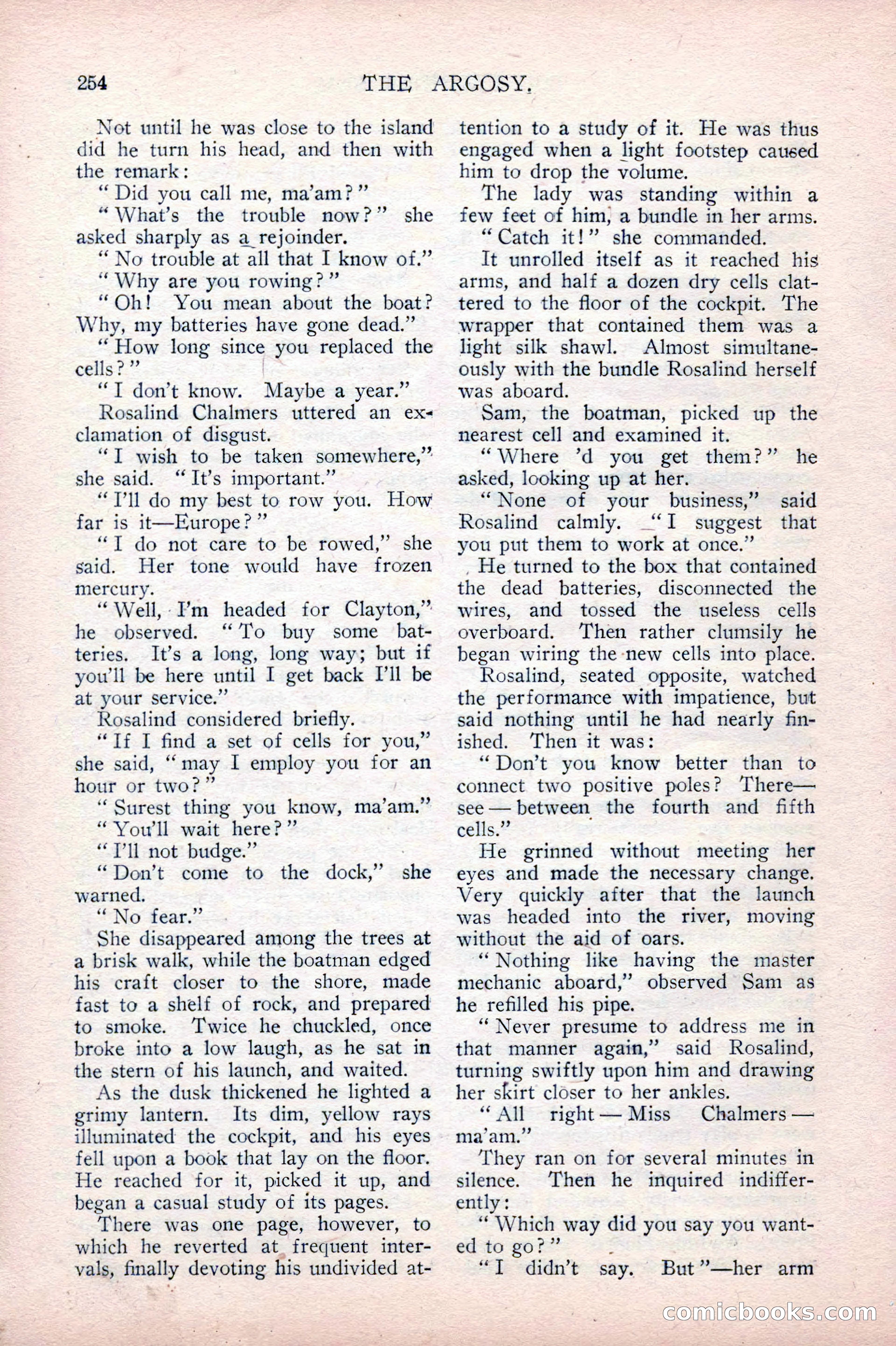
A restored page from Pulp Fiction, 1915. Page through the whole issue in the reader above.
📄 Transcribed text from this page (OCR, searchable)
Machine-transcribed from the original scan — historical spelling and the odd misread are preserved.
254 Not until he was close to the island did he turn his head, and then with the remark: “Did you call me, ma’am?”’ “What's the trouble now?” asked sharply as a_rejoinder. “No trouble at all that I know of.” “Why are you rowing?” “Oh! You mean about the boat? Why, my batteries have gone dead.” “How long since you replaced the cells?” “T don’t know. Maybe a year.” Rosalind Chalmers uttered an ex< clamation of disgust. “TI wish to be taken somewhere,” she said. “It’s important.” “Tl do my best to row you. How far is it—Europe?” “IT do not care to be rowed,” she said. Her tone would have frozen mercury. ‘Well, I’m headed for Clayton,” he observed. “Io buy some _bat- teries. It’s a long, long way; but if you'll be here until I get back Pll be at your service.” Rosalind considered briefly. “Tf I find a set of cells for you,” she said, “may 1 employ you for an hour or two?” ‘“Surest thing you know, ma’am.” “You'll wait here?” “Tll not budge.” “Don’t come to the dock,” warned, ‘““No fear.” She disappeared among the trees at a brisk walk, while the boatman edged his craft closer to the shore, made fast to a shelf of rock, and prepared to smoke. Twice he chuckled, once broke into a low laugh, as he sat in the stern of his launch, and waited. As the dusk thickened he lighted a grimy lantern. Its dim, yellow rays illuminated the cockpit, and his eyes fell upon a book that lay on the floor. He reached for it, picked it up, and began a casual study of its pages. There was one page, however, to which he reverted at_ frequent inter- vals, Btally devoting his undivided at- she she THE ARGOSY. tention to a study of it. He was thus engaged when a light footstep caused him to drop the volume. The lady was standing within a few feet of him, a bundle in her arms. “Catch it!” she commanded. It unrolled itself as it reached his arms, and half a dozen dry cells clat- tered to the floor of the cockpit. The wrapper that contained them was a light silk shawl. Almost simultane- ously with the bundle Rosalind herself was aboard. Sam, the boatman, picked up the nearest cell and examined it. “Where ’d you get them?” he asked, looking up at her. “None of your business,” said Rosalind calmly. “I suggest that you put them to work at once.” . He turned to the box that contained the dead batteries, disconnected the wires, and tossed the useless cells overboard. ‘Then rather clumsily he began wiring the -new cells into place. Rosalind, seated opposite, watched the performance with impatience, but said nothing until he had nearly fin- ished. Then it was: “Don’t you know better than to connect two positive poles? There— see — between the fourth and fifth cells.” He grinned without meeting her eyes and made the necessary change. Very quickly after that the launch was headed into the river, moving without the aid of oars. “Nothing like having the master mechanic aboard,” observed Sam as he refilled his pipe. ‘““ Never presume to address me in that manner again,” said Rosalind, turning swiftly upon him and drawing her skirt closer to her ankles. “All right— Miss Chalmers — ma’am.” They ran on for several minutes in silence. Then he inquired indiffer- entl = Which way did you say you want- ed to go?” “T didn’t say. But ’—her arm COPMICLOOOKS (C@)