
Pulp Fiction, 1915 · page 36 of 246
The Argosy, September 1915 — page 36: what you’re looking at
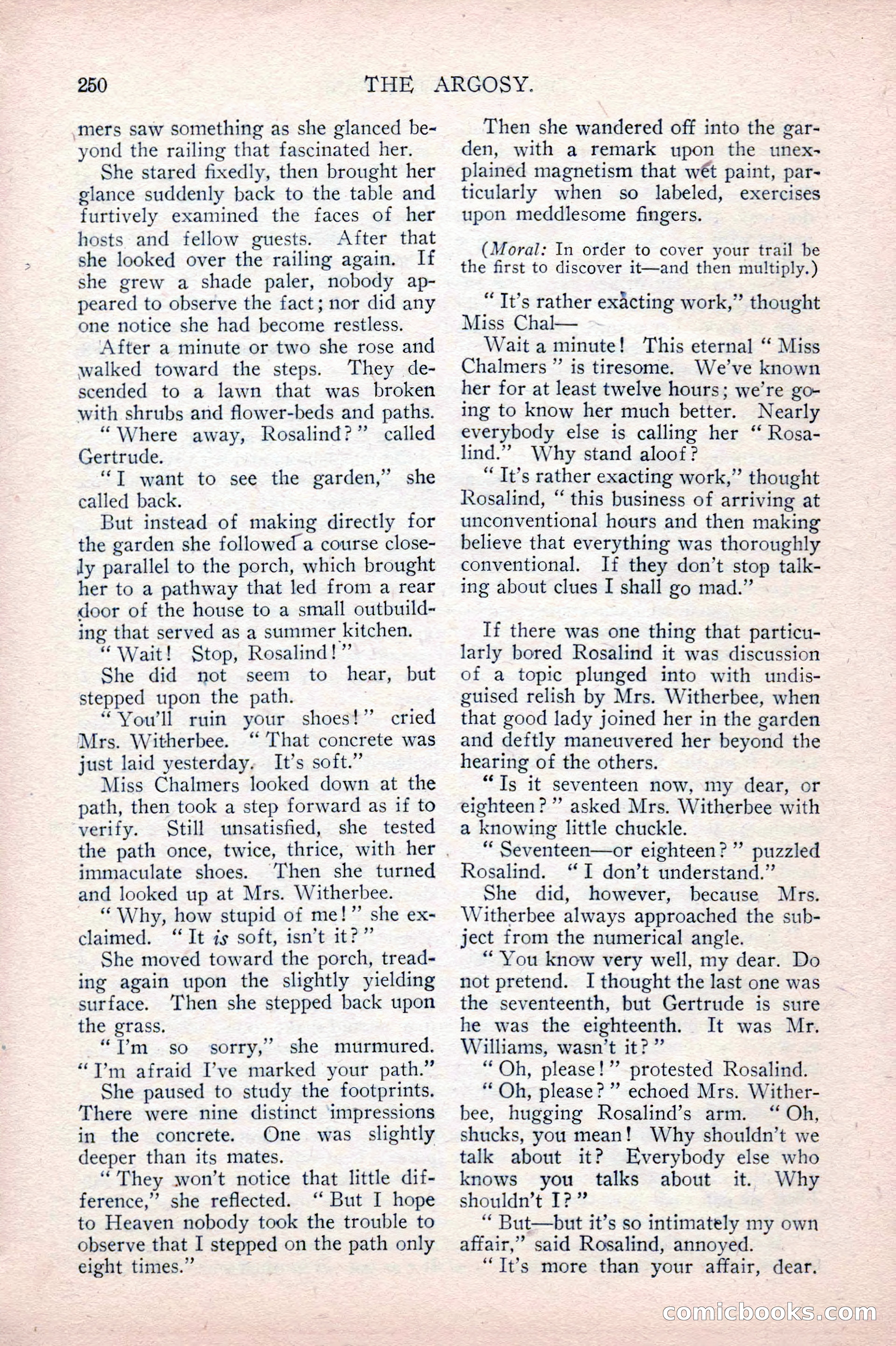
A restored page from Pulp Fiction, 1915. Page through the whole issue in the reader above.
📄 Transcribed text from this page (OCR, searchable)
Machine-transcribed from the original scan — historical spelling and the odd misread are preserved.
250 THE mers saw something as she glanced be~ yond the railing that fascinated her. She stared fixedly, then brought her glance suddenly back to the table and furtively examined the faces of her hosts and fellow guests. After that she looked over the railing again. If she grew a shade paler, nobody ap- peared to observe the fact; nor did any one notice she had become restless. After a minute or two she rose and walked toward the steps. They de- scended to a lawn that was broken with shrubs and flower-beds and paths. “Where away, Rosalind?” called Gertrude. ‘““T want to see the garden,” she called back. But instead of making directly for the garden she followed a course close- ly parallel to the porch, which brought her to a pathway that led from a rear door of the house to a small outbuild- ing that served as a summer kitchen. “Wait! Stop, Rosalind!” She did not seem to hear, but stepped upon the path. “You'll ruin your shoes!” cried Mrs. Witherbee. ‘“ That concrete was just laid yesterday. It’s soft.” Miss Chalmers looked down at the path, then took a step forward as if to verify. Still unsatisfied, she tested the path once, twice, thrice, with her | immaculate shoes. Then she turned and looked up at Mrs. Witherbee. “Why, how stupid of me!” she ex- claimed. ‘It zs soft, isn’t it?” She moved toward the porch, tread- ing again upon the slightly yielding surface. ‘Then she stepped back upon the grass. “T’m so. sorry,” she murmured. “T’m afraid I’ve marked your path.” She paused to study the footprints. There were nine distinct impressions in the concrete. One was slightly deeper than its mates. “They won’t notice that little dif- ference,’ she reflected. ‘‘ But I hope to Heaven nobody took the trouble to observe that I stepped on the path only eight times.” ARGOSY. Then she wandered off into the gar- den, with a remark upon the unex- plained magnetism that wé€t paint, par- ticularly when so labeled, exercises upon meddlesome fingers. (Moral: In order to cover your trail be the first to discover it—and then mu!tiply.) “It’s rather exacting work,” thought Miss Chal— Wait a minute! This eternal “ Miss Chalmers ” is tiresome. We've known her for at least twelve hours; we're go- ing to know her much better. Nearly everybody else is calling her ‘ Rosa- lind.” Why stand aloof? “ It’s rather exacting work,” thought Rosalind, “this business of arriving at unconventional hours and then making believe that everything was thoroughly conventional. If they don’t stop talk- ing about clues I shall go mad.” If there was one thing that particu- larly bored Rosalind it was discussion of a topic plunged into with undis- guised relish by Mrs. Witherbee, when that good lady joined her in the garden and deftly maneuvered her beyond the hearing of the others. “Is it seventeen now, my dear, or eighteen? ”’ asked Mrs. Witherbee with a knowing little chuckle. “* Seventeen—or eighteen? ” puzzled Rosalind. “I don’t understand.” She did, however, because Mrs. Witherbee always approached the sub- ject from the numerical angle. “You know very well, my dear. Do not pretend. I thought the last one was the seventeenth, but Gertrude is sure he was the eighteenth. It was Mr. Williams, wasn’t it?” “Oh, please!” protested Rosalind. “Oh, please? ” echoed Mrs. Wither- bee, hugging Rosalind’s arm. “ Oh, shucks, you mean! Why shouldn’t we talk about it? Everybody else who knows you talks about it. Why shouldn’t I?” ‘“ But—but it’s so intimately my own affair,” said Rosalind, annoyed. ‘It’s more than your affair, dear. CORMICLOOOKS (E@)