
Pulp Fiction, 1915 · page 34 of 246
The Argosy, September 1915 — page 34: what you’re looking at
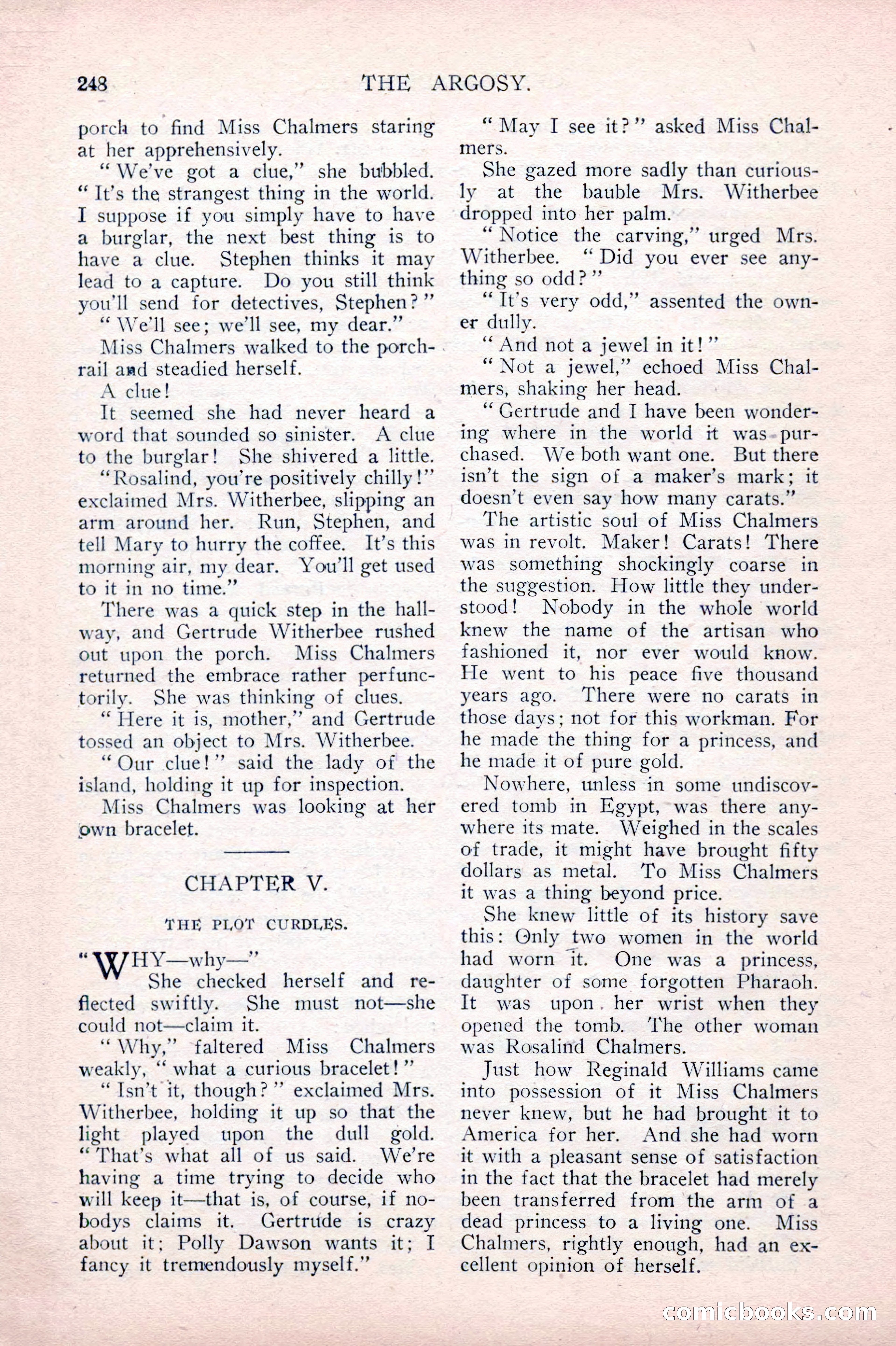
A restored page from Pulp Fiction, 1915. Page through the whole issue in the reader above.
📄 Transcribed text from this page (OCR, searchable)
Machine-transcribed from the original scan — historical spelling and the odd misread are preserved.
248 THE porch to find Miss Chalmers staring at her apprehensively. “We've got a clue,” she bubbled. “It’s the strangest thing in the world. I suppose if you simply have to have a burglar, the next best thing is to have a clue. Stephen thinks it may lead to a capture. Do you still think you'll send for detectives, Stephen?” “ We'll see; we'll see, my dear.” Miss Chalmers walked to the porch-. rail and steadied herself. A clue! It seemed she had never heard a word that sounded so sinister. A clue to the burglar! She shivered a little. “Rosalind, you’re positively chilly!” exclaimed Mrs. Witherbee, slipping an arm around her. Run, Stephen, and tell Mary to hurry the coffee. It’s this morning air, my dear. You'll get used to it in no time.” There was a quick step in the hall- way, and Gertrude Witherbee rushed out upon the porch. Miss Chalmers returned the embrace rather perfunc- torily. She was thinking of clues. “ Here it is, mother,’ and Gertrude tossed an object to Mrs. Witherbee. “Our clue!” said the lady of the island, holding it up for inspection. Miss Chalmers was looking at her own bracelet. CHAPTER V. THE PLOT CURDLES. : HY—why—” She checked herself and re- flected swiftly. She must not—she could not—claim it. “Why,” faltered Miss Chalmers weakly, ‘“ what a curious bracelet! ”’ “Isn't it, though?’ exclaimed Mrs. Witherbee, holding it up so that the light played upon the dull gold. “That’s what all of us said. We're having a time trying to decide who will keep it—that is, of course, if no- bodys claims it. Gertrude is crazy about it; Polly Dawson wants it; I fancy it tremendously myself.” ARGOSY. “May I see it?” asked Miss Chal- mers. She gazed more sadly than curious- ly at the bauble Mrs. Witherbee dropped into her palm. “Notice the carving,” urged Mrs. Witherbee. ‘“ Did you ever see any- thing so odd?” “It’s very odd,” assented the own- er dully. “And not a jewel in it!” “Not a jewel,’ echoed Miss Chal- mers, shaking her head. ‘Gertrude and I have been wonder- ing where in the world it was-pur- chased. We both want one. But there isn’t the sign of a maker’s mark; it doesn’t even say how many carats.” The artistic soul of Miss Chalmers was in revolt. Maker! Carats! There was something shockingly coarse in the suggestion. How little they under- stood! Nobody in the whole world knew the name of the artisan who fashioned it, nor ever would know. He went to his peace five thousand years ago. There were no carats in those days; not for this workman. For he made the thing for a princess, and he made it of pure gold. Nowhere, unless in some undiscov- ered tomb in Egypt, was there any- where its mate. Weighed in the scales of trade, it might have brought fifty dollars as metal. To Miss Chalmers it was a thing beyond price. She knew little of its history save this: Qnly two women in the world had worn it. One was a princess, daughter of some forgotten Pharaoh. It was upon. her wrist when they opened the tomb. The other woman was Rosalind Chalmers. Just how Reginald Williams came into possession of it Miss Chalmers never knew, but he had brought it to America for her. And she had worn it with a pleasant sense of satisfaction in the fact that the bracelet had merely been transferred from the arm of a dead princess to a living one. Miss Chalmers, rightly enough, had an ex- cellent opinion of herself. ECORNICLOOO S (C@)