
Pulp Fiction, 1915 · page 32 of 246
The Argosy, September 1915 — page 32: what you’re looking at
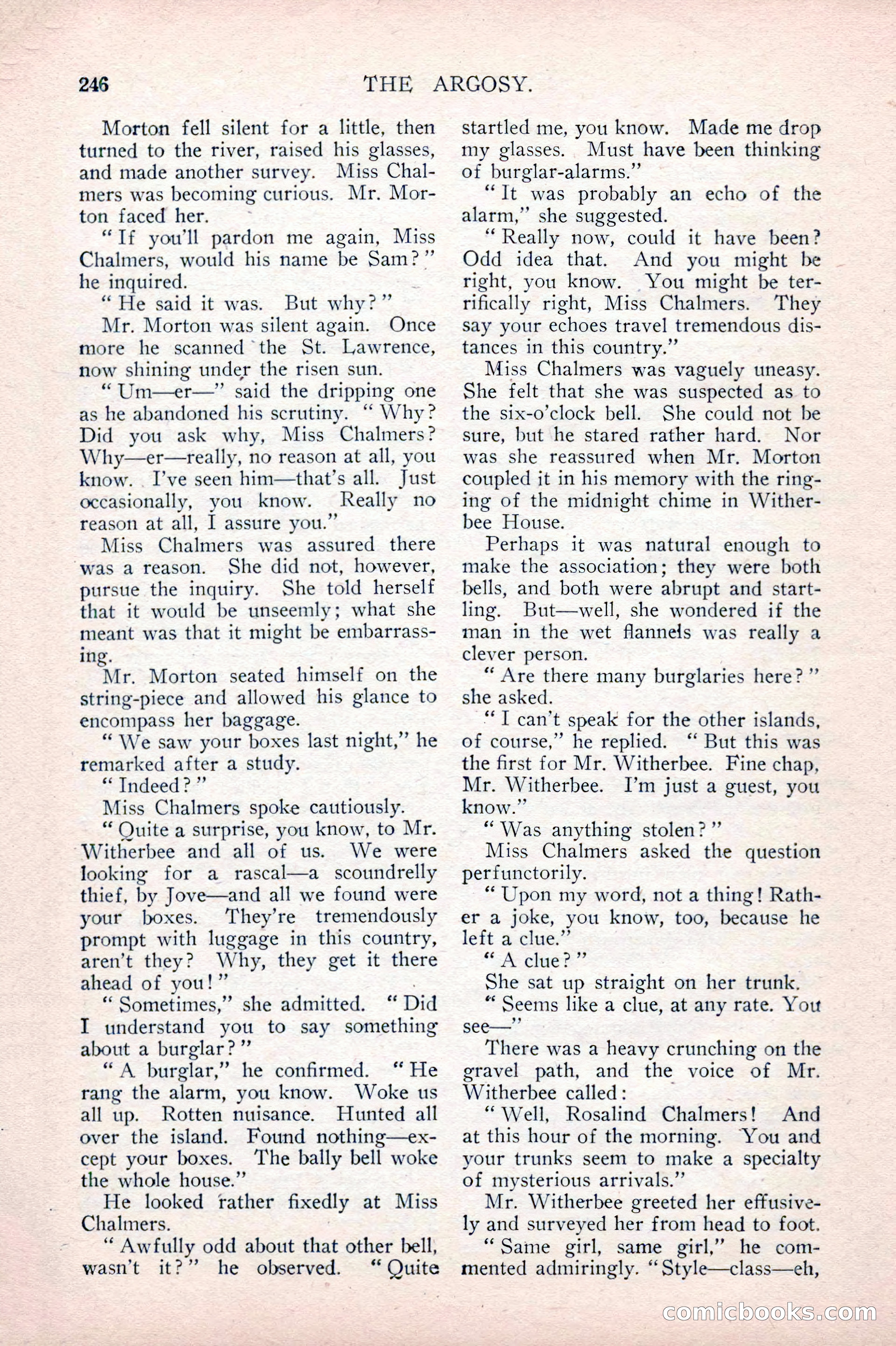
A restored page from Pulp Fiction, 1915. Page through the whole issue in the reader above.
📄 Transcribed text from this page (OCR, searchable)
Machine-transcribed from the original scan — historical spelling and the odd misread are preserved.
246 Morton fell silent for a little, then turned to the river, raised his glasses, and made another survey. Miss Chal- mers was becoming curious. Mr. Mor- ton faced her. “Tf you'll pardon me again, Miss Chalmers, would his name be Sam?” he inquired. “He said it was. But why?” Mr. Morton was silent again. Once more he scanned the St. Lawrence, now shining under the risen sun. “ Um—er—” said the dripping one as he abandoned his scrutiny. “ Why? Did you ask why, Miss Chalmers? Why—er—really, no reason at all, you know. . I’ve seen him—that’s all. Just occasionally, you know. Really no reason at all, I assure you.” Miss Chalmers was assured there ‘was a reason. She did not, however, pursue the inquiry. She told herself that it would be unseemly; what she meant was that it might be embarrass- ing. Mr. Morton seated himself on the string-piece and allowed his glance to encompass her baggage. “We saw your boxes last night,” he remarked after a study. “Indeed?” Miss Chalmers spoke cautiously. “ Quite a surprise, you know, to Mr. Witherbee and all of us. We were looking for a rascal—a _ scoundrelly thief, by Jove—and all we found were your boxes. They’re tremendously prompt with luggage in this country, aren't they? Why, they get it there ahead of you!” | “ Sometimes,” she admitted. ‘ Did IT understand you to say something about a burglar?” “A burglar,” he confirmed. “ He rang the alarm, you know. Woke us all up. Rotten nuisance. Hunted all over the island. Found nothing—ex- cept your boxes. The bally bell woke the whole house.” He looked rather fixedly at Miss Chalmers. “ Awfully odd about that other bell, wasn't it?” he observed. “ Quite THE ARGOSY. startled me, you know. Made me drop my glasses. Must have been thinking of burglar-alarms.”’ “It was probably an echo of the alarm,’ she suggested. ‘Really now, could it have been? Odd idea that. And you might be right, you know. You might be ter- rifically right, Miss Chalmers. They say your echoes travel tremendous dis- tances in this country.” Miss Chalmers was vaguely uneasy. She felt that she was suspected as to the six-o’clock bell. She could not be sure, but he stared rather hard. Nor was she reassured when Mr. Morton coupled it in his memory with the ring- ing of the midnight chime in Wither- bee House. Perhaps it was natural enough to make the association; they were both bells, and both were abrupt and start- ling. But—well, she wondered if the man in the wet flannels was really a clever person. “Are there many burglaries here?” she asked. ““T can’t speak for the other islands, of course,” he replied. “ But this was the first for Mr. Witherbee. Fine chap, Mr. Witherbee. I’m just a guest, you know.”’ “Was anything stolen?” Miss Chalmers asked the question perfunctorily. “Upon my word, not a thing! Rath- er a joke, you know, too, because he leit aclue;* “Ac clue?” She sat up straight on her trunk. “ Seems like a clue, at any rate. Yout see—"” There was a heavy crunching on the gravel path, and the voice of Mr. Witherbee called: “Well, Rosalind Chalmers! And at this hour of the morning. You and your trunks seem to make a specialty of mysterious arrivals.” Mr. Witherbee greeted her effusive- ly and surveyed her from head to foot. “Same girl, same girl,” he com- mented admiringly. “Style—class—eh, Go .OO AMG S (C@)