
Pulp Fiction, 1915 · page 24 of 246
The Argosy, September 1915 — page 24: what you’re looking at
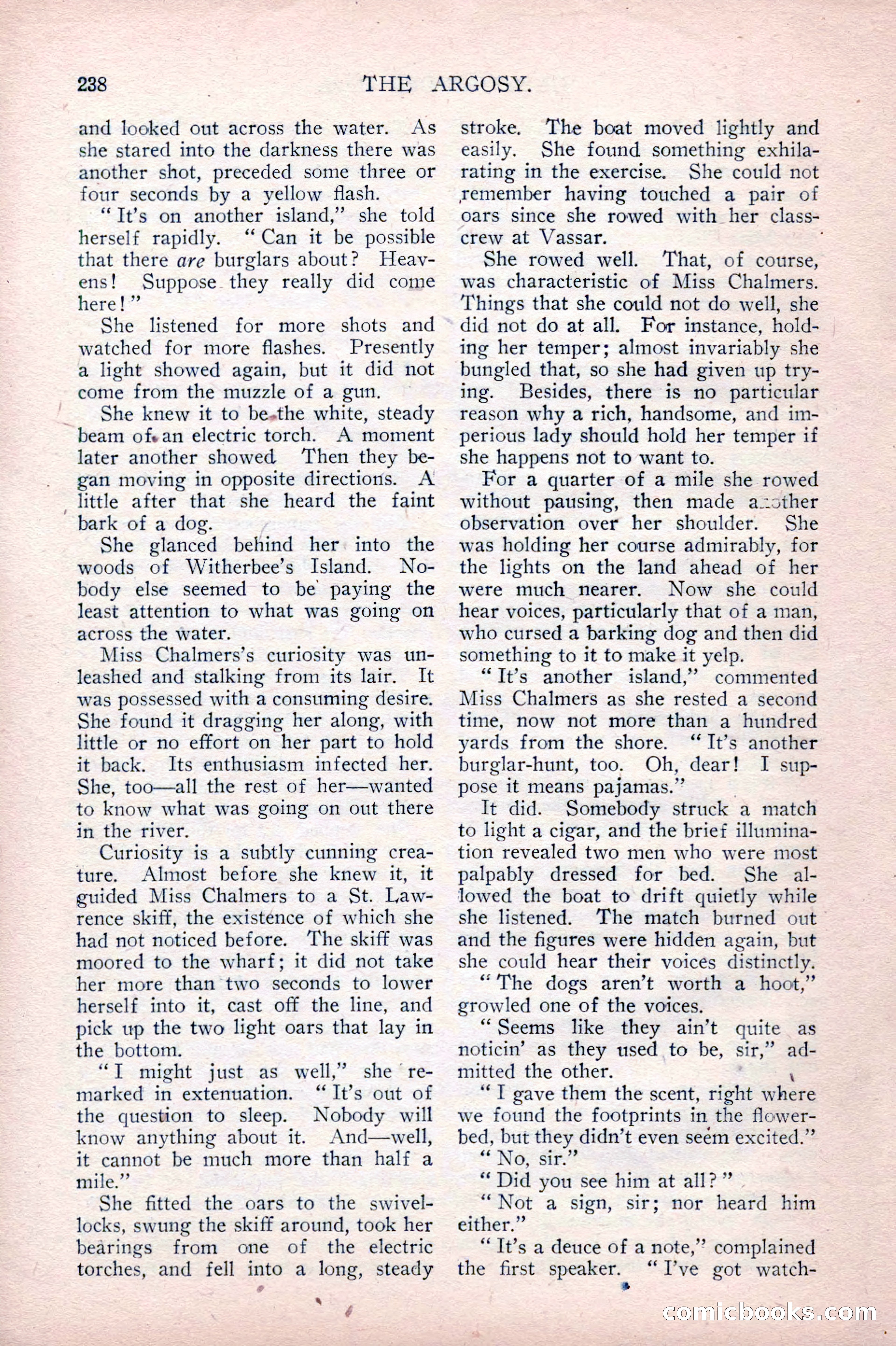
A restored page from Pulp Fiction, 1915. Page through the whole issue in the reader above.
📄 Transcribed text from this page (OCR, searchable)
Machine-transcribed from the original scan — historical spelling and the odd misread are preserved.
~ 238 and looked out across the water. As she stared into the darkness there was another shot, preceded some three or four seconds by a yellow flash. “Tt’s on another island,’ she told herself rapidly. “Can it be possible that there are burglars about? Heav- ens! Suppose they really did come here!” She listened for more shots and watched for more flashes. Presently a light showed again, but it did not come from the muzzle of a gun. She knew it to be.the white, steady ~ beam ofean electric torch. A moment later another showed ‘Then they be- gan moving in opposite directions. A little after that she heard the faint bark of a dog. She glanced behind her into the woods of Witherbee’s Island. No- body else seemed to be paying the least attention to what was going on across the water. Miss Chalmers’s curiosity was un- leashed and stalking from its lair. It was possessed with a consuming desire. She found it dragging her along, with little or no effort on her part to hold it back. Its enthusiasm infected her. She, too—all the rest of her—wanted to know what was going on out there in the river. Curiosity is a subtly cunning crea- ture. Almost before she knew it, it guided Miss Chalmers to a St. Law- rence skiff, the existence of which she had not noticed before. The skiff was moored to the wharf; it did not take her more than two seconds to lower herself into it, cast off the line, and pick up the two light oars that lay in the bottom. “JT might just as well,’ she re- marked in extenuation. “ It’s out of the question to sleep. Nobody will know anything about it. And—well, it cannot be much more than half a mile.”’ She fitted the oars to the swivel- locks, swung the skiff around, took her bearings from one of the electric torches, and fell into a long, steady 8 é THE ARGOSY. stroke. The boat moved lightly and easily. She found something exhila- rating in the exercise. She could not remember having touched a pair of oars since she rowed with her class- crew at Vassar. She rowed well. That, of course, was characteristic of Miss Chalmers. Things that she could not do well, she did not do at all. For instance, hold- ing her temper; almost invariably she bungled that, so she had given up try- ing. Besides, there is no particular reason why a rich, handsome, and im- perious lady should hold her temper if she happens not to want to. For a quarter of a mile she rowed without pausing, then made a-cother observation over her shoulder. She was holding her course admirably, for the lights on the land ahead of her were much nearer. Now she could hear voices, particularly that of a man, who cursed a barking dog and then did something to it to make it yelp. “It’s another island,’ commented Miss Chalmers as she rested a second time, now not more than a hundred yards from the shore. “ It’s another burglar-hunt, too. Oh, dear! I sup- pose it means pajamas.” It did. Somebody struck a match to light a cigar, and the brief illumina- tion revealed two men who were most palpably dressed for bed. She al- lowed the boat to drift quietly while she listened. "The match burned out and the figures were hidden again, but she could hear their voices distinctly. “The dogs aren’t worth a hoot,” growled one of the voices. “Seems like they ain’t quite as noticin’ as they used to be, sir,” ad- mitted the other. ‘““T gave them the scent, right whee we found the footprints in the flower- bed, but they didn’t even seem excited.” “No, sir.” “Did you see him at all?” “Not a sign, sir; nor heard him either.” “It’s a deuce of a note,’ complained the first speaker. “ve got watch- & CORMICGLOOKS (E@)