
Pulp Fiction, 1915 · page 238 of 246
The Argosy, September 1915 — page 238: what you’re looking at
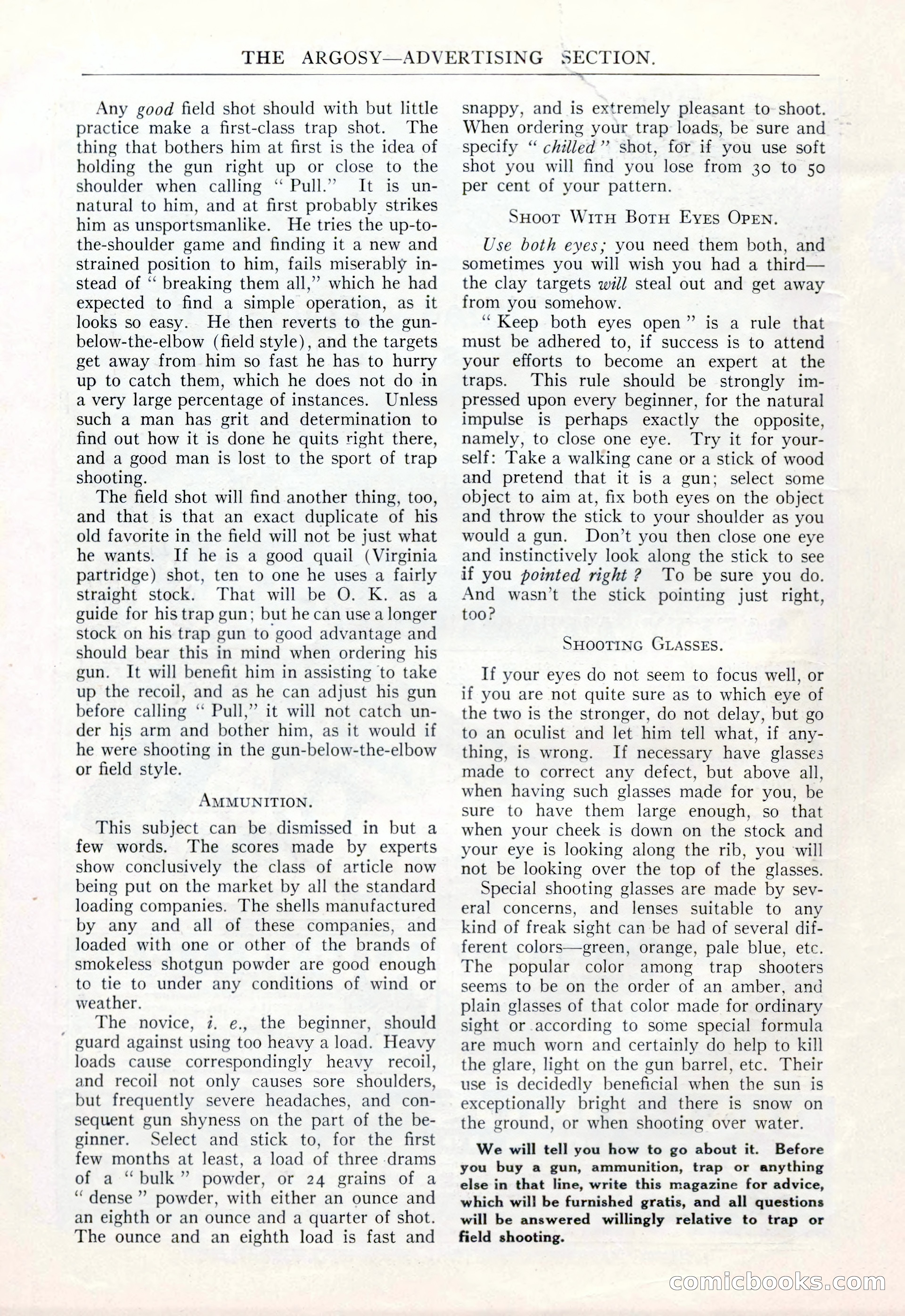
A restored page from Pulp Fiction, 1915. Page through the whole issue in the reader above.
📄 Transcribed text from this page (OCR, searchable)
Machine-transcribed from the original scan — historical spelling and the odd misread are preserved.
THE ARGOSY—ADVERTISING SECTION. Any good field shot should with but little practice make a first-class trap shot. The thing that bothers him at first is the idea of holding the gun right up or close to the shoulder when calling ‘‘ Pull.” It is un- natural to him, and at first probably strikes him as unsportsmanlike. He tries the up-to- the-shoulder game and finding it a new and strained position to him, fails miserably in- stead of “‘ breaking them all,’ which he had expected to find a simple operation, as it looks so easy. He then reverts to the gun- below-the-elbow (field style), and the targets get away from him so fast he has to hurry up to catch them, which he does not do in a very large percentage of instances. Unless such a man has grit and determination to find out how it is done he quits right there, and a good man is lost to the sport of trap shooting. The field shot will find another thing, too, and that is that an exact duplicate of his old favorite in the field will not be just what he wants. If he is a good quail (Virginia partridge) shot, ten to one he uses a fairly straight stock. That will be O. K. as a guide for his trap gun; but he can use a longer stock on his trap gun to good advantage and should bear this in mind when ordering his gun. It will benefit him in assisting to take up the recoil, and as he can adjust his gun before calling ‘‘ Pull,” it will not catch un- der his arm and bother him, as it would if he were shooting in the gun-below-the-elbow or field style. AMMUNITION. This subject can be dismissed in but a few words. The scores made by experts show conclusively the class of article now being put on the market by all the standard loading companies. The shells manufactured by any and all of these companies, and loaded with one or other of the brands of smokeless shotgun powder are good enough to tie to under any conditions of wind or weather. The novice, 7. e., the beginner, should - guard against using too heavy a load. Heavy loads cause correspondingly heavy recoil, and recoil not only causes sore shoulders, but frequently severe headaches, and con- sequent gun shyness on the part of the be- ginner. Select and stick to, for the first few months at least, a load of three drams of a “bulk” powder, or 24 grains of a “dense ” powder, with either an ounce and an eighth or an ounce and a quarter of shot. The ounce and an eighth load is fast and snappy, and is extremely pleasant to shoot. When ordering your trap loads, be sure and specify “ chilled”’ shot, for if you use soft shot you will find you lose from 30 to 50 per cent of your pattern. SHoot WitH Botu Eves OPEN. Use both eyes; you need them both, and sometimes you will wish you had a third— the clay targets wild steal out and get away from you somehow. ‘Keep both eyes open” is a rule that must be adhered to, if success is to attend your efforts to become an expert at the traps. This rule should be strongly im- pressed upon every beginner, for the natural impulse is perhaps exactly the opposite, namely, to close one eye. Try it for your- self: Take a walking cane or a stick of wood and pretend that it is a gun; select some object to aim at, fix both eyes on the object and throw the stick to your shoulder as you would a gun. Don’t you then close one eye and instinctively look along the stick to see if you pointed right ? To be sure you do. And wasn’t the stick pointing just right, too? SHOOTING GLASSES. If your eyes do not seem to focus well, or if you are not quite sure as to which eye of the two is the stronger, do not delay, but go to an oculist and let him tell what, if any- thing, is wrong. If necessary have glasses made to correct any defect, but above all, when having such glasses made for you, be sure to have them large enough, so that when your cheek is down on the stock and your eye is looking along the rib, you will not be looking over the top of the glasses. Special shooting glasses are made by sev- eral concerns, and lenses suitable to any kind of freak sight can be had of several dif- ferent colors—green, orange, pale blue, etc. The popular color among trap shooters seems to be on the order of an amber, and plain glasses of that color made for ordinary sight or according to some special formula are much worn and certainly do help to kill the glare, light on the gun barrel, etc. Their use is decidedly beneficial when the sun is exceptionally bright and there is snow on the ground, or when shooting over water. We will tell you how to go about it. Before you buy a gun, ammunition, trap or anything else in that line, write this magazine for advice, which will be furnished gratis, and all questions will be answered willingly relative to trap or field shooting. COnmiICLOOokKSs (C@