
Pulp Fiction, 1915 · page 210 of 246
The Argosy, September 1915 — page 210: what you’re looking at
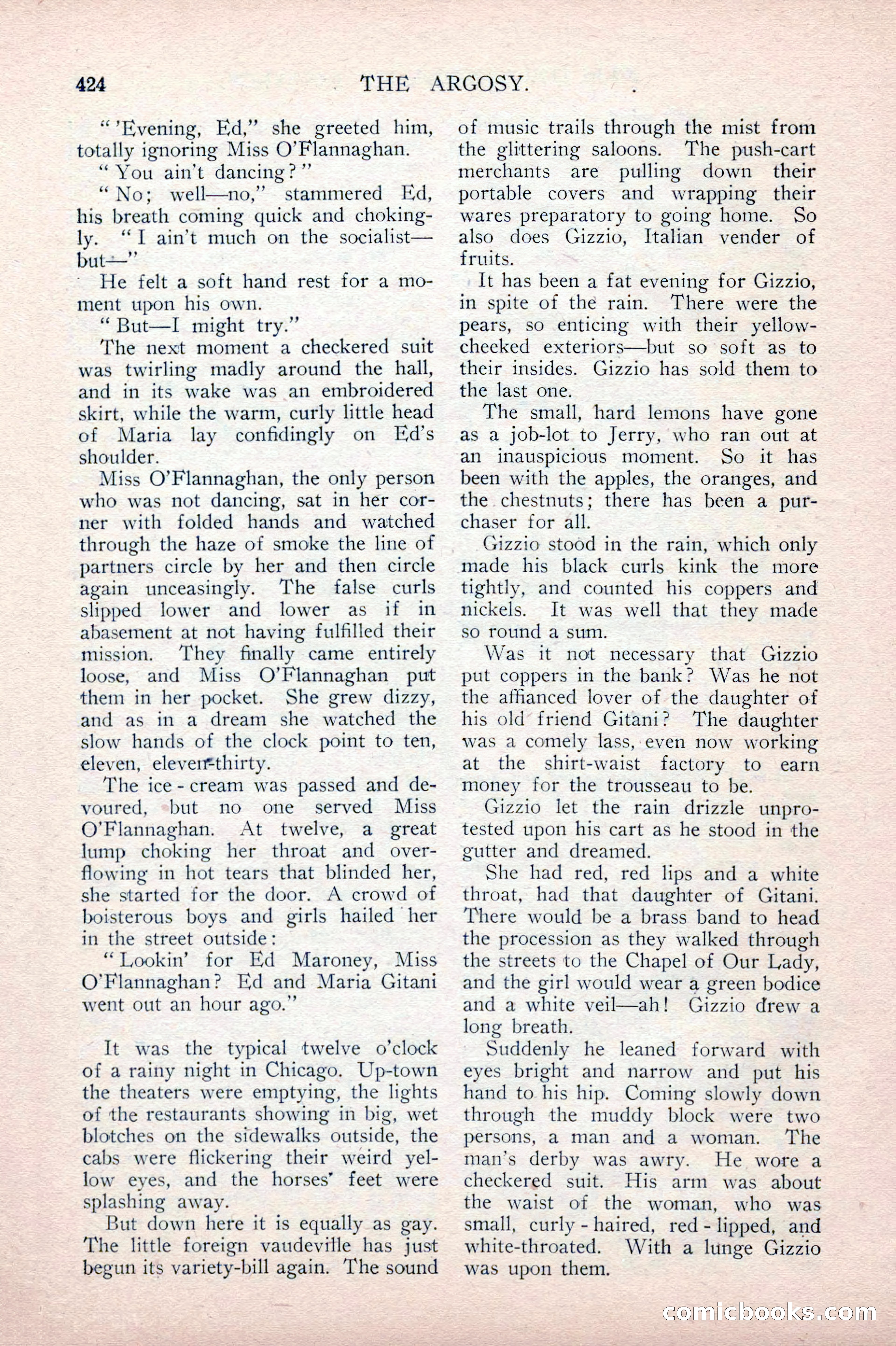
A restored page from Pulp Fiction, 1915. Page through the whole issue in the reader above.
📄 Transcribed text from this page (OCR, searchable)
Machine-transcribed from the original scan — historical spelling and the odd misread are preserved.
424 “Evening, Ed,” she greeted him, totally ignoring Miss O’Flannaghan. “You ain't dancing?”’ “No; well—no,”’ stammered Ed, his breath coming quick and choking- ly. “I ain’t much on the socialist— but—”’ He felt a soft hand rest for a mo- ment upon his own. ‘“ But—I might try.” The next moment a checkered suit was twirling madly around the hall, and in its wake was an embroidered skirt, while the warm, curly little head of Maria lay confidingly on Ed’s shoulder. Miss O’Flannaghan, the only person who was not dancing, sat in her cor- ner with folded hands and watched through the haze of smoke the line of partners circle by her and then circle again unceasingly. The false curls slipped lower and lower as if in abasement at not having fulfilled their mission. They finally came entirely loose, and Miss O’Flannaghan put them in her pocket. She grew dizzy, and as in a dream she watched the slow hands of the clock point to ten, eleven, elevertthirty. The ice - cream was passed and de- voured, but no one served Miss O’Flannaghan. At twelve, a_ great lump choking her throat and _ over- flowing in hot tears that blinded her, she started for the door. A crowd of boisterous boys and girls hailed her in the street outside: “TLookin’ for Ed Maroney, Miss O’Flannaghan? Ed and Maria Gitani went out an hour ago.” It was the typical twelve o’clock of a rainy night in Chicago. Up-town the theaters were emptying, the lights of the restaurants showing in big, wet blotches on the sidewalks outside, the cabs were flickering their weird yel- low eyes, and the horses’ feet were splashing away. But down here it is equally as gay. The little foreign vaudeville has just begun its variety-bill again. The sound THE ARGOSY. of music trails through the mist from the glittering saloons. The push-cart merchants are pulling down their portable covers and wrapping their wares preparatory to going home. So also does Gizzio, Italian vender of fruits. It has been a fat evening for Gizzio, in spite of the rain. There were the pears, so enticing with their yellow- cheeked exteriors—but so soft as to their insides. Gizzio has sold them to the last one. The small, hard lemons have gone as a job-lot to Jerry, who ran out at an inauspicious moment. So it has been with the apples, the oranges, and the chestnuts; there has been a pur- chaser for all. Gizzio stood in the rain, which only made his black curls kink the more tightly, and counted his coppers and nickels. It was well that they made so round a sum. Was it not necessary that Gizzio put coppers in the bank? Was he not the afhanced lover of the daughter of his old friend Gitani? The daughter was a comely lass, even now working at the shirt-waist factory to earn money for the trousseau to be. Gizzio let the rain drizzle unpro- tested upon his cart as he stood in the eutter and dreamed. She had red, red lips and a white throat, had that daughter of Gitani. There would be a brass band to head the procession as they walked through the streets to the Chapel of Our Lady, and the girl would wear a green bodice and a white veil—ah! Gizzio drew a long breath. Suddenly he leaned forward with eyes bright and narrow and put his hand to his hip. Coming slowly down through the muddy block were two persons, a man and a woman. The man’s derby was awry. He wore a checkered suit. His arm was about the waist of the woman, who was small, curly - haired, red - lipped, and white-throated. With a lunge Gizzio was upon them. (COMMU DOOKS (E@)