
Pulp Fiction, 1915 · page 19 of 246
The Argosy, September 1915 — page 19: what you’re looking at
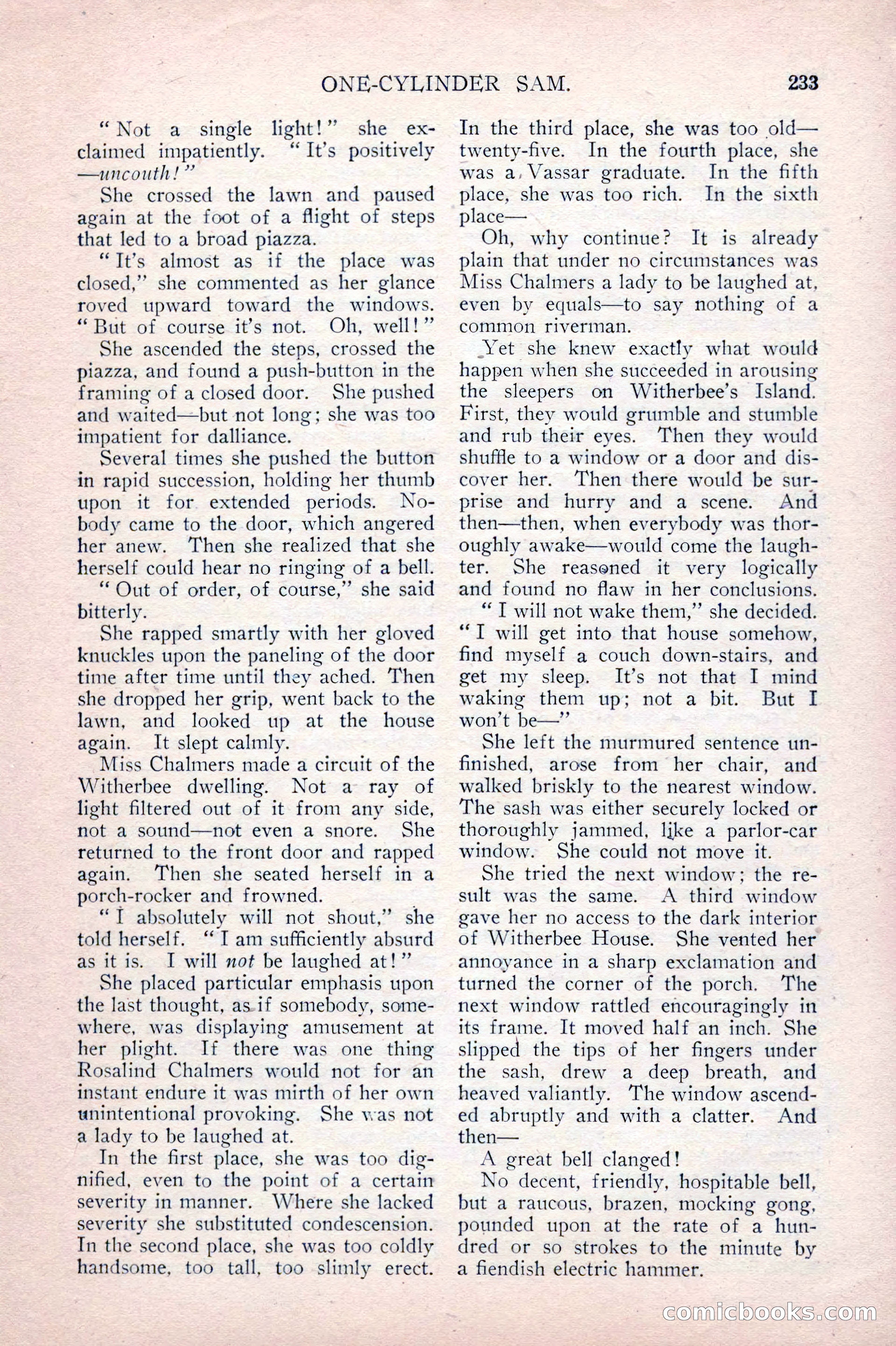
A restored page from Pulp Fiction, 1915. Page through the whole issue in the reader above.
📄 Transcribed text from this page (OCR, searchable)
Machine-transcribed from the original scan — historical spelling and the odd misread are preserved.
ONE-CYLINDER SAM. “Not a single light!” she ex- claimed impatiently. “It’s positively —uncouth!” She crossed the lawn and paused again at the foot of a flight of steps that led to a broad piazza. “Tt’s almost as if the place was closed,”” she commented as her glance roved upward toward the windows. “But of course it’s not. Oh, well!” She ascended the steps, crossed the piazza, and found a push-button in the framing of a closed door. She pushed and waited—but not long; she was too impatient for dalliance. Several times she pushed the button in rapid succession, holding her thumb upon it for extended periods. No- body came to the door, which angered her anew. Then she realized that she herself could hear no ringing of a bell. “Out of order, of course,” she said bitterly. She rapped smartly with her gloved knuckles upon the paneling of the door time after time until they ached. Then she dropped her grip, went back to the lawn, and looked up at the house again. It slept calmly. Miss Chalmers made a circuit of the Witherbee dwelling. Not a ray of light filtered out of it from any side, not a sound—not even a snore. She returned to the front door and rapped again. Then she seated herself in a porch-rocker and frowned. . “T absolutely will not shout,” she told herself. ‘I am sufficiently absurd as itis. I will mot be laughed at!” She placed particular emphasis upon the last thought, as.if somebody, some- where, was displaying amusement at her plight. If there was one thing Rosalind Chalmers would not for an instant endure it was mirth of her own unintentional provoking. She was not a lady to be laughed at. In the first place, she was too dig- nified, even to the point of a certain severity in manner. Where she lacked severity she substituted condescension. In the second place, she was too coldly handsome, too tall, too slimly erect. 233 In the third place, she was too old— twenty-five. In the fourth place, she was a, Vassar graduate. In the fifth place, she was too rich. In the sixth place— Oh, why continue? It is already plain that under no circumstances was Miss Chalmers a lady to be laughed at, even by equals—to say nothing of a common riverman. Yet she knew exactly what would happen when she succeeded in arousing the sleepers on Witherbee’s Island. First, they would grumble and stumble and rub their eyes. Then they would shuffle to a window or a door and dis- cover her. Then there would be sur- prise and hurry and a scene. And then—then, when everybody was thor- oughly awake—would come the laugh- ter. She reasoned it very logically and found no flaw in her conclusions. ** T will not wake them,” she decided. “T will get into that house somehow, find myself a couch down-stairs, and get my sleep. It’s not that I mind waking them up; not a bit. But I won't be—” She left the murmured sentence un- finished, arose from her chair, and walked briskly to the nearest window. The sash was either securely locked or thoroughly jammed, like a parlor-car window. She could not move it. She tried the next window; the re- sult was the same. A third window gave her no access to the dark interior of Witherbee House. She vented her annoyance in a sharp exclamation and turned the corner of the porch. The next window rattled encouragingly in its frame. It moved half an inch. She slipped the tips of her fingers under the sash, drew a deep breath, and heaved valiantly. The window ascend- ed abruptly and with a clatter. And then— A great bell clanged! No decent, friendly, hospitable bell, but a raucous, brazen, mocking gong, pounded upon at the rate of a hun- dred or so strokes to the minute by a fiendish electric hammer. EOPMNICLOOOKS (C@)