
Pulp Fiction, 1915 · page 17 of 246
The Argosy, September 1915 — page 17: what you’re looking at
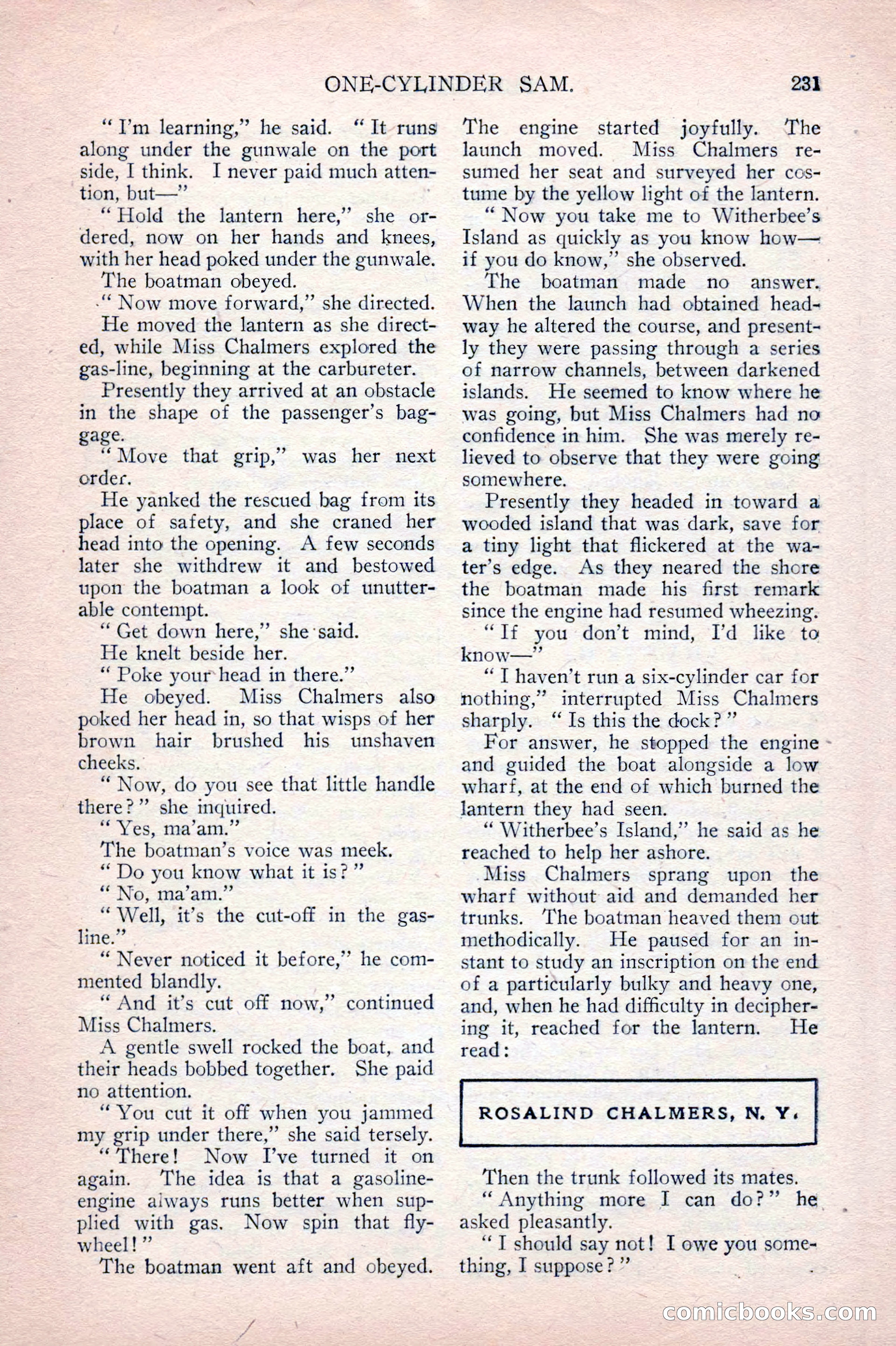
A restored page from Pulp Fiction, 1915. Page through the whole issue in the reader above.
📄 Transcribed text from this page (OCR, searchable)
Machine-transcribed from the original scan — historical spelling and the odd misread are preserved.
ONE-CYLINDER SAM. “T’m learning,” he said. “ It runs along under the gunwale on the port side, I think. I never paid much atten tion, but—” : “Hold the lantern here,’ she or- dered, now on her hands and knees, with her head poked under the gunwale. The boatman obeyed. -“ Now move forward,” she directed. He moved the lantern as she direct- ed, while Miss Chalmers explored the gas-line, beginning at the carbureter. Presently they arrived at an obstacle in the shape of the passenger’s bag- gage. “Move that grip,’ was her next order. He yanked the rescued bag from its place of safety, and she craned her _ head into the opening. A few seconds later she withdrew it and bestowed upon the boatman a look of unutter- able contempt. “Get down here,” she‘said. He knelt beside her. “Poke your head in there.” He obeyed. Miss Chalmers also poked her head in, so that wisps of her brown hair brushed his unshaven cheeks. “ Now, do you see that little handle there? ”’ she inquired. ‘Yes, ma’am.” The boatman’s voice was meek, “Do you know what it is?” “* No, ma’am.” “Well, it’s the cut-off in the gas- line.” * Never noticed it before,” he com- mented blandly. “ And it’s cut off now,” continued Miss Chalmers. A gentle swell rocked the boat, and their heads bobbed together. She paid no attention. 3 “You cut it off when you jammed my grip under there,’’ she said tersely. “There! Now I’ve turned it on again. The idea is that a gasoline- engine always runs better when sup- plied with gas. Now spin that fly- wheel!” The boatman went aft and obeyed. 231 The engine started joyfully. The launch moved. Miss Chalmers re- sumed her seat and surveyed her cos- tume by the yellow light of the lantern. “Now you take me to Witherbee’s Island as quickly as you know how— if you do know,” she observed. The boatman made no answer. When the launch had obtained head- way he altered the course, and present- ly they were passing through a series of narrow channels, between darkened islands. He seemed to know where he was going, but Miss Chalmers had no confidence in him. She was merely re- lieved to observe that they were going somewhere. Presently they headed in toward a wooded island that was dark, save for a tiny light that flickered at the wa- ter’s edge. As they neared the shore the boatman made his first remark since the engine had resumed wheezing. “Jf you don’t mind, I'd like to know—” “T haven’t run a six-cylinder car for nothing,” interrupted Miss Chalmers sharply. “Is this the dock?” For answer, he stopped the engine - and guided the boat alongside a low wharf, at the end of which burned the lantern they had seen. “ Witherbee’s Island,” he said as he reached to help her ashore. Miss Chalmers sprang upon the wharf without aid and demanded her trunks. The boatman heaved them out methodically. He paused for an in- stant to study an inscription on the end of a particularly bulky and heavy one, and, when he had difficulty in decipher- ing it, reached for the lantern. He read: ROSALIND CHALMERS, N. Y« Then the trunk followed its mates. “Anything more I can do?” he asked pleasantly. ‘““T should say not! I owe you some- thing, I suppose? ” COPMICLOOOKS (C@)