
Pulp Fiction, 1914 · page 72 of 258
The Argosy, August 1914 — page 72: what you’re looking at
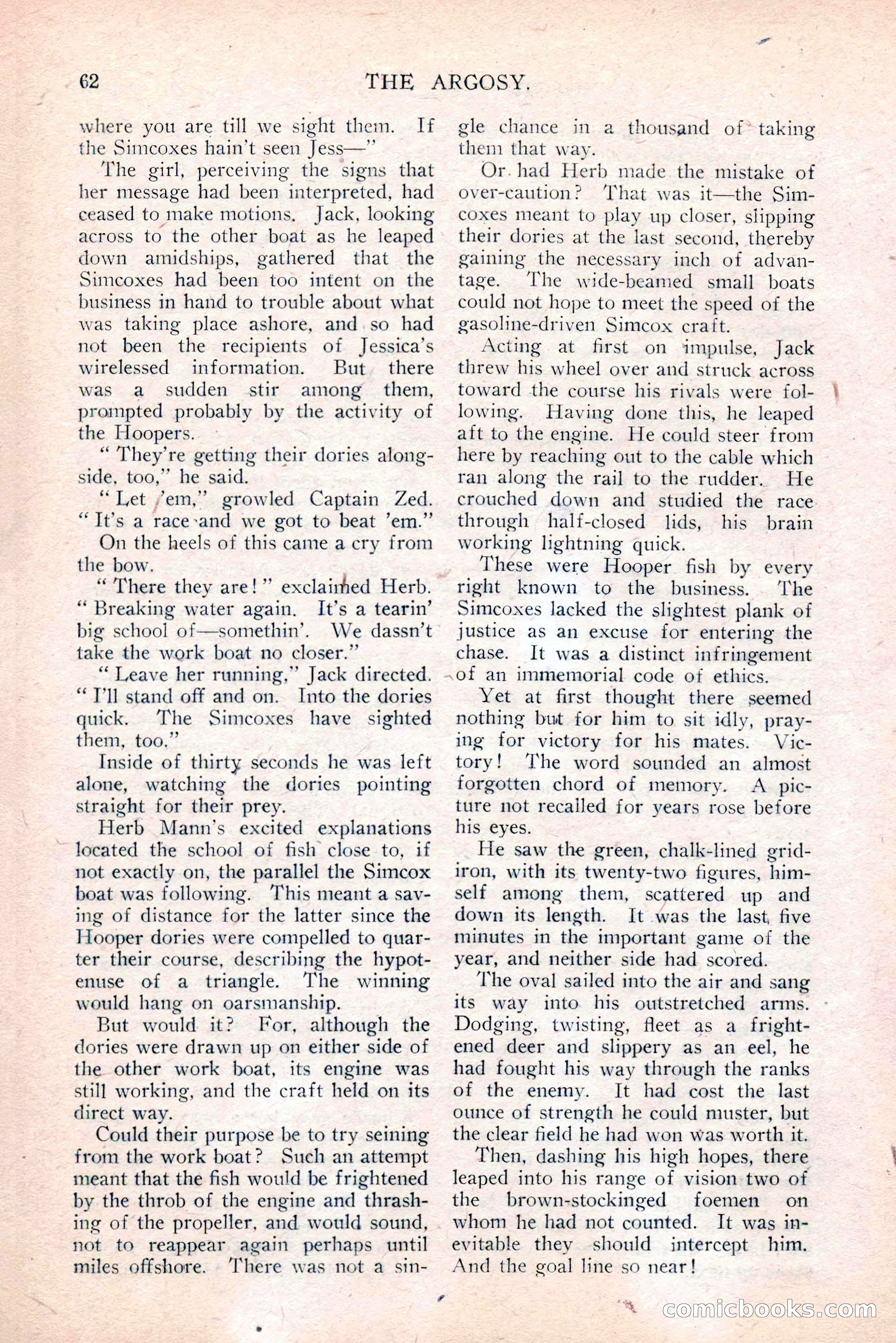
A restored page from Pulp Fiction, 1914. Page through the whole issue in the reader above.
📄 Transcribed text from this page (OCR, searchable)
Machine-transcribed from the original scan — historical spelling and the odd misread are preserved.
62 where you are till we sight them. If the Simcoxes hain't seen Jess—’’ The girl, perceiving the signs that her message had been interpreted, had ceased to make motions, Jack, looking across to the other boat as he leaped down amidships, gathered that the Simcoxes had been too intent on the business in hand to trouble about what was taking place ashore, and.so had not been the recipients of Jessica’s wirelessed information. But. there was a sudden stir among them, prompted probably by the activity of the Hoopers. “ They're getting their dories along- side, too,” he said. “Let ’em,” growled Captain Zed. “Tt’s a race-and we got to beat ’em.”’ On the heels of this came a cry from the bow. “There they are!” exclaimed Herb. “ Breaking water again. It’s a tearin’ big school of—somethin’. We dassn’t take the work boat no closer.” “Leave her running,” Jack directed. “Tl stand off and on. Into the dories quick. The Simcoxes have sighted them, too.” Inside of thirty seconds he was left alone, watching the dories pointing straight for their prey. Herb Mann’s excited explanations located the school of fish close to, if not exactly on, the parallel the Simcox boat was following. This meant a sav- ing of distance for the latter since the Hooper dories were compelled to quar- ter their course, describing the hypot- enuse of a triangle. The winning would hang on oarsmanship. But would it? For, although the dories were drawn up on either side of the other work boat, its engine was still working, and the craft held on its direct way. Could their purpose be to try seining from the work boat? Such an attempt meant that the fish would be frightened by the throb of the engine and thrash- ing of the propeller, and would sound, not to reappear again perhaps until miles offshore. ‘There was not a sin- THE ARGOSY. gle chance in a thousand of* taking them that way. Or. had Herb made the mistake of over-caution? ‘That was it—the Sim- coxes meant to play up closer, slipping their dories at the last second, thereby gaining the necessary inch of advan- tage. The wide-beamed small boats could not hope to meet the speed of the gasoline-driven Simcox craft. Acting at first on impulse, Jack threw his wheel over and struck across toward the course his rivals were fol- lowing. Having done this, he leaped aft to the engine. He could steer from here by reaching out to the cable which ran along the rail to the rudder. He crouched down and studied the race through half-closed lids, his brain working lightning quick. These were Hooper fish by every right known to the business. ‘The Simcoxes lacked the slightest plank of justice as an excuse for entering the chase. It was a distinct infringement .of an immemorial code of ethics. Yet at first thought there seemed nothing but for him to sit idly, pray- ing for victory for his mates. Vic- tory! The word sounded an almost forgotten chord of memory. A pic- ture not recailed for years rose before his eyes. He saw the green, chalk-lined grid- iron, with its twenty-two figures, him- self among them, scattered up and down its length. It was the last, five minutes in the important game of the year, and neither side had scored. The oval sailed into the air and sang its way into his outstretched arms. Dodging, twisting, fleet as a fright- ened deer and slippery as an eel, he had fought his way through the ranks of the enemy. It had cost the last ounce of strength he could muster, but the clear field he had won was worth it. Then, dashing his high hopes, there leaped into his range of vision two of the brown-stockinged foemen on whom he had not counted. It was in- evitable they should intercept him. And the goal line so near! *% COnmCcooOokKs (C@