
Pulp Fiction, 1914 · page 45 of 258
The Argosy, August 1914 — page 45: what you’re looking at
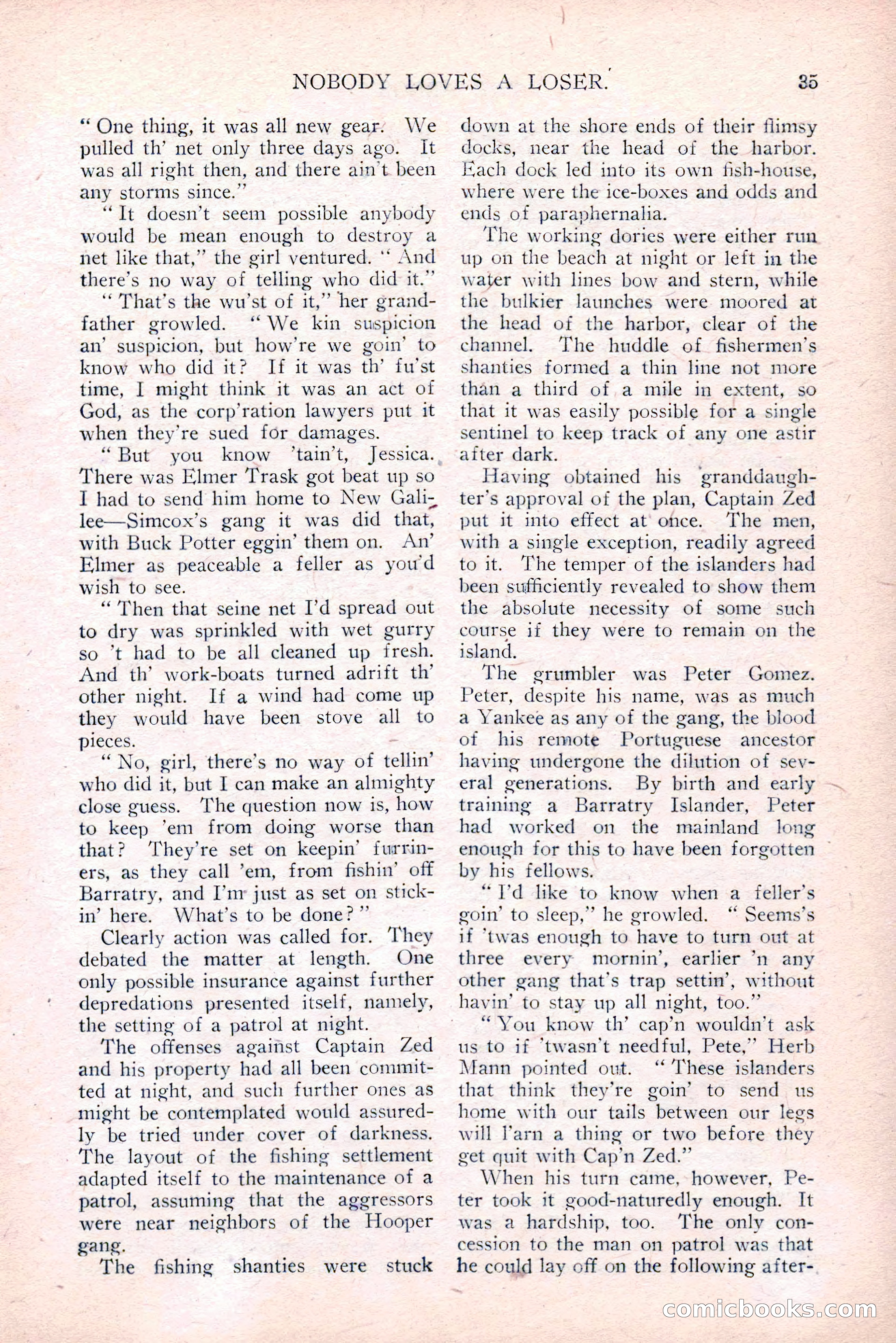
A restored page from Pulp Fiction, 1914. Page through the whole issue in the reader above.
📄 Transcribed text from this page (OCR, searchable)
Machine-transcribed from the original scan — historical spelling and the odd misread are preserved.
NOBODY LOVES A LOSER. “One thing, it was all new gear. We pulled th’ net only three days ago. It was all right then, and there ain't been any storms since.” ‘It doesn’t seem possible anybody would be mean enough to destroy a net like that,” the girl ventured. ‘* And there’s no way of telling who did it.” ‘’'That’s the wu’st of it,” her grand- father growled. ‘We kin suspicion an’ suspicion, but how're we goin’ to know who did it? If it was th’ fu’st time, | might think it was an act of God, as the corp’ration lawyers put it when they're sued for damages. “But you know ’tain’t, Jessica. There was Elmer Trask got beat up so I had to send him home to New Gali- lee—Simcox’s gang it was did that, with Buck Potter eggin’ them on. An’ Elmer as peaceable a feller as you'd wish to see. “Then that seine net I’d spread out to dry was sprinkled with wet gurry so ‘t had to be all cleaned up fresh. And th’ work-boats turned adrift th’ other night. If a wind had come up they would have been stove all to pieces. . “No, girl, there’s no way of tellin’ who did it, but I can make an almighty close guess. ‘The question now is, how to keep ’em from doing worse than that? ‘They’re set on keepin’ furrin- ers, as they call ’em, from fishin’ off Barratry, and [’nr just as set on stick- in’ here. What's to be done?” Clearly action was called for. They debated the matter at length. One only possible insurance against further depredations presented itself, namely, the setting of a patrol at night. The offenses against Captain Zed and his property had all been commit- ted at night, and such further ones as might be contemplated would assured- ly be tried under cover of darkness. The layout of the fishing settlement adapted itself to the maintenance of a patrol, assuming that the aggressors were near neighbors of the Hooper gang. The fishing shanties were stuck down at the shore ends of their flimsy docks, near the head of the harbor. Fach dock led into its own fish-house, where were the ice-boxes and odds and ends of paraphernalia. The working dories were either run up on the beach at night or left in the water with lines bow and stern, while the bulkier launches were moored at the head of the harbor, clear of the channel. The huddle of fishermen’s shanties formed a thin line not more than a third of.a mile in extent, so that it was easily possible for a single sentinel to keep track of any one astir aiter dark. Having obtained his granddaugh- ter’s approval of the plan, Captain Zed put it into effect at once. The men, with a single exception, readily agreed to it. The temper of the islanders had been sufficiently revealed to show them the absolute necessity of some such course if they were to remain on the island. The grumbler was Peter Gomez. Peter, despite his name, was as much a Yankee as any of the gang, the blood of his remote Portuguese ancestor having undergone the dilution of sev- eral generations. By birth and early training a Barratry Islander, Peter had worked on the mainland long 35 enough for this to have been forgotten — by his fellows. “Td like to know when a feller’s goin’ to sleep,” he growled. “ Seems’s if ‘twas enough to have to turn out at three every mornin’, earlier ‘n any other gang that’s trap settin’, without havin’ to stay up all night, too.” “You know th’ cap’n wouldn't ask us to if ‘twasn't needful, Pete,’ Herb Mann pointed out. ‘‘ These islanders that think they’re goin’ to send us home with our tails between our legs will Tarn a thing or two before they eet quit with Cap'n Zed.” When his turn came, however, Pe- ter took it good-naturedly enough. It was a hardship, too. The only con- cession to the man on patrol was that he could lay off on the following after- CORmMICLoOoks (C@