
Pulp Fiction, 1914 · page 32 of 258
The Argosy, August 1914 — page 32: what you’re looking at
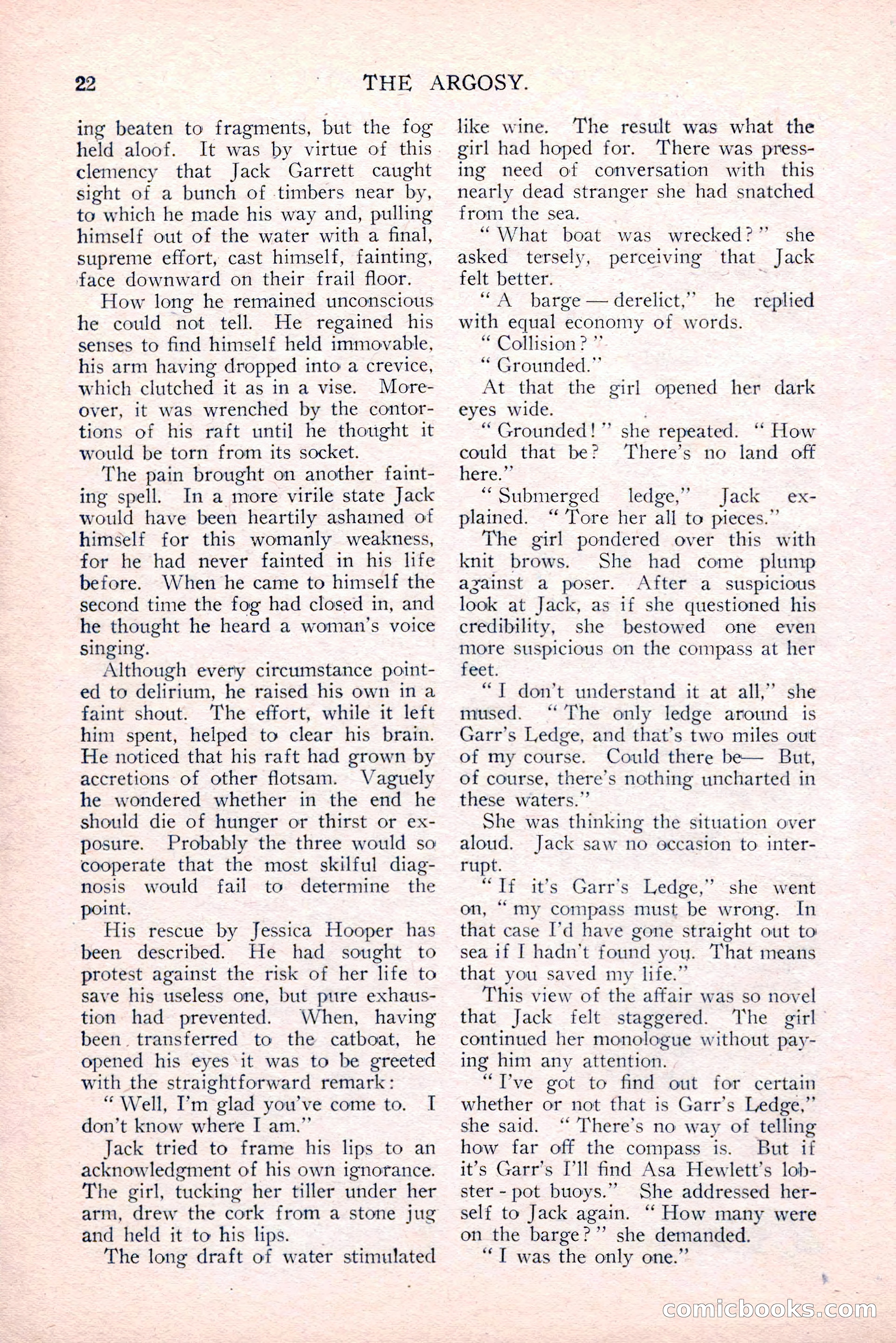
A restored page from Pulp Fiction, 1914. Page through the whole issue in the reader above.
📄 Transcribed text from this page (OCR, searchable)
Machine-transcribed from the original scan — historical spelling and the odd misread are preserved.
22 ing beaten to fragments, but the fog held aloof. It was by virtue of this clemency that Jack Garrett caught sight of a bunch of timbers near by, to which he made his way and, pulling himself out of the water with a final, supreme effort, cast himself, fainting, face downward on their frail floor. How long he remained unconscious he could not tell. He regained his senses to find himself held immovable, his arm having dropped into a crevice, which clutched it as in a vise. More- over, it was wrenched by the contor- tions of his raft until he thought it would be torn from its socket. The pain brought on another faint- ing spell. In a more virile state Jack would have been heartily ashamed of himself for this womanly weakness, for he had never fainted in his life before. When he came to himself the second time the fog had closed in, and he thought he heard a woman’s voice singing. Although every circumstance point- ed to delirium, he raised his own in a faint shout. The effort, while it left him spent, helped to clear his brain. He noticed that his raft had grown by accretions of other flotsam. Vaguely he wondered whether in the end he should die of hunger or thirst or ex- posure. Probably the three would so cooperate that the most skilful diag- nosis would fail to determine the point. His rescue by Jessica Hooper has been described. He had sought to protest against the risk of her life to save his useless one, but pure exhaus- tion had prevented. When, having been transferred to the catboat, he opened his eyes it was to be greeted with the straightforward remark: “Well, ’'m glad you’ve come to. I don’t know where I am.” Jack tried to frame his lips to an acknowledgment of his own ignorance. The girl, tucking her tiller under her arm, drew the cork from a stone jug and held it to his lips. The long draft of water stimulated THE ARGOSY. like wine. The result was what the girl had hoped for. There was press- ing need of conversation with this nearly dead stranger she had snatched from the sea. “What boat was wrecked?” she asked tersely, perceiving that Jack felt better. | “A barge — derelict,” he with equal economy of words. “ Collision? ” “ Grounded.” At that the girl opened her dark eyes wide. “ Grounded!” she repeated. ‘ How could that be? There’s no land off replied here.” “ Submerged ~ ledge,” Jack _ex- plained. “ Tore her all to pieces.” The girl pondered over this with knit brows. She had come plump azainst a poser. After a suspicious look at Jack, as if she questioned his credibility, she bestowed one even more suspicious on the compass at her feet. “J don’t understand it at all,” she mused. “The only ledge around is Garr’s Ledge, and that’s two miles out of my course. Could there be— But, of course, there’s nothing uncharted in these waters.” She was thinking the situation over aloud. Jack saw no occasion to inter- rupt. “Tf it’s Garr’s Ledge,’ she went on, “ my compass must be wrong. In that case I'd have gone straight out to sea if | hadn't found you. That means that you saved my life.” This view of the affair was so novel that Jack felt staggered. continued her monologue without pay- ing him any attention. “Tve got to find out for certain whether or not that is Garr’s Ledge,” she said. ‘‘ There’s no way of telling how far off the compass is. But if it’s Garr’s [ll find Asa Hewlett’s lob- ster - pot buoys.”’ She addressed her- self to Jack again. “ How many were on the barge?” she demanded. ‘*[T was the only one.” Gomichbook The girl (C©@)