
Pulp Fiction, 1914 · page 28 of 258
The Argosy, August 1914 — page 28: what you’re looking at
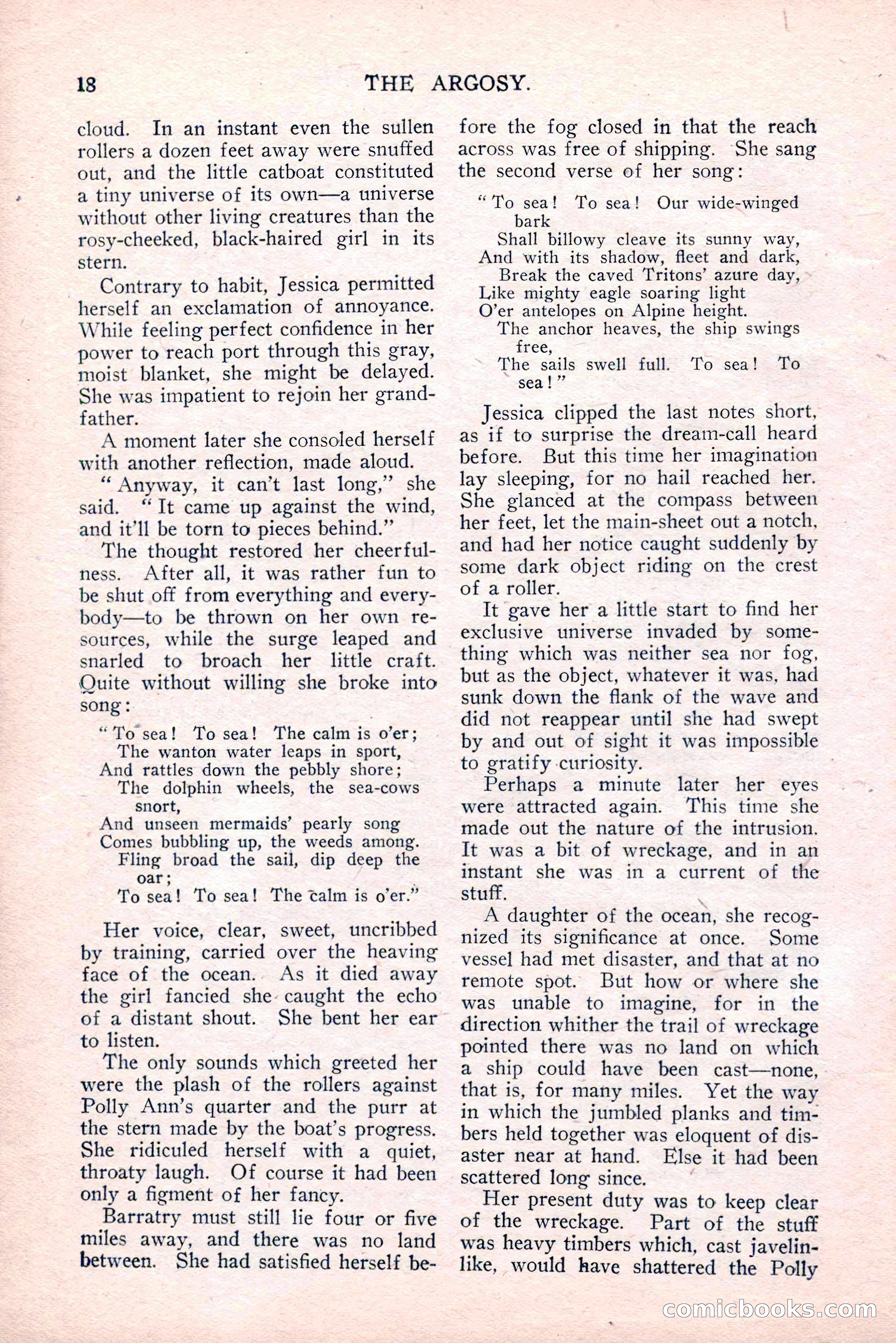
A restored page from Pulp Fiction, 1914. Page through the whole issue in the reader above.
📄 Transcribed text from this page (OCR, searchable)
Machine-transcribed from the original scan — historical spelling and the odd misread are preserved.
18 cloud. In an instant even the sullen rollers a dozen feet away were snuffed out, and the little catboat constituted a tiny universe of its own—a universe without other living creatures than the rosy-cheeked, black-haired girl in its stern. Contrary to habit, Jessica permitted herself an exclamation of annoyance. While feeling perfect confidence in her power to reach port through this gray, moist blanket, she might be delayed. She was impatient to rejoin her grand- father. A moment later she consoled herself with another reflection, made aloud. “ Anyway, it can’t last long,’ she said. “It came up against the wind, and it'll be torn to pieces behind.” The thought restored her cheerful- ness. After all, it was rather fun to be shut off from everything and every- body—to be thrown on her own re- sources, while the surge leaped and snarled to broach her little craft. Quite without willing she broke into song : “To sea! To sea! The calm is o’er; The wanton water leaps in sport, And rattles down the pebbly shore; The dolphin wheels, the sea-cows snort, And unseen mermaids’ pearly song Comes bubbling up, the weeds among. Fling broad the sail, dip deep the oar ; To sea! To sea! The calm is o’er.” Her voice, clear, sweet, tuncribbed by training, carried over the heaving face of the ocean.. As it died away the girl fancied she caught the echo of a distant shout. She bent her ear to listen. The only sounds which greeted her were the plash of the rollers against Polly Ann’s quarter and the purr at the stern made by the boat’s progress. She ridiculed herself with a quiet, throaty laugh. Of course it had been only a figment of her fancy. Barratry must still lie four or five miles away, and there was no land between. She had satisfied herself be- THE ARGOSY. fore the fog closed in that the reach across was free of shipping. She sang the second verse of her song: “To sea! To sea! Our wide-winged bark Shall billowy cleave its sunny way, And with its shadow, fleet and dark, Break the caved Tritons’ azure day, Like mighty eagle soaring light O’er antelopes on Alpine height. The anchor heaves, the ship swings free, The sails swell full. To sea!” To sea! Jessica clipped the last notes short, as if to surprise the dream-call heard before. But this time her imagination lay sleeping, for no hail reached her. She glanced at the compass between her feet, let the main-sheet out a notch, and had her notice caught suddenly by some dark object riding on the crest of a roller. It gave her a little start to find her exclusive universe invaded by some- thing which was neither sea nor fog, but as the object, whatever it was, had sunk down the flank of the wave and did not reappear until she had swept by and out of sight it was impossible to gratify curiosity. Perhaps a minute later her eyes were attracted again. This time she made out the nature of the intrusion. It was a bit of wreckage, and in an instant she was in a current of the stuff. A daughter of the ocean, she recog- nized its significance at once. Some vessel had met disaster, and that at no remote spot. But how or where she was unable to imagine, for in the direction whither the trail of wreckage pointed there was no land on which a ship could have been cast—none, that is, for many miles. Yet the way in which the jumbled planks and tim- bers held together was eloquent of dis- aster near at hand. Else it had been scattered long since. Her present duty was to keep clear of the wreckage. Part of the stuff was heavy timbers which, cast javelin- like, would have shattered the Polly Go 0) AMG SS (C@