
Pulp Fiction, 1914 · page 25 of 258
The Argosy, August 1914 — page 25: what you’re looking at
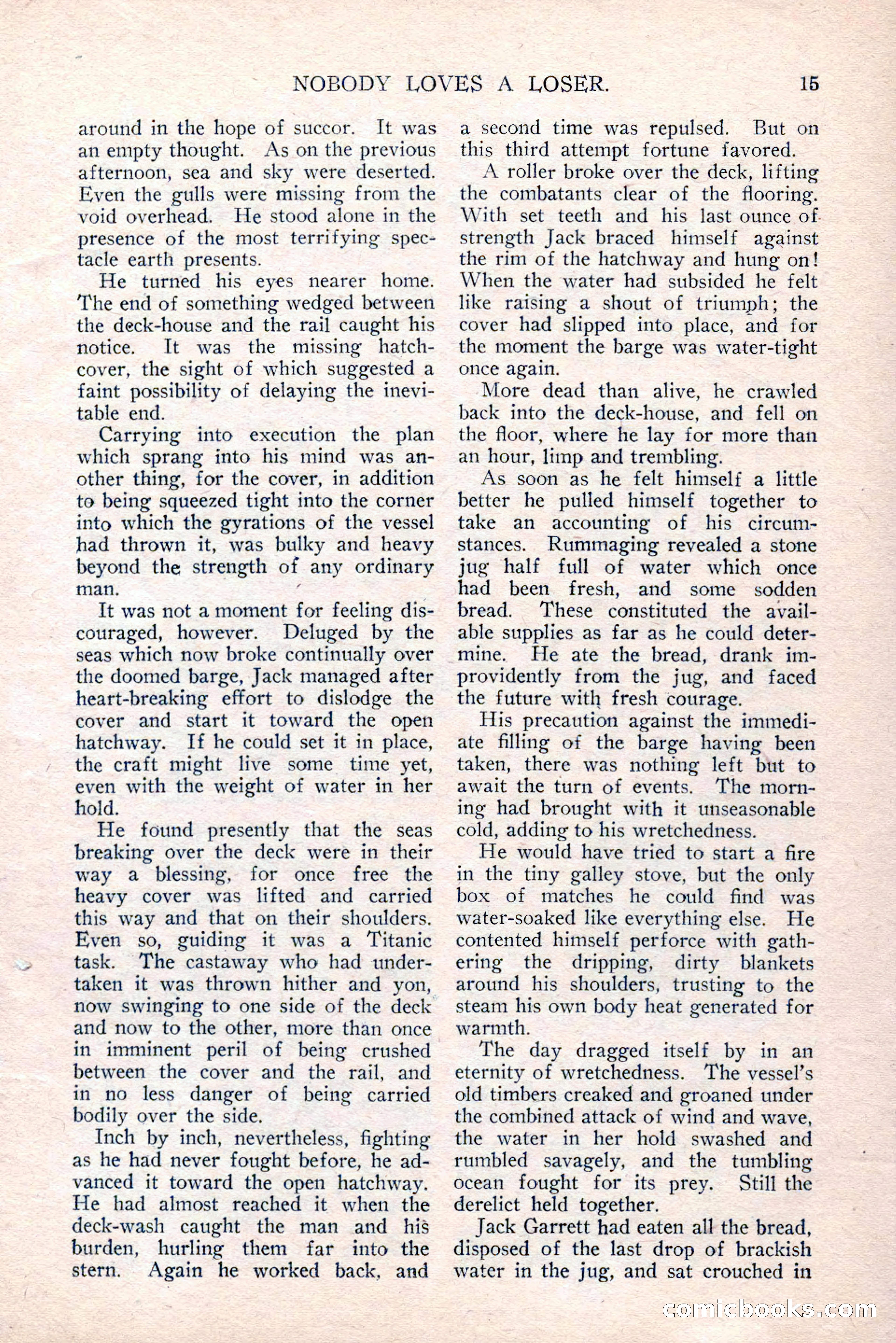
A restored page from Pulp Fiction, 1914. Page through the whole issue in the reader above.
📄 Transcribed text from this page (OCR, searchable)
Machine-transcribed from the original scan — historical spelling and the odd misread are preserved.
NOBODY LOVES A LOSER. around in the hope of succor. It was an empty thought. As on the previous afternoon, sea and sky were deserted. Even the gulls were missing from the void overhead. He stood alone in the presence of the most terrifying spec- tacle earth presents. He turned his eyes nearer home. The end of something wedged between the deck-house and the rail caught his notice. It was the missing hatch- cover, the sight of which suggested a faint possibility of delaying the inevi- table end. Carrying into execution the plan which sprang into his mind was an- other thing, for the cover, in addition to being squeezed tight into the corner into which the gyrations of the vessel had thrown it, was bulky and heavy beyond the strength of any ordinary man. It was not a moment for feeling dis- couraged, however. Deluged by the seas which now broke continually over the doomed barge, Jack managed after heart-breaking effort to dislodge the cover and start it toward the open hatchway. If he could set it in place, the craft might live some time yet, even with the weight of water in her hold. He found presently that the seas breaking over the deck were in their way a blessing, for once free the heavy cover was lifted and carried this way and that on their shoulders. Even so, guiding it was a ‘Titanic task. The castaway who had under- taken it was thrown hither and yon, now swinging to one side of the deck and now to the other, more than once in imminent peril of being crushed between the cover and the rail, and in no less danger of being carried bodily over the side. Inch by inch, nevertheless, fighting as he had never fought before, he ad- vanced it toward the open hatchway. He had almost reached it when the deck-wash caught the man and his burden, hurling them far into the stern. Again he worked back, and 15 a second time was repulsed. But on this third attempt fortune favored. A roller broke over the deck, lifting the combatants clear of the flooring. With set teeth and his last ounce of. strength Jack braced himself against the rim of the hatchway and hung on! When the water had subsided he felt like raising a shout of triumph; the cover had slipped into place, and for the moment the barge was water-tight once again. More dead than alive, he crawled back into the deck-house, and fell on the floor, where he lay for more than an hour, limp and trembling. As soon as he felt himself a little better he pulled himself together to take an accounting of his circum- stances. Rummaging revealed a stone jug half full of water which once had been fresh, and some sodden bread. These constituted the avail- able supplies as far as he could deter- mine. He ate the bread, drank im- providently from the jug, and faced the future with fresh courage. His precaution against the immedi- ate filling of the barge having been taken, there was nothing left but to await the turn of events. The morn- ing had brought with it unseasonable cold, adding to his wretchedness. He would have tried to start a fire in the tiny galley stove, but the only box of matches he could find was water-soaked like everything else. He contented himself perforce with gath- ering the dripping, dirty blankets around his shoulders, trusting to the steam his own body heat generated for warmth. The day dragged itself by in an eternity of wretchedness. The vessel’s old timbers creaked and groaned under the combined attack of wind and wave, the water in her hold swashed and rumbled savagely, and the tumbling ocean fought for its prey. Still the derelict held together. Jack Garrett had eaten all the bread, disposed of the last drop of brackish water in the jug, and sat crouched in CORICLOOOKS (C@