
Pulp Fiction, 1914 · page 22 of 258
The Argosy, August 1914 — page 22: what you’re looking at
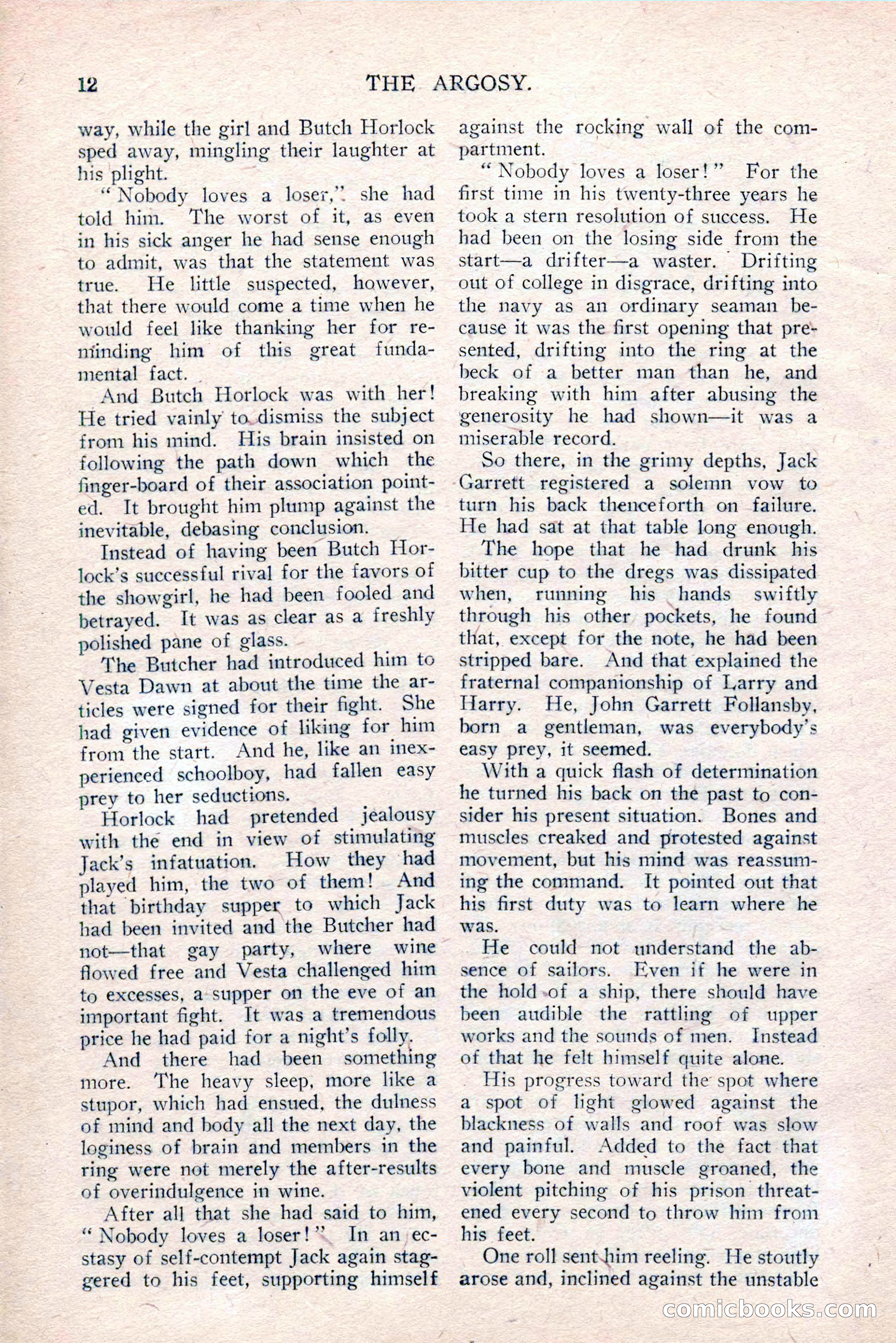
A restored page from Pulp Fiction, 1914. Page through the whole issue in the reader above.
📄 Transcribed text from this page (OCR, searchable)
Machine-transcribed from the original scan — historical spelling and the odd misread are preserved.
12 way, while the girl and Butch Horlock sped away, mingling their laughter at his plight. ‘““Nobody loves a loser,’ she had told him. The worst of it, as even in his sick anger he had sense enough to admit, was that the statement was true. He little suspected, however, that there would come a time when he would feel like thanking her for re- niinding him of this great funda- mental fact. _ And Butch Horlock was with her! He tried vainly to.dismiss the subject from his mind. His brain insisted on following the path down which the finger-board of their association point- ed. It brought him plump against the inevitable, debasing conclusion. Instead of having been Butch Hor- lock’s successful rival for the favors of the showgirl, he had been fooled and betrayed. It was as clear as a freshly polished pane of glass. The Butcher had introduced him to Vesta Dawn at about the time the ar- ticles were signed for their fight. She had given evidence of liking for him from the start. And he, like an inex- perienced schoolboy, had fallen easy prey to her seductions. Horlock had pretended jealousy with the end in view of stimulating Jack’s infatuation. How they had played him, the two of them! And that birthday supper to which Jack had been invited and the Butcher had not—that gay party, where wine flowed free and Vesta challenged him to excesses, a supper on the eve of an important fight. It was a tremendous price he had paid for a night's folly. And there had been something more. ‘The heavy sleep, more like a stupor, which had ensued, the dulness of mind and body all the next day, the loginess of brain and members in the ring were not merely the after-results of overindulgence in wine. After all that she had said to him, ‘““ Nobody loves a loser!** In an ec- stasy of self-contempt Jack again stag- gered to his feet, supporting himself THE. ARGOSY. against the rocking wall of the com- partment. “Nobody loves a loser!” For the first time in his twenty-three years he took a stern resolution of success. He had been on the losing side from the start—a drifter—a waster. Drifting out of college in disgrace, drifting into the navy as an ordinary seaman be- cause it was the first opening that pre- sented, drifting into the ring at the beck of a better man than he, and breaking with him after abusing the generosity he had shown—it was a miserable record. So there, in the grimy depths, Jack Garrett registered a solemn vow to turn his back thenceforth on failure. He had sat at that table long enough. The hope that he had drunk his bitter cup to the dregs was dissipated when, running his hands _ swiftly through his other pockets, he found that, except for the note, he had been stripped bare. And that explained the fraternal companionship of Larry and Harry. He, John Garrett Follansby, born a gentleman, was everybody’s easy prey, it seemed. With a quick flash of determination he turned his back on the past to con- sider his present situation. Bones and muscles creaked and protested against movement, but his mind was reassum- ing the command. It pointed out that his first duty was to learn where he was. He could not understand the ab- sence of sailors. Even if he were in the hold-of a ship, there should have been audible the rattling of upper works and the sounds of men. Instead of that he felt himself quite alone. His progress toward the spot where a spot of light glowed against the blackness of walls and roof was slow and painful. Added to the fact that every bone and muscle groaned, the violent pitching of his prison threat- ened every second to throw him from his feet. One roll sentJhim reeling. He stoutly arose and, inclined against the unstable GOmiGcbdooks (C@